ULA SUM and Difference
Total-difference monopulse tracker for ULA.
blockType: ULASUMandDifference
|
Path in the library: |
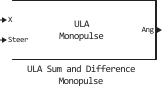
Description
The ULA Sum-and-Difference Monopulse unit evaluates the direction of arrival of a narrowband signal to a uniform linear antenna array based on an initial assumption using the sum-and-difference antenna length algorithm.
The block obtains a difference control vector by changing the phase of the second half of the total control vector.
Ports
Entrance
X — received pass signal:q[<br>]the complex matrix
The input signal is in the form of a matrix, the columns of which correspond to the channels. The rows correspond to the signal samples.
Data types: Float16, Float32, Float64, Int8, Int16, Int32, Int64, UInt8, UInt16, UInt32, UInt64
Support for complex numbers: Yes
Steer — initializing signal
non-negative real column vector (1, 1)
Initializing the input signal in the form of a non-negative real column vector.
Data types: Float16, Float32, Float64, Int8, Int16, Int32, Int64, UInt8, UInt16, UInt32, UInt64
Output
Ang — directions of arrival of pass signals:q[<br>] a non-negative real column vector
The arrival directions of the signals returned as a non-negative real column vector. The angle of the arrival direction is the angle between the direction of the source and the axis of the antenna array. The angle measurement units are degrees. The length of the vector is equal to the number of signals specified by the Number of signals parameter. If it is not possible to identify peaks in the spectrum, the result is returned NaN.
Data types: Float16, Float32, Float64, Int8, Int16, Int32, Int64, UInt8, UInt16, UInt32, UInt64
Parameters
Main
Signal propagation speed (m/s) — signal propagation speed, m/s
299792458 m/s (default) | positive scalar
The propagation velocity of the signal in the form of a real positive scalar.
The default value is the speed of light.: 299792458 m/s.
The units of measurement are m/s.
You can use the physconst function to specify the speed of light.
Data types: Float16, Float32, Float64, Int8, Int16, Int32, Int64, UInt8, UInt16, UInt32, UInt64
Operating frequency (Hz) — operating frequency of the system, Hz
3e8 (default) | positive scalar
The operating frequency of the system, set as a positive scalar.
The units of measurement are Hz.
Data types: Float16, Float32, Float64, Int8, Int16, Int32, Int64, UInt8, UInt16, UInt32, UInt64, Bool
Number of bits in phase shifters — number of phase shift quantization bits
0 (default) | a non-negative integer
The number of bits used to quantize the phase shift component of the beamformer or the weights of the control vector. Specify the number of bits as a non-negative integer.
A value of zero means that quantization is not performed.
Sensor Array
Specify sensor array as — method for specifying the pass array:q[<br>] Array (no subarrays)
Method for setting the array specified as Array (no subarrays).
-
Array (no subarrays)— block parameters are used to set the array.
Element
Element type — types of elements of the pass array:q[<br>] Isotropic Antenna (default) | Cardioid Antenna | Cosine Antenna | Custom Antenna | Gaussian Antenna | Sinc Antenna | Omni Microphone | Custom Microphone
The type of antenna or microphone.
Available values:
-
Isotropic Antenna -
Cardioid Antenna -
Cosine Antenna -
Custom Antenna -
Gaussian Antenna -
Sinc Antenna -
Omni Microphone -
Custom Microphone
Operating frequency range (Hz) — operating frequency range of the antenna or microphone
[0 1e20] (default) | A real vector is a 1 by 2 row
The operating frequency range of the antenna or microphone in the form of a vector is a 1 by 2 row in the form [LowerBound,UpperBound]. Outside of this frequency range, the element has no response.
The units of frequency measurement are Hz.
Dependencies
To use this parameter, set the Element type parameter to Isotropic Antenna, Cosine Antenna or Omni Microphone.
Baffle the back of the element — set the response of the rear hemisphere Isotropic Antenna element or Omni Microphone equal to zero
disabled (by default) | enabled
Select this option to mute the echo of the element.
When retracting, the echo at all azimuth angles exceeding ± 90° from the wide side is set to zero. The wide side is defined as the azimuth angle of 0° and the elevation angle of 0°.
Dependencies
To use this parameter, set the Element type parameter to Isotropic Antenna or Omni Microphone.
Null axis direction — the direction of the zero radiation axis.
-x (default) | +x | +y | -y | +z | -z
The direction of the zero radiation axis.
Dependencies
To use this parameter, set the Element type parameter to Cardioid Antenna.
Exponent of cosine pattern — setting the exponents of azimuthal and altitude cosine radiation patterns
[1.5 1.5] (default) | a non-negative scalar | a real matrix of non-negative values of 1 by 2
Exponents of the cosine model in the form of a non-negative scalar or a 1 by 2 real matrix of non-negative values. If the Exponent of cosine pattern is a 1 by 2 vector, then the first element is the exponent in the azimuth direction, and the second is in the location direction. With a scalar value of this parameter, the cosines in the azimuthal and elevation directions are raised to one power.
Dependencies
To use this parameter, set the Element type parameter to Cosine Antenna.
Operating frequency vector (Hz) — operating frequency range of the user antenna or microphone
[0,1e20] (default) | A real vector is a string
The range of operating frequencies of the antenna or microphone in the form of a vector row 1 on increasing actual values. The element has no response beyond the frequency range specified by the minimum and maximum elements of this vector. The units of frequency measurement are Hz.
Dependencies
To use this parameter, set the Element type parameter to Custom Antenna or Custom Microphone. To set the responses at these frequencies, use the Frequency responses (dB) parameter.
Frequency responses (dB) — frequency responses of the antenna and microphone
[0,0] (default)| A real vector is a string
The frequency response of the user antenna or user microphone for the frequencies defined by the parameter Operating frequency vector (Hz). The dimensions of the Frequency responses (dB) vector must match the dimensions of the vector specified by the Operating frequency vector (Hz) parameter.
Dependencies
To use this parameter, set the Element type parameter to Custom Antenna or Custom Microphone.
Input Pattern Coordinate System — the coordinate system of the radiation pattern of the user antenna
az-el (default) | phi-theta
The coordinate system of the directional pattern of the user antenna is specified az-el or phi-theta. When specifying az-el The Azimuth angles (deg) and Elevation angles (deg) parameters are used to set the coordinates of the directional pattern points. When specifying a parameter phi-theta The Phi angle (deg) and Theta angles (deg) parameters are used to set the coordinates of the part points.
Dependencies
To use this parameter, set the Element type parameter to Custom Antenna.
Azimuth angles (deg) — azimuth angles of the radiation pattern of the antenna
[-180:180] (default) | A real vector is a string
Azimuth angles, which will be used to calculate the radiation pattern of the antenna in the form of a vector row 1 on P. P must be greater than 2. The azimuth angles must be in the range of −180° up to 180° inclusive and arranged in strictly ascending order.
Dependencies
To use this parameter, set the Element type parameter to Custom Antenna, and for the parameter Input Pattern Coordinate System — az-el.
Elevation angles (deg) — the angles of the radiation pattern of the antenna
[-90:90] (default) | A real vector is a string
The angles of the location at which it is necessary to calculate the radiation pattern in the form of a vector 1 on . it must be more than 2. The units of measurement of angles are degrees. The angles of the seat should be in the range of −90° to 90° inclusive and arranged in strictly ascending order.
Dependencies
To use this parameter, set the Element type parameter to Custom Antenna, and for the parameter Input Pattern Coordinate System — az-el.
Magnitude pattern (dB) is the magnitude of the radiation pattern of the combined pass antenna:q[<br>] zeros(181,361) (default) | the real matrix Q on P | a real array of Q by P by L
The value of the radiation pattern of the combined antenna, set as a matrix on or an array on on .
-
If the Input Pattern Coordinate System parameter is set to
az-el, then Q is equal to the length of the vector specified by the Elevation angles (deg) parameter, and P is the length of the vector specified by the Azimuth angles (deg) parameter. -
If the Input Pattern Coordinate System parameter is set to
phi-thetaThen is equal to the length of the vector specified by the Theta Angles (deg) parameter, and — the length of the vector specified by the Phi Angles (deg) parameter.
Value is equal to the value of the Operating frequency vector (Hz) parameter.
-
If the value of this parameter is a matrix on , then the same scheme is applied for all frequencies specified in the parameter Operating frequency vector (Hz).
-
If the parameter is an array on on , then each page on The array defines a template for the corresponding frequency specified in the parameter Operating frequency vector (Hz).
Dependencies
To use this parameter, set the Element type parameter to Custom Antenna.
Phase pattern (deg) is the phase of the radiation pattern of the user antenna
zeros(181,361) (default) | the real matrix Q on P | a real array of Q by P by L
The phase of the radiation pattern of the combined antenna, set as a matrix on or an array on on .
-
If the Input Pattern Coordinate System parameter is set to
az-elThen is equal to the length of the vector specified by the Elevation angles (deg) parameter, and — the length of the vector specified by the Azimuth angles (deg) parameter. -
If the Input Pattern Coordinate System parameter is set to
phi-thetaThen is equal to the length of the vector specified by the Theta Angles (deg) parameter, and — the length of the vector specified by the Phi Angles (deg) parameter.
Value is equal to the value of the Operating frequency vector (Hz) parameter.
-
If the value of this parameter is a matrix on , then the same scheme is applied for all frequencies specified in the parameter Operating frequency vector (Hz).
-
If the parameter is an array on on , then each page on The array defines a template for the corresponding frequency specified in the parameter Operating frequency vector (Hz).
Dependencies
To use this parameter, set the Element type parameter to Custom Antenna.
Align element normal with array normal — rotate the antenna element to the normal position of the array
enabled (by default) | turned off
If the parameter value is enabled then the radiation pattern of the antenna element is rotated to align with the normal of the array. If turned off, then the drawing of the element does not rotate.
If the antenna is used in an antenna array and the parameter Input Pattern Coordinate System is set to az-el If this flag is selected, the radiation pattern rotates so that the x-axis of the element’s coordinate system points along the normal of the array. If there is no selection, the element template is used without rotation.
If the antenna is used in an antenna array and the parameter Input Pattern Coordinate System is set to phi-theta If this flag is selected, the radiation pattern rotates so that the z axis of the element’s coordinate system points along the normal of the array.
Use this parameter together with the Array Normal parameter of the URA and UCA arrays.
Dependencies
To use this parameter, set the Element type parameter to Custom Antenna.
Radiation pattern beamwidth (deg) — angles of the solution of the radiation pattern
[10, 10] (default) | the real scalar | A real vector is a 1 by 2 row
The angles of the radiation pattern solution in degrees.
Dependencies
To use this parameter, set the Element type parameter to Gaussian Antenna or Sinc Antenna.
Polar pattern frequencies (Hz) — microphone response frequencies of the polar radiation pattern
1e3 (default) | the real scalar | the real vector is row 1 on L
The response frequencies of a microphone with a polar pattern, set as a real scalar or a real vector, are lines 1 on . The response frequencies are in the frequency range specified by the parameter Operating frequency vector (Hz).
Dependencies
To use this parameter, set the Element type parameter to Custom Microphone.
Polar pattern angles (deg) — response angles of the polar radiation pattern
[-180:180] (default) | the real vector is row 1 on P
Set the response angles of the polar radiation pattern as a vector 1 on . The angles are measured from the central axis of the microphone and should be in the range of −180° to 180° inclusive.
Dependencies
To use this parameter, set the Element type parameter to Custom Microphone.
Polar pattern (dB) — polar characteristic of the user microphone
zeros(1,361) (default) | the real vector is row 1 on L
Set the value of the polar radiation pattern of the user microphone as a real vector-row 1 on , where — the number of frequencies specified in the parameter Polar pattern frequencies (Hz). The string represents the value of the polar radiation pattern measured at the corresponding frequency specified in the Polar pattern frequencies (Hz). The radiation pattern is measured in the azimuthal plane. In the azimuthal plane, the elevation angle is 0°, and the central axis is 0° in azimuth and 0° in elevation. The polar radiation pattern is symmetrical around the central axis. Based on the polar diagram, it is possible to construct a microphone directional pattern in three-dimensional space.
Dependencies
To use this parameter, set the Element type parameter to Custom Microphone.
ULA
Number of elements — the number of elements of the pass array:q[<br>] 2 (by default) | an integer greater than or equal to 2
The number of array elements for ULA arrays, set as an integer greater than or equal to 2.
Element spacing (m) — the distance between the elements of the antenna array
0.5 (default) | positive scalar
The distance between adjacent elements of the antenna array is set as a positive scalar.
The units of measurement are m.
Array axis — direction of the linear axis ULA
y (default) | x | z
The direction of the ULA linear axis, defined as y, x or z. All elements of the ULA array are evenly distributed along this axis in the local coordinate system of the array.
Dependencies
To enable this parameter, set the Geometry parameter to ULA. This option is also enabled when the block supports only ULA arrays.
Taper — complex weighting coefficients for amplitude weighing
1 (default) | the complex scalar | A complex vector is a row of 1 by N | The complex column vector is N by 1
Complex weighting coefficients for antenna array elements, given as a complex scalar, a complex string vector on or a complex column vector on , where It represents the number of antenna array elements. Weighting factors are applied to each antenna element of the antenna array and change the amplitude and phase of the received data.
-
If Taper is a scalar, the same coefficient value is applied to all elements of the antenna array.
-
If Taper is a vector, its own coefficient value is applied to each element of the antenna array.