Unit Delay Enabled Resettable Synchronous (Discrete)
Delays the input signal by one count when the external signal on the Enable port is true and the external signal on the Reset port is false.
blockType: UnitDelayEnabledResettableSynchronous
|
Path in the library: |
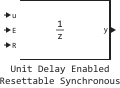
Description
Block Unit Delay Enabled Resettable Synchronous delays the input signal u by one count when the external input signal E (Enable) is true and the external input signal R (Reset) is false. When the Enable signal is false, the output signal is equal to the previous input signal count. When the Reset signal is true, the output signal takes the value of the Initial condition parameter. The Enable and Reset signals are true when E and R are positive, and false when E and R are less than or equal to zero.
Ports
Input
#
u
—
Input signal
scalar | vector | the matrix | array | bus
Details
The input signal of the data types listed below. For more information, seeData types.
| Data types |
|
| Complex numbers support |
Yes |
#
E
—
resolution signal
scalar
Details
The activation input signal. For more information, seeData types.
| Data types |
|
| Complex numbers support |
I don’t |
#
R
—
reset signal
scalar
Details
Reset input signal. For more information, seeData types.
| Data types |
|
| Complex numbers support |
I don’t |
Output
#
y
—
Output signal
scalar | vector | the matrix | array | bus
Details
The output signal. The output data type is the same as the input data.
| Data types |
|
| Complex numbers support |
Yes |
Parameters
Parameters
#
Initial condition —
the initial value of the output signal
Scalar / array of real and/or complex numbers
Details
The initial value of the output signal. The Initial condition parameter can take a scalar value or have the same dimension as the input signal. The Initial condition parameter must use the same data type as the input signal.
Values cannot be set for this parameter. NaN or Inf.
| Default value |
|
| Program usage name |
|
| Tunable |
Yes |
| Evaluatable |
Yes |
#
Sample time —
the time interval between the counts
SampleTime (real number / vector of two real numbers)
Details
The time interval between the discretizations, specified as a real scalar or vector. A scalar defines the period, and a two–digit vector defines the period and the offset. The period and offset must be finite and non-negative, and the offset must be less than the period.
| Default value |
|
| Program usage name |
|
| Tunable |
No |
| Evaluatable |
Yes |