Belt Drive
|
Page in progress. |
Belt drive with a tensioned belt connecting two pulleys.
blockType: Engee1DMechanical.Transmission.BeltDrive
|
Path in the library: |
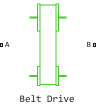
Description
Block Belt Drive It consists of a pair of pulleys connected by a flexible, ideal, flat or wedge-shaped belt. If for the parameter Belt type the value is set Ideal - No slip the belt does not slip relative to the pulley surfaces.
The block takes into account the friction between the flexible belt and the pulley periphery. If the friction force is not sufficient to move the load, the block may slip. The relationship between the tension in the leading and driven branches corresponds to the Euler equation for rope friction on a cylinder, also known as the Euler—Eitelwein equation. The unit takes into account the centrifugal load on the flexible belt, the inertia of the pulley and the friction in the bearings.
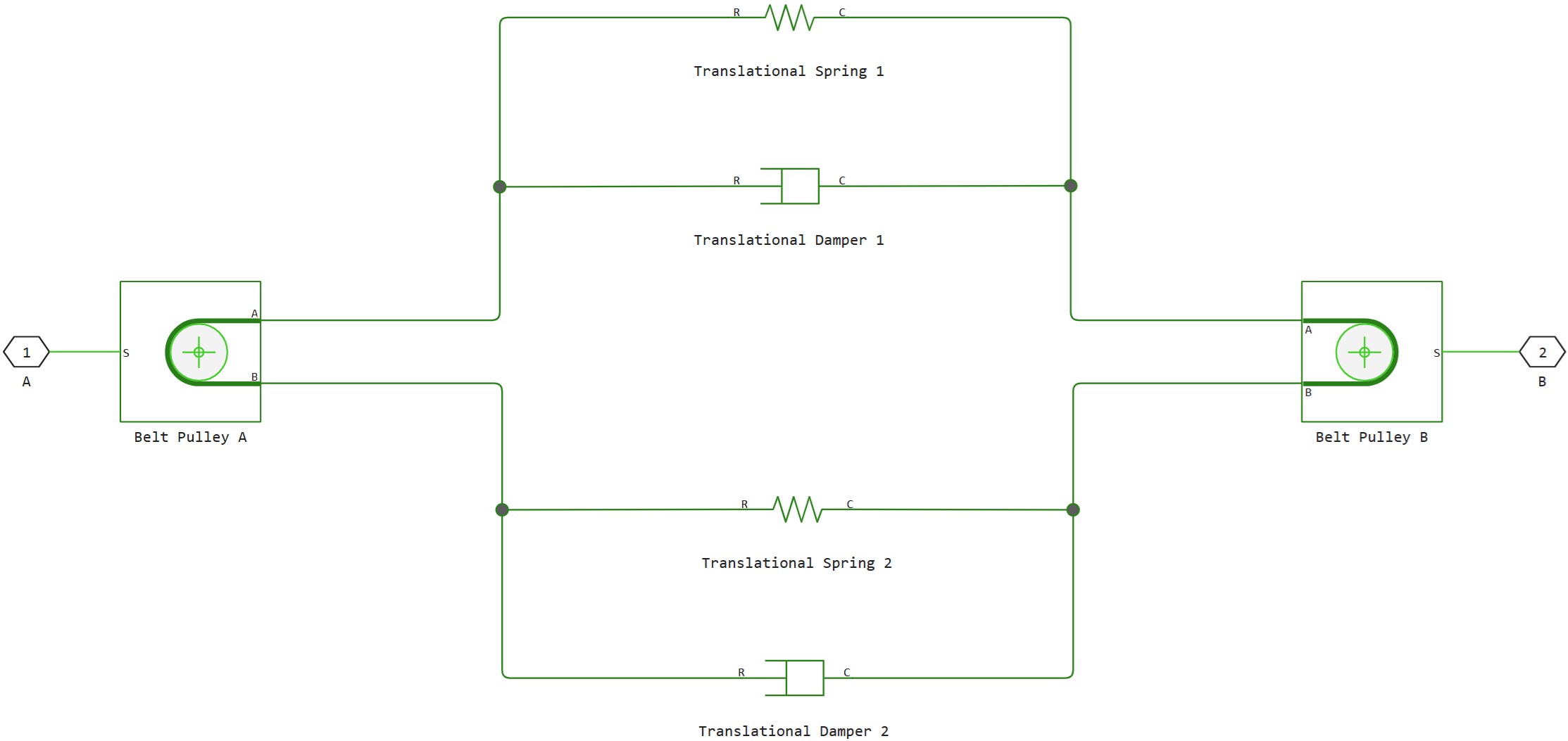
Block Belt Drive It is a structural component based on a block Belt Pulley and blocks Translational Spring and Translational Damper.
Blocks Translational Spring and Translational Damper they simulate the pliability of the belt. The equations describing the dynamics of the contact between the belt and the pulley can be found in the description of the unit. Belt Pulley. The figure shows the functional block diagram of the block Belt Drive.
The equations
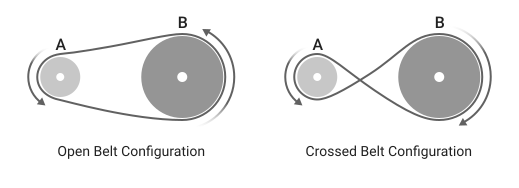
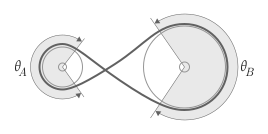
The diagrams show open and cross belt drives. If for the parameter Drive type the value is set Open belt both pulleys rotate in the same direction, with the larger pulley having a larger belt girth angle. If for the parameter Drive type the value is set Crossed belt the pulleys rotate in opposite directions and have the same girth angle.
_ Schemes of belt drives_
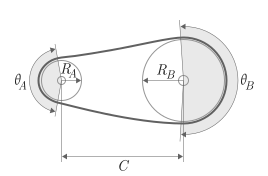
The following values are shown in the figures and in the equations:
-
— the girth angle of the pulley A;
-
— the girth angle of the pulley B;
-
— effective radius of the pulley A;
-
— effective radius of the pulley B;
-
— the distance between the centers of pulleys A and B.
opened belt drive
If for the parameter Drive type the value is set Open belt The block calculates the belt girth angle around each pulley as follows:
The diagram shows the angles and girth parameters.
the cross belt drive
If for the parameter Drive type the value is set Crossed belt, then both girth angles will be equal, and the girth angle of the belt around each pulley is
The diagram shows the angles and girth parameters.
Assumptions and limitations
-
The pulleys do not move.
-
The coefficient of friction and the threshold friction velocity between the belt and each of the pulleys are the same. To parameterize individual friction interactions, use two blocks Belt Pulley.
Parameters
Belt
#
Belt type —
belt parameterization
Ideal - No slip | Flat belt | V-belt
Details
Choosing the type of belt. The type of belt affects the slip conditions:
-
Ideal - No slip— parameterization of an ideal belt that does not slip relative to the pulley. -
Flat belt— parameterization of a belt with a rectangular cross-section. -
V-belt— parameterization of the wedge-shaped belt.
| Values |
|
| Default value |
|
| Program usage name |
|
| Evaluatable |
No |
#
Belt mass per unit length —
running weight
kg/m
Details
The contribution of centrifugal force is determined by linear density, expressed as mass per unit length.
Dependencies
To use this parameter, set for the parameter Belt type meaning Flat belt or V-belt and check the box Centrifugal force.
| Units |
|
| Default value |
|
| Program usage name |
|
| Evaluatable |
Yes |
# Maximum tension — threshold tension parameter
Details
The ability to set the maximum tension. If you select this option, and the belt tension at any of its ends reaches or exceeds the value set for the parameter Belt maximum tension, the simulation will stop and give an error.
Dependencies
To use this parameter, set:
-
for the parameter Belt type meaning
Ideal - No slipand a flag Compliance, or -
for the parameter Belt type meaning
Flat beltorV-belt.
| Default value |
|
| Program usage name |
|
| Evaluatable |
No |
#
Pre-tension —
belt tension at rest
N | nN | uN | mN | kN | MN | GN | dyn | lbf | kgf
Details
Belt tension when the belt and pulleys are at rest. The value must be positive.
Dependencies
To use this parameter, set:
-
for the parameter Belt type meaning
Ideal - No slipand a flag Compliance, or -
for the parameter Belt type meaning
Flat beltorV-belt.
| Units |
|
| Default value |
|
| Program usage name |
|
| Evaluatable |
Yes |
#
Belt maximum tension —
threshold value of maximum tension
N | nN | uN | mN | kN | MN | GN | dyn | lbf | kgf
Details
The maximum allowable tension for each belt. When the tension at either end of the belt reaches or exceeds this value, the simulation stops and generates an error.
Dependencies
To use this parameter, set:
-
for the parameter Belt type meaning
Ideal - No slipand checkboxes Compliance and Maximum tension, or -
for the parameter Belt type meaning
Flat beltorV-beltand a flag Maximum tension.
| Units |
|
| Default value |
|
| Program usage name |
|
| Evaluatable |
Yes |
# Centrifugal force — the option of accounting for centrifugal force
Details
An option to account for the effect of centrifugal force. If you check this box, the centrifugal force will reach approximately 90% of the force value at each end of the belt.
Dependencies
To use this parameter, set for the parameter Belt type meaning Flat belt or V-belt.
| Default value |
|
| Program usage name |
|
| Evaluatable |
No |
#
Longitudinal stiffness —
effective belt stiffness
N/m | mN/m | kN/m | MN/m | GN/m | kgf/m | lbf/ft | lbf/in
Details
Effective belt stiffness.
Dependencies
To use this parameter, set:
-
for the parameter Belt type meaning
Ideal - No slipand a flag Compliance, or -
for the parameter Belt type meaning
Flat beltorV-belt.
| Units |
|
| Default value |
|
| Program usage name |
|
| Evaluatable |
Yes |
#
Drive type —
belt drive type
Open belt | Crossed belt
Details
Type of belt drive. For more information, see Belt drive diagrams.
| Values |
|
| Default value |
|
| Program usage name |
|
| Evaluatable |
No |
# Number of V-belts — number of straps
Details
The number of wedge-shaped straps.
The block rounds non-integer values to the nearest integer. Increasing the number of belts increases the friction force, the effective mass per unit length, and the maximum allowable tension.
Dependencies
To use this parameter, set for the parameter Belt type meaning V-belt.
| Default value |
|
| Program usage name |
|
| Evaluatable |
Yes |
#
V-belt sheave angle —
pulley groove angle
rad | deg | rev | mrad | arcsec | arcmin | gon
Details
The angle of the pulley groove for the wedge-shaped belt.
Dependencies
To use this parameter, set for the parameter Belt type meaning V-belt.
| Units |
|
| Default value |
|
| Program usage name |
|
| Evaluatable |
Yes |
# Compliance — an option for modeling belt compliance
Details
An option for modeling belt compliance.
-
If the flag is unchecked, the unit simulates an unyielding belt in which elastic deformations do not occur under the influence of force. To improve performance, uncheck the box.
-
If the check box is selected, the block simulates a malleable belt that elastically deforms under the action of force. To increase the accuracy, check the box.
Dependencies
To use this parameter, set for the parameter Belt type meaning Ideal - No slip.
| Default value |
|
| Program usage name |
|
| Evaluatable |
No |
#
Longitudinal damping —
effective belt damping
N*s/m | kgf*s/m | lbf*s/ft | lbf*s/in
Details
Effective belt damping.
Dependencies
To use this parameter, set:
-
for the parameter Belt type meaning
Ideal - No slipand a flag Compliance, or -
for the parameter Belt type meaning
Flat beltorV-belt.
| Units |
|
| Default value |
|
| Program usage name |
|
| Evaluatable |
Yes |
Pulley A
#
Pulley inertia —
inertia of the pulley A
kg*m^2 | g*m^2 | kg*cm^2 | g*cm^2 | lbm*in^2 | lbm*ft^2 | slug*in^2 | slug*ft^2
Details
The moment of inertia of rotation of the pulley A.
Dependencies
To use this option, check the box Inertia.
| Units |
|
| Default value |
|
| Program usage name |
|
| Evaluatable |
Yes |
#
Pulley radius —
pulley radius A
m | um | mm | cm | km | in | ft | yd | mi | nmi
Details
The radius of the pulley is A.
| Units |
|
| Default value |
|
| Program usage name |
|
| Evaluatable |
Yes |
#
Bearing viscous friction coefficient —
viscous friction of bearings
N*m*s/rad | mN*m*s/rad | kN*m*s/rad | kgf*m*s/rad | lbf*ft*s/rad
Details
Viscous friction associated with the bearings holding the pulley axis A.
| Units |
|
| Default value |
|
| Program usage name |
|
| Evaluatable |
Yes |
# Inertia — moment of inertia of rotation
Details
The possibility of parameterizing the moment of inertia of rotation using the initial velocity.
| Default value |
|
| Program usage name |
|
| Evaluatable |
No |
#
Pulley initial velocity —
the initial speed of rotation of the pulley A
rad/s | deg/s | rad/min | deg/min | rpm | rps
Details
The initial rotation speed of the pulley is A.
Dependencies
To use this option, check the box Inertia.
| Units |
|
| Default value |
|
| Program usage name |
|
| Evaluatable |
Yes |
Pulley B
#
Pulley inertia —
inertia of pulley B
kg*m^2 | g*m^2 | kg*cm^2 | g*cm^2 | lbm*in^2 | lbm*ft^2 | slug*in^2 | slug*ft^2
Details
The moment of inertia of rotation of the pulley B.
Dependencies
To use this option, check the box Inertia.
| Units |
|
| Default value |
|
| Program usage name |
|
| Evaluatable |
Yes |
# Inertia — moment of inertia of rotation
Details
The possibility of parameterizing the moment of inertia of rotation using the initial velocity.
| Default value |
|
| Program usage name |
|
| Evaluatable |
No |
#
Pulley initial velocity —
the initial speed of rotation of the pulley B
rad/s | deg/s | rad/min | deg/min | rpm | rps
Details
The initial rotation speed of the pulley is B.
Dependencies
To use this option, check the box Inertia.
| Units |
|
| Default value |
|
| Program usage name |
|
| Evaluatable |
Yes |
#
Bearing viscous friction coefficient —
viscous friction of bearings
N*m*s/rad | mN*m*s/rad | kN*m*s/rad | kgf*m*s/rad | lbf*ft*s/rad
Details
Viscous friction associated with the bearings holding the pulley B axis.
| Units |
|
| Default value |
|
| Program usage name |
|
| Evaluatable |
Yes |
#
Pulley radius —
pulley radius B
m | um | mm | cm | km | in | ft | yd | mi | nmi
Details
The radius of the pulley is B.
| Units |
|
| Default value |
|
| Program usage name |
|
| Evaluatable |
Yes |
Contact
#
Pulley B wrap angle —
pulley girth angle B
rad | deg | rev | mrad | arcsec | arcmin | gon
Details
The contact angle between the belt and the pulley connected to port B.
Dependencies
To use this parameter, set for the parameter Wrap angle calculation meaning Specify wrap angles.
| Units |
|
| Default value |
|
| Program usage name |
|
| Evaluatable |
Yes |
#
Velocity threshold —
contact threshold value
m/s | mm/s | cm/s | km/s | m/hr | km/hr | in/s | ft/s | mi/s | ft/min | mi/hr | kn
Details
The relative velocity required to achieve the peak value of kinetic friction in contact. The threshold value of the friction velocity increases the numerical stability of the simulation, ensuring the continuity of the force when changing the direction of velocity.
Dependencies
To use this parameter, set for the parameter Belt type meaning Flat belt or V-belt.
| Units |
|
| Default value |
|
| Program usage name |
|
| Evaluatable |
Yes |
#
Pulley center separation —
the distance between the centers of the pulleys
m | um | mm | cm | km | in | ft | yd | mi | nmi
Details
The distance between the centers of the pulleys.
Dependencies
To use this parameter, set for the parameter Wrap angle calculation meaning Specify pulley center separation.
| Units |
|
| Default value |
|
| Program usage name |
|
| Evaluatable |
Yes |
# Kinetic friction coefficient — coefficient of kinetic friction
Details
Belt friction when slipping.
Dependencies
To use this parameter, set for the parameter Friction model meaning Modal.
| Default value |
|
| Program usage name |
|
| Evaluatable |
Yes |
# Static friction coefficient — coefficient of static friction
Details
Belt friction while maintaining static contact.
Dependencies
To use this parameter, set for the parameter Friction model meaning Modal.
| Default value |
|
| Program usage name |
|
| Evaluatable |
Yes |
# Contact friction coefficient — coefficient of contact friction
Details
The coefficient of Coulomb friction between the belt and the pulley surface.
Dependencies
To use this parameter, set for the parameter Friction model meaning Continuous.
| Default value |
|
| Program usage name |
|
| Evaluatable |
Yes |
#
Wrap angle calculation —
type of angle calculation
Specify pulley center separation | Specify wrap angles
Details
The ability to calculate the girth angle based on the distance between the centers of the pulleys or directly specify these values.
-
Specify pulley center separation— The unit calculates the belt girth angle using the radii of the pulleys, the distance between the centers and the type of transmission. -
Specify wrap angles— The block uses the girth angles you set.
Dependencies
To use this parameter, set for the parameter Belt type meaning Flat belt or V-belt.
| Values |
|
| Default value |
|
| Program usage name |
|
| Evaluatable |
No |
#
Pulley B initial state —
initial condition of pulley B
Unlocked | Locked
Details
The ability to initialize the simulation with a locked or unlocked pulley B.
Dependencies
To use this parameter, set for the parameter Friction model meaning Modal.
| Values |
|
| Default value |
|
| Program usage name |
|
| Evaluatable |
No |
#
Pulley A wrap angle —
pulley girth angle A
rad | deg | rev | mrad | arcsec | arcmin | gon
Details
The contact angle between the belt and the pulley connected to the A port.
Dependencies
To use this parameter, set for the parameter Wrap angle calculation meaning Specify wrap angles.
| Units |
|
| Default value |
|
| Program usage name |
|
| Evaluatable |
Yes |
#
Friction model —
choosing the friction method
Continuous | Modal
Details
The possibility of parameterization of continuous or modal friction.
Dependencies
To use this parameter, set for the parameter Belt type meaning Flat belt or V-belt.
| Values |
|
| Default value |
|
| Program usage name |
|
| Evaluatable |
No |
#
Pulley A initial state —
the initial state of the pulley A
Unlocked | Locked
Details
The possibility of initializing the simulation with the locked or unlocked pulley A.
Dependencies
To use this parameter, set for the parameter Friction model meaning Modal.
| Values |
|
| Default value |
|
| Program usage name |
|
| Evaluatable |
No |
#
Force threshold —
force threshold value
N | nN | uN | mN | kN | MN | GN | dyn | lbf | kgf
Details
The relative force required to achieve the peak value of kinetic friction in contact.
Dependencies
To use this parameter, set for the parameter Belt type meaning Flat belt or V-belt.
| Units |
|
| Default value |
|
| Program usage name |
|
| Evaluatable |
Yes |