Chain Drive
A power transmission system with a chain and two sprockets.
blockType: Engee1DMechanical.Transmission.ChainDrive
|
Path in the library: |
Description
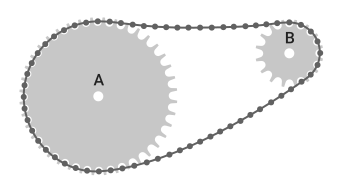
Block Chain Drive It is a power transmission system consisting of a circuit and two sprockets. The chain engages with the sprockets, transmitting rotational motion between them. Under the influence of external loads, power transmission can occur in the opposite direction, that is, from the leading sprocket to the driven one. This state is called reverse motion.
The drive chain is malleable. It can stretch when stretched or sag when loosened. The compliance model consists of a linear spring and a damper arranged in parallel. The spring resists chain tension. The damper resists the stretching motion between the circuit elements.
The forces of the spring and the damper act directly on the sprockets that connect the chain. The spring force occurs when one section of the chain is stretched. The damper force acts continuously. If the resulting tensile force in the circuit exceeds the set maximum tension value, the unit stops the simulation and outputs an error.
The block takes into account the viscous friction in the bearings of the sprocket joint. During movement, viscous friction causes losses in energy transfer, reducing the efficiency of the chain drive. These losses are compounded by the damping of the circuit. To eliminate power transmission losses in a chain drive, in the parameter group Dynamics set the parameters of viscous friction and chain damping to zero.
The equations
The strain rate of a chain under tension is the difference between the tangential components of the speed of the sprockets, which are the product of the angular velocity and the dividing radius.:
where
-
— strain strain;
-
, — angular velocities of asterisks;
-
, — the radii of the dividing circles of the asterisks.
The figure shows the relevant variables.
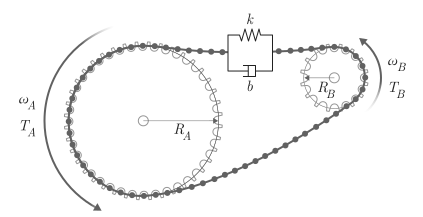
The stretching force of the chain is the net sum of the forces of the spring and the damper. The force in a spring is the product of the strain strain and the stiffness coefficient of the spring. This force is zero when the tensile strain is less than the sagging of the chain. The force in the damper is the product of the tensile strain rate and the damping coefficient.
where
-
— sagging chain;
-
— the coefficient of spring stiffness;
-
— damping coefficient.
The chain transmits to each sprocket a torque equal to the product of the tensile force and the radius of the dividing circle of the sprocket. These two torques act in opposite directions according to the equations:
where
-
— the torque that the chain transmits to the sprocket A;
-
— the torque that the chain transmits to the sprocket B.
Let’s write down these equations taking into account velocity and friction.:
where
-
— angular velocity of the asterisk A;
-
— angular velocity of the asterisk B;
-
— coefficient of viscous friction for the sprocket A;
-
— coefficient of viscous friction for the asterisk B.
Parameters
Geometry
#
Chain model —
the model of malleability and backlash of the chain
Ideal - no chain compliance or backlash | Model chain compliance and backlash
Details
The model of ductility and backlash for the block:
-
Ideal - no chain compliance or backlash— stiffness, damping and backlash of the chain are not modeled. -
Model chain compliance and backlash— stiffness, damping and backlash of the chain are modeled. When selecting this value, the associated parameters and variables are used.
| Values |
|
| Default value |
|
| Program usage name |
|
| Evaluatable |
No |
#
Sprocket B pitch radius —
the radius of the dividing circle of the asterisk B
m | um | mm | cm | km | in | ft | yd | mi | nmi
Details
The radius of the dividing circle for the asterisk B. The dividing circle is an imaginary circle passing through the point of contact between the roller chain and the sprocket tooth when fully engaged.
| Units |
|
| Default value |
|
| Program usage name |
|
| Evaluatable |
Yes |
#
Sprocket A pitch radius —
the radius of the dividing circle of the asterisk A
m | um | mm | cm | km | in | ft | yd | mi | nmi
Details
The radius of the dividing circle for the asterisk A. The dividing circle is an imaginary circle passing through the point of contact between the roller chain and the sprocket tooth when fully engaged.
| Units |
|
| Default value |
|
| Program usage name |
|
| Evaluatable |
Yes |
#
Chain slack length —
maximum chain slack length
m | um | mm | cm | km | in | ft | yd | mi | nmi
Details
The maximum distance that a free section of the drive chain can travel before it stretches. This distance is equal to the difference in length between the actual and fully tensioned drive chain.
If one sprocket is held in place while the upper section of the chain is tensioned, then the slack length is the tangential distance that the second sprocket must turn before the lower section of the chain becomes tensioned.
Dependencies
To use this parameter, set for the parameter Chain model meaning Model chain compliance and backlash.
| Units |
|
| Default value |
|
| Program usage name |
|
| Evaluatable |
Yes |
Dynamics
#
Viscous friction coefficient of sprocket A —
coefficient of viscous friction of the sprocket A
N*m*s/rad | mN*m*s/rad | kN*m*s/rad | kgf*m*s/rad | lbf*ft*s/rad
Details
The coefficient of friction caused by the rolling bearing of the sprocket joint A in the presence of viscous grease.
| Units |
|
| Default value |
|
| Program usage name |
|
| Evaluatable |
Yes |
#
Chain stiffness —
stiffness of the linear spring
N/m | mN/m | kN/m | MN/m | GN/m | kgf/m | lbf/ft | lbf/in
Details
The stiffness coefficient of a linear spring in the chain compliance model. This coefficient describes the resistance of the deformation chain. The spring element takes into account the accumulation of elastic energy in the circuit during deformation.
Dependencies
To use this parameter, set for the parameter Chain model meaning Model chain compliance and backlash.
| Units |
|
| Default value |
|
| Program usage name |
|
| Evaluatable |
Yes |
#
Chain damping —
linear damping coefficient
N*s/m | kgf*s/m | lbf*s/ft | lbf*s/in
Details
The coefficient of linear damping in the circuit compliance model. This coefficient describes the tensile strength between adjacent chain elements. The damping element takes into account the power loss in the circuit due to deformation.
Dependencies
To use this parameter, set for the parameter Chain model meaning Model chain compliance and backlash.
| Units |
|
| Default value |
|
| Program usage name |
|
| Evaluatable |
Yes |
#
Viscous friction coefficient of sprocket B —
coefficient of viscous friction of the sprocket B
N*m*s/rad | mN*m*s/rad | kN*m*s/rad | kgf*m*s/rad | lbf*ft*s/rad
Details
The coefficient of friction caused by the rolling bearing of the sprocket joint B in the presence of a viscous lubricant.
| Units |
|
| Default value |
|
| Program usage name |
|
| Evaluatable |
Yes |
Maximum Tension
#
Chain maximum tension —
upper tension limit
N | nN | uN | mN | kN | MN | GN | dyn | lbf | kgf
Details
The maximum allowable value of the tensile force acting on the chain.
Dependencies
To use this parameter, set for the parameter Chain model meaning Model chain compliance and backlash and check the box Maximum tension.
| Units |
|
| Default value |
|
| Program usage name |
|
| Evaluatable |
Yes |
# Maximum tension — The ultimate tension model
Details
Select whether to limit the maximum value of the tensile force in the drive chain.:
-
if the check box Maximum tension If removed, the chain tension can be arbitrarily high during simulation.;
-
if the check box Maximum tension If installed, the chain tension must remain below the maximum value. If the tension exceeds this value, the simulation stops and the block generates an error.
Dependencies
To use this parameter, set for the parameter Chain model meaning Model chain compliance and backlash.
| Default value |
|
| Program usage name |
|
| Evaluatable |
No |