Ravigneaux Gear
A planetary gear with two solar gears and two sets of planetary gears.
blockType: Engee1DMechanical.Transmission.Gears.Planetary.Ravigneaux
|
Path in the library: |

Description
Block Ravigneaux Gear It is a planetary mechanism with two solar and planetary gears. Two solar gears are located in the center and longitudinally spaced along the common axis of rotation. The smaller of these gears engages with an internal planetary gear, which, in turn, engages with an external planetary gear. The outer planetary gear, whose length covers the distance between the two solar gears, engages with both the larger solar gear and the crown gear.
The driver holds the planetary gears at different radii. The drive wheel, rigidly connected to the driveshaft, can rotate as a single unit relative to the solar and corona gears. Pivoting hinges located between the planetary gear and the driver allow the gears to rotate around their longitudinal axes.
The relative angular velocities of the solar, planetary, and corona gears are determined by the kinematic relationships between them. For more information, see The equations.

Block Ravigneaux Gear It consists of blocks Sun-Planet, Planet-Planet and Ring-Planet. The figure shows an equivalent block diagram of this block.
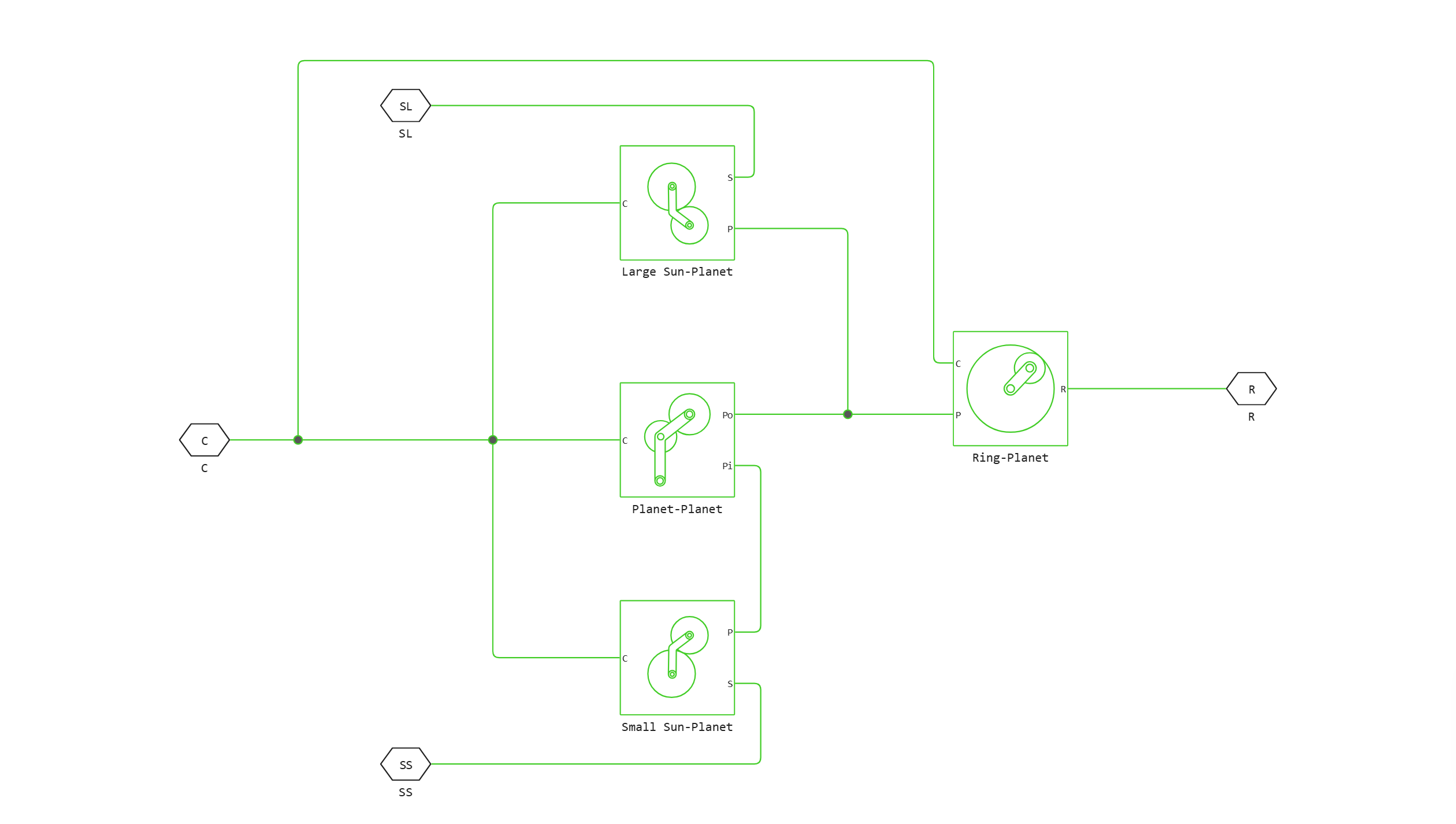
To improve the accuracy of the gear model, characteristics such as gear inertia, gearing losses, and viscous losses can be set. By default, it is assumed that gear inertia and viscous losses are negligible. The block allows you to set the inertia of internal planetary gears. To simulate the inertia of the driver, large solar gear, small solar gear and crown gear, connect the blocks Inertia to ports C, SL, SS and R.
The thermal model
You can simulate the effects of heat flow and temperature changes by turning on an additional heat port. To enable this port, set the parameter Friction model meaning Temperature-dependent efficiency.
The equations
ideal limitations and gear ratios
Block Ravigneaux Gear imposes four kinematic and four geometric constraints on four connected axles and two internal wheels (internal and external planetary gears):
where
-
— radius of the inner driver;
-
— angular velocity of the driver;
-
— radius of the small solar gear;
-
— angular velocity of the small solar gear;
-
— the radius of the inner planetary transmission;
-
— angular velocity of internal planetary transmission;
-
— radius of the external driver;
-
— the radius of the large solar gear;
-
— angular velocity of a large solar gear;
-
— the radius of the external planetary transmission;
-
— angular velocity of the external planetary transmission;
-
— angular velocity of the crown gear.
Gear ratios of the crown gear to the solar one:
where
-
— the gear ratio of the crown gear to the small solar gear;
-
— the number of teeth of the crown gear;
-
— the number of teeth of a small solar gear;
-
— the gear ratio of the crown gear to the large solar gear;
-
— the number of teeth of a large solar gear.
In terms of these gear ratios, the main kinematic limitations are as follows:
The six degrees of freedom are reduced to two independent degrees of freedom. Pairs of gears: and .
| Gear ratio must be strictly greater than the gear ratio . Gear ratio it must be strictly more than one. |
The torque transmissions are as follows:
where
-
— transmission of torque to a small solar gear;
-
— transmission of torque to the crown gear;
-
— losses in the transmission of torque between the small solar gear and the crown gear;
-
— transmission of torque to a large solar gear;
-
— losses in the transmission of torque between the large solar gear and the crown gear.
Ideally, when there is no loss of torque., .
not ideal limitations and losses in gears
In an imperfect case .
Assumptions and limitations
-
Gears are treated as solids.
-
Coulomb friction slows down the simulation (for more information, see here).
Ports
Conserving
#
SL
—
large solar gear
rotational mechanics
Details
A non-directional port connected to a large solar gear.
| Program usage name |
|
#
SS
—
small solar gear
rotational mechanics
Details
A non-directional port connected to a small solar gear.
| Program usage name |
|
#
C
—
planetary transmission satellite carrier
rotational mechanics
Details
A non-directional port connected to the satellite carrier of the planetary transmission.
| Program usage name |
|
#
H
—
heat flow
warm
Details
A non-directional port connected to the heat flow. The heat flow affects the efficiency of power transmission by changing the temperature of the gear.
Dependencies
To use this port, set the parameter Friction model meaning Temperature-dependent efficiency.
| Program usage name |
|
#
R
—
crown gear
rotational mechanics
Details
A non-directional port connected to the crown gear.
| Program usage name |
|
Parameters
Inertia
#
Outer planet gear inertia —
the moment of inertia of the external planetary transmission
kg*m^2 | g*m^2 | kg*cm^2 | g*cm^2 | lbm*in^2 | lbm*ft^2 | slug*in^2 | slug*ft^2
Details
The moment of inertia of the external planetary transmission. This value must be positive.
Dependencies
To use this option, check the box next to the option Inertia.
| Units |
|
| Default value |
|
| Program usage name |
|
| Evaluatable |
Yes |
# Inertia — the inertia model
Details
Inertia model for the block:
-
The check box is set to simulate the inertia of a gear train.
-
Unchecked — ignore the inertia of the gear train.
| Default value |
|
| Program usage name |
|
| Evaluatable |
No |
#
Inner planet gear inertia —
the moment of inertia of the internal planetary transmission
kg*m^2 | g*m^2 | kg*cm^2 | g*cm^2 | lbm*in^2 | lbm*ft^2 | slug*in^2 | slug*ft^2
Details
The moment of inertia of the internal planetary transmission. This value must be positive.
Dependencies
To use this option, check the box next to the option Inertia.
| Units |
|
| Default value |
|
| Program usage name |
|
| Evaluatable |
Yes |
Thermal Port
#
Initial temperature —
Initial temperature
K | degC | degF | degR | deltaK | deltadegC | deltadegF | deltadegR
Details
The temperature of the block at the beginning of the simulation. The initial temperature sets the initial efficiencies of the components according to their efficiency vectors.
Dependencies
To use this parameter, set for the parameter Friction model meaning Temperature-dependent efficiency.
| Units |
|
| Default value |
|
| Program usage name |
|
| Evaluatable |
Yes |
#
Thermal mass —
thermal mass
J/K | kJ/K
Details
The thermal energy required to change the temperature of a component by one unit of temperature. The greater the thermal mass, the more resistant the component is to temperature changes.
Dependencies
To use this parameter, set for the parameter Friction model meaning Temperature-dependent efficiency.
| Units |
|
| Default value |
|
| Program usage name |
|
| Evaluatable |
Yes |
Meshing Losses
# Large sun-planet, small sun-planet, ring-planet and planet-planet ordinary efficiencies — Torque transmission efficiency
Details
Vector efficiency of torque transmission for gearing gear pairs, the large sun is a satellite, the small sun is a satellite, the crown is a satellite and the satellite is a satellite, respectively. The elements of the vector must be in the range (0,1].
Dependencies
To use this parameter, set for the parameter Friction model meaning Constant efficiency.
| Default value |
|
| Program usage name |
|
| Evaluatable |
Yes |
#
Large sun-carrier, small sun-carrier, large sun planet-carrier and small sun planet-carrier power thresholds —
minimum power thresholds for gears: large solar gear — drive, small solar gear — drive, large sun-satellite — drive and small sun-satellite — drive
W | uW | mW | kW | MW | GW | V*A | HP_DIN
Details
A vector of power thresholds, over which full efficiencies are applied. Enter the thresholds in the following order: large solar gear, small solar gear, large solar satellite gear, and small solar satellite gear, all relative to the driver. Below these values, the efficiency is smoothed out by the hyperbolic tangent function.
If for the parameter Friction model the value is set Constant efficiency, the unit reduces efficiency losses to zero in the absence of power transfer. If for the parameter Friction model the value is set Temperature-dependent efficiency The unit smooths the efficiency from zero at rest to the values indicated in the interpolation tables of temperature and efficiency at power thresholds.
Dependencies
To use this parameter, set for the parameter Friction model meaning Temperature-dependent efficiency.
| Units |
|
| Default value |
|
| Program usage name |
|
| Evaluatable |
Yes |
# Small sun-planet efficiency — EFFICIENCY of torque transmission from small solar gears to planetary gears
Details
A vector of output and input power ratios describing the power flow from a small solar gear to planetary gears . The block uses the values to build a one-dimensional interpolation table of temperature versus efficiency.
Each element represents an efficiency related to the temperature in the vector Temperature. The length of the vector must be equal to the length of the vector Temperature. Each element of the vector must be in the range (0,1].
Dependencies
To use this parameter, set for the parameter Friction model meaning Temperature-dependent efficiency.
| Default value |
|
| Program usage name |
|
| Evaluatable |
Yes |
# Ring-planet efficiency — EFFICIENCY of torque transmission from crown gear to planetary gear
Details
A vector of output and input power ratios describing the power flow from the crown gear to the external planetary gears . The block uses these values to build a one-dimensional interpolation table of temperature versus efficiency.
Each element represents an efficiency related to the temperature in the vector Temperature. The length of the vector must be equal to the length of the vector Temperature. Each element of the vector must be in the range (0,1].
Dependencies
To use this parameter, set for the parameter Friction model meaning Temperature-dependent efficiency.
| Default value |
|
| Program usage name |
|
| Evaluatable |
Yes |
#
Friction model —
the friction model
No meshing losses - Suitable for HIL simulation | Constant efficiency | Temperature-dependent efficiency
Details
The friction model for the block:
-
No meshing losses - Suitable for HIL simulation— perfect gear engagement. -
Constant efficiency— the transmission of torque between pairs of gears is reduced by a constant efficiency , such that . -
Temperature-dependent efficiency— the transmission of torque between pairs of gears is determined by the temperature interpolation table.
| Values |
|
| Default value |
|
| Program usage name |
|
| Evaluatable |
No |
# Large sun-planet efficiency — EFFICIENCY of torque transmission from large solar gears to planetary gears
Details
A vector of output and input power ratios describing the power flow from a large solar gear to planetary gears . The block uses the values to build a one-dimensional interpolation table of temperature versus efficiency.
Each element represents an efficiency related to the temperature in the vector Temperature. The length of the vector must be equal to the length of the vector Temperature. Each element of the vector must be in the range (0,1].
Dependencies
To use this parameter, set for the parameter Friction model meaning Temperature-dependent efficiency.
| Default value |
|
| Program usage name |
|
| Evaluatable |
Yes |
# Planet-planet efficiency — Satellite interaction efficiency
Details
A vector of output and input power ratios describing the power flow from small planetary gears to large ones . The block uses the values to build a one-dimensional interpolation table of temperature versus efficiency.
Each element represents an efficiency related to the temperature in the vector Temperature. The length of the vector must be equal to the length of the vector Temperature. Each element of the vector must be in the range (0,1].
Dependencies
To use this parameter, set for the parameter Friction model meaning Temperature-dependent efficiency.
| Default value |
|
| Program usage name |
|
| Evaluatable |
Yes |
#
Temperature —
temperature
K | degC | degF | degR | deltaK | deltadegC | deltadegF | deltadegR
Details
The temperature vector used to construct a one-dimensional interpolation table of temperature and efficiency correspondence. The elements of the vector should increase from left to right.
Dependencies
To use this parameter, set for the parameter Friction model meaning Temperature-dependent efficiency.
| Units |
|
| Default value |
|
| Program usage name |
|
| Evaluatable |
Yes |
Main
# Ring (R) to large sun (SL) teeth ratio (NR/NSL) — gear ratio of crown gear and large solar gear
Details
Gear ratio crown gear to solar gear, determined by the ratio of the number of teeth of the crown gear to the number of teeth of the large solar gear.
| Default value |
|
| Program usage name |
|
| Evaluatable |
Yes |
# Ring (R) to small sun (SS) teeth ratio (NR/NSS) — gear ratio of crown gear and small sun gear
Details
Gear ratio the ratio of the number of teeth of the crown gear to the number of teeth of the small solar gear, determined by the ratio of the number of teeth of the crown gear to the number of teeth of the small solar gear. This gear ratio must be strictly greater than Ring (R) to large sun (SL) teeth ratio (NR/NSL).
| Default value |
|
| Program usage name |
|
| Evaluatable |
Yes |
Viscous Losses
#
Large sun-carrier, small sun-carrier, large sun planet-carrier and small sun planet-carrier viscous friction coefficients —
viscous friction of gears
N*m*s/rad | mN*m*s/rad | kN*m*s/rad | kgf*m*s/rad | lbf*ft*s/rad
Details
Vector of viscous friction coefficients for the movement of large solar, small solar, large solar satellite and small solar satellite gears relative to the driver, respectively.
| Units |
|
| Default value |
|
| Program usage name |
|
| Evaluatable |
Yes |