Second-Order Low-Pass Filter (Discrete or Continuous)
A low-pass filter of the second order of discrete or continuous time.
blockType: SubSystem
|
Path in the library: |
Description
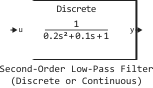
Block Second-Order Low-Pass Filter (Discrete or Continuous) implements a second-order low-pass filter in accordance with the IEEE 421.5-2016 standard [1]. According to the standard, the filter is a signal processing device with one input and one output, which is used in an SM PSS1A type power system stabilizer.

In the SM PSS1A system, this filter takes into account some low-frequency effects caused by the operation of high-frequency torsion filters. It also allows you to adjust the gain characteristics and phase characteristics of the stabilizer.
Switch between continuous and discrete block implementations Second-Order Low-Pass Filter (Discrete or Continuous) you can use the parameter Sample time (-1 for inherited).
Determining the initial conditions
The initial conditions of the block can be set using the parameter Initialization. Set the value:
-
Inherited from block input— the unit will set the initial conditions of the status and output signal equal to the initial input value; -
Specify as parameter— the block will set the initial condition of the state equal to the value of the parameter Initial state.
Ports
Input
#
u
—
filter input
scalar | vector
Details
The input signal of the second-order low-pass filter.
| Data types |
|
| Complex numbers support |
I don’t |
Output
#
y
—
filter output signal
scalar | vector
Details
The output signal of the second-order low-pass filter. The output signal contains as many elements as the input.
| Data types |
|
| Complex numbers support |
I don’t |
Parameters
Main group
# Coefficient of s A1 — ratio
Details
— the coefficient at a frequency filter for signal processing.
| Default value |
|
| Program usage name |
|
| Evaluatable |
Yes |
# Coefficient of s^2 A2 — ratio
Details
— the coefficient at a frequency filter for signal processing.
| Default value |
|
| Program usage name |
|
| Evaluatable |
Yes |
#
Initialization —
the method of setting the initial state
Inherited from block input | Specify as parameter
Details
Select the initial state for this block. For more information, see Determining the initial conditions.
| Values |
|
| Default value |
|
| Program usage name |
|
| Evaluatable |
Yes |
# Initial state — initial state
Details
The initial state of the block.
Dependencies
To use this parameter, set for the parameter Initialization meaning Specify as parameter.
| Default value |
|
| Program usage name |
|
| Evaluatable |
Yes |
# Sample time (-1 for inherited) — block sampling period
Details
The time between consecutive block executions. During execution, the block generates output signals and, if necessary, updates its internal state.
For the inherited discrete time mode, set this parameter to −1. For discrete mode, set this parameter to a positive real number. For continuous mode, set this parameter to 0.
| Default value |
|
| Program usage name |
|
| Evaluatable |
Yes |