Washout (Discrete or Continuous)
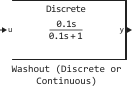
A washout filter (high-pass filter) in discrete or continuous time.
blockType: SubSystem
|
Path in the library: |
Description
Block Washout (Discrete or Continuous) implements a washout filter in accordance with IEEE 421.5-2016 [1]. A washout filter is also known as a high-pass filter.
You can switch between continuous and discrete filter implementations using the parameter Sample time (-1 for inherited).
The equations
notable mode
To set the filter for continuous operation, set the parameter Sample time (-1 for inherited) meaning 0. This representation is equivalent to a continuous transfer function.
where — the time constant of the filter.
The above transfer function implies a system of equations defining the filter:
where
-
— filter input signal;
-
— filter status;
-
— filter output signal;
-
— simulation time;
-
— the initial value of the input signal of the block.
discret mode
To set the filter to work in discrete mode, set the parameter Sample time (-1 for inherited) positive non-zero value or value −1 to inherit the sampling period from the upstream block. The discrete representation is equivalent to the transfer function
where — the sampling period.
Based on the discrete transfer function, the filter equations are determined using the direct Euler method:
where
-
— filter input signal;
-
— filter status;
-
— filter output signal;
-
— time step of the simulation;
-
— the initial input signal of the block.
Determining the initial conditions
The initial conditions of the block can be set using the parameter Initialization. Set the value:
-
Inherited from block input— the unit will set the initial conditions of the status and output signal equal to the initial input value; -
Specify as parameter— the block will set the initial condition of the state equal to the value of the parameter Initial state.
Ports
Input
#
u
—
filter input
vector
Details
The input signal of the filter is washed out. The block uses the initial value of the input signal to determine the initial value of the state.
| Data types |
|
| Complex numbers support |
I don’t |
Output
#
y
—
filter output signal
vector
Details
The output signal of the filter is washed out.
| Data types |
|
| Complex numbers support |
I don’t |
Parameters
Main group
# Time constant — filter time constant
Details
The time constant of the washout filter. To ignore the filter dynamics, set this parameter to a value less than or equal to the parameter value. Sample time (-1 for inherited).
| Default value |
|
| Program usage name |
|
| Evaluatable |
Yes |
#
Initialization —
the method of setting the initial state
Inherited from block input | Specify as parameter
Details
Select the initial state for this block. For more information, see Determining the initial conditions.
| Values |
|
| Default value |
|
| Program usage name |
|
| Evaluatable |
Yes |
# Initial state — initial state
Details
The initial state of the block.
Dependencies
To use this parameter, set for the parameter Initialization meaning Specify as parameter.
| Default value |
|
| Program usage name |
|
| Evaluatable |
Yes |
# Sample time (-1 for inherited) — block sampling period
Details
The time between consecutive block executions. During execution, the block generates output signals and, if necessary, updates its internal state.
For the inherited discrete time mode, set this parameter to −1. For discrete mode, set this parameter to a positive integer. For continuous mode, set this parameter to 0.
| Default value |
|
| Program usage name |
|
| Evaluatable |
Yes |