Amplifier (CE)
An amplifier model for envelope analysis.
blockType: SubSystem
|
Path in the library: |
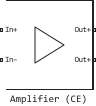
Description
Block Amplifier (CE) It is used to simulate a linear or nonlinear amplifier. Use the options on the tab Main to set the gain factor, using values from the technical specifications or the coefficients of the circuit envelope polynomial.
The amplifier is implemented as a voltage-controlled polynomial Voltage Source (VCVS). VCVS includes non-linearities, which are described by the parameters listed on the tab Nonlinearity. To simulate linear gain, the ratio is implemented in the amplifier between the input and output voltages. The input voltage is , and the output voltage is on each carrier RF components in Engee.
The nonlinear gain is modeled by a polynomial (with automatic calculation of saturation power). This also leads to additional intermodulation frequencies.
Ports
Conserving
#
In+
—
The input signal
electricity
Details
The electrical port connected to the input signal.
| Program usage name |
|
#
In−
—
The input signal
electricity
Details
The electrical port connected to the input signal.
| Program usage name |
|
#
Out+
—
The output signal
electricity
Details
The electrical port connected to the output signal.
| Program usage name |
|
#
Out−
—
The output signal
electricity
Details
The electrical port connected to the output signal.
| Program usage name |
|
Parameters
Main
Main
#
Source of amplifier gain —
The source of the amplifier gain
Available power gain
Details
The source of the amplifier’s gain factor, set as
-
Available power gain— the block uses the parameter value Available power gain, dB to calculate the linear voltage gain the VCVS polynomial. This calculation assumes a consistent load for the amplifier.
| Values |
|
| Default value |
|
| Program usage name |
|
| Tunable |
No |
| Evaluatable |
Yes |
# Available power gain, dB — available power gain
Details
The available amplifier power gain, set as a scalar in dB.
| Default value |
|
| Program usage name |
|
| Tunable |
No |
| Evaluatable |
Yes |
# Input impedance, Ohm — input impedance
Details
The input impedance of the amplifier, set as a positive scalar in ohms.
| Default value |
|
| Program usage name |
|
| Tunable |
No |
| Evaluatable |
Yes |
# Output impedance, Ohm — output impedance
Details
The output impedance of the amplifier, set as a positive scalar in ohms.
| Default value |
|
| Program usage name |
|
| Tunable |
No |
| Evaluatable |
Yes |
Nonlinearity
Nonlinearity
#
Nonlinear polynomial type —
type of non-linearity
Even and odd order | Odd order
Details
The type of non-linearity that can be set using one of the following methods:
-
Even and odd order— when this value is selected, the amplifier can generate second- and third-order intermodulation frequencies in addition to the linear component.; -
Odd order— when this value is selected, the amplifier generates only odd-order intermodulation frequencies.The linear gain determines the linear component . The block calculates the remaining components based on the set parameters. One of these parameters is IP3, dBm. The number of constraints set determines the order of the model.
| Values |
|
| Default value |
|
| Program usage name |
|
| Tunable |
No |
| Evaluatable |
Yes |
#
Intercept points convention —
the legend of the intersection points
Output | Input
Details
The symbol of the intersection points, defined as Input or Output. Use this specification for intersection points, compression power with gain 1 dB and saturation power.
| Values |
|
| Default value |
|
| Program usage name |
|
| Tunable |
No |
| Evaluatable |
Yes |
# IP2, dBm — the intersection point of the second order
Details
The intersection point of the second order, defined as a scalar.
Dependencies
To use this parameter, on the tab Nonlinearity set for the parameter Nonlinear polynomial type meaning Even and odd order.
| Default value |
|
| Program usage name |
|
| Tunable |
No |
| Evaluatable |
Yes |
# IP3, dBm — the intersection point of the third order
Details
The intersection point of the third order, defined as a scalar.
| Default value |
|
| Program usage name |
|
| Tunable |
No |
| Evaluatable |
Yes |
Literature
-
Gonzalez, Guillermo. «Microwave Transistor Amplifiers: Analysis and Design», Englewood Cliffs, N.J.: Prentice-Hall, 1984.
-
Kundert, Ken. «Accurate and Rapid Measurement of IP2 and IP3», The Designers Guide Community, Version 1b, May 22, 2002. http://www.designers-guide.org/analysis/intercept-point.pdf.
-
Pozar, David M. «Microwave Engineering», Hoboken NJ: John Wiley & Sons, 2005.
-
Razavi, Behzad. RF Microelectronics. Upper Saddle River, NJ: Prentice Hall, 2011.