Mixer (CE)
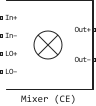
The mixer model in RF systems.
blockType: SubSystem
|
Path in the library: |
Description
Block Mixer (CE) performs signal frequency conversion and nonlinear amplification.
For a given RF input signal and the LO input signal the mixer multiplies the signals at the input ports:
This mixing converts the frequency of the radio frequency signal into and . In order for the mixer to perform this operation correctly, the frequencies must be switched on or in the simulation frequencies calculated by the block Configuration (CE).
The power gain specification for this unit correlates the power of a single-band signal (SSB) with the input signal.
After mixing the RF and LO signals, the mixer unit performs amplification. To simulate linear gain, the mixer scales the signals by a factor of . A Voltage Controlled Voltage Source (VCVS), specified by a polynomial, implements nonlinear amplification. The polynomial automatically turns on saturation and creates additional intermodulation frequencies.
Ports
Conserving
#
In+
—
RF input signal
electricity
Details
The electrical port connected to the RF input signal.
| Program usage name |
|
#
In−
—
RF input signal
electricity
Details
The electrical port connected to the RF input signal.
| Program usage name |
|
#
LO+
—
LO input signal
electricity
Details
The electrical port connected to the input LO signal.
| Program usage name |
|
#
LO−
—
LO input signal
electricity
Details
The electrical port connected to the input LO signal.
| Program usage name |
|
#
Out+
—
The output signal
electricity
Details
The electrical port connected to the output signal.
| Program usage name |
|
#
Out−
—
The output signal
electricity
Details
The electrical port connected to the output signal.
| Program usage name |
|
Parameters
Main
Main
#
Source of conversion gain —
parameter of the conversion gain source
Available power gain
Details
The parameter of the conversion gain source, set as
-
Available power gain— the block uses the parameter value Available power gain, dB to calculate the linear voltage gain the VCVS polynomial. This calculation assumes a consistent load for the mixer.
| Values |
|
| Default value |
|
| Program usage name |
|
| Tunable |
No |
| Evaluatable |
Yes |
# Available power gain, dB — linear mixer gain
Details
The linear gain of the mixer, set as a scalar in dB.
| Default value |
|
| Program usage name |
|
| Tunable |
No |
| Evaluatable |
Yes |
# Input impedance, Ohm — mixer input impedance
Details
The input impedance of the mixer, set as a scalar in ohms.
| Default value |
|
| Program usage name |
|
| Tunable |
No |
| Evaluatable |
Yes |
# Output impedance, Ohm — mixer output impedance
Details
The output impedance of the mixer, set as a scalar in ohms.
| Default value |
|
| Program usage name |
|
| Tunable |
No |
| Evaluatable |
Yes |
# LO impedance, Ohm — impedance at the LO ports of the mixer
Details
The impedance at the ports LO of the mixer, set as a scalar in ohms.
| Default value |
|
| Program usage name |
|
| Tunable |
No |
| Evaluatable |
Yes |
Nonlinearity
Nonlinearity
#
Nonlinear polynomial type —
polynomial nonlinearity
Even and odd order
Details
Polynomial nonlinearity, defined as
-
Even and odd order— when this value is selected, the mixer can generate intermodulation frequencies of the second and third order in addition to the linear component.
| Values |
|
| Default value |
|
| Program usage name |
|
| Tunable |
No |
| Evaluatable |
Yes |
#
Intercept points convention —
the legend of the intersection points
Output | Input
Details
The symbol of the intersection points, defined as Input or Output. Use this specification for intersection points, compression power with gain 1 dB and saturation power.
| Values |
|
| Default value |
|
| Program usage name |
|
| Tunable |
No |
| Evaluatable |
Yes |
# IP2, dBm — the intersection point of the second order
Details
The intersection point of the second order, defined as a scalar in dBm. Default value Inf corresponds to an unspecified point.
| Default value |
|
| Program usage name |
|
| Tunable |
No |
| Evaluatable |
Yes |
# IP3, dBm — the intersection point of the third order
Details
The intersection point of the third order, defined as a scalar in dBm. Default value Inf corresponds to an unspecified point.
| Default value |
|
| Program usage name |
|
| Tunable |
No |
| Evaluatable |
Yes |