Transmission Line (CE)
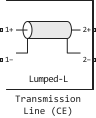
The model of the transmission line.
blockType: SubSystem
|
Path in the library: |
Description
Block Transmission Line (CE) simulates transmission lines with delay, lumped parameters, and distributed transmission. The block parameters are automatically changed depending on the selected model type.
Ports
Conserving
#
1+
—
the first electrical port
electricity
Details
The electrical port corresponding to the positive terminal of the RF circuit.
| Program usage name |
|
#
1-
—
the first electrical port
electricity
Details
The electrical port corresponding to the negative terminal of the RF circuit.
| Program usage name |
|
#
2+
—
the second electrical port
electricity
Details
The electrical port corresponding to the positive terminal of the RF circuit.
| Program usage name |
|
#
2-
—
the second electrical port
electricity
Details
The electrical port corresponding to the negative terminal of the RF circuit.
| Program usage name |
|
Parameters
Parameters
#
Model type: —
transmission line model
Lumped parameter L-section | Lumped parameter Pi-section
Details
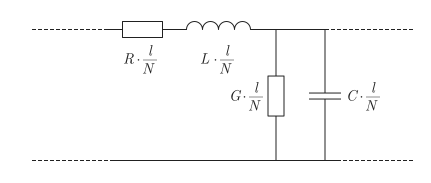
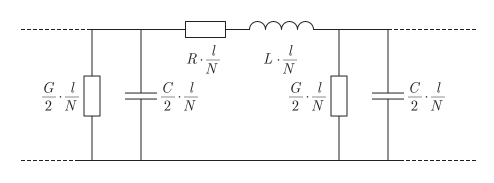
The type of transmission line model specified as one of the following options.
| Types of transmission lines | Description |
|---|---|
|
A model of an L-section RLGC transmission line.
|
|
A transmission line model with RLGC pi sections.
|
| Values |
|
| Default value |
|
| Program usage name |
|
| Tunable |
No |
| Evaluatable |
Yes |
#
Parameterization: —
the type of parameters for modeling segments in a transmission line
By characteristic impedance and capacitance | By inductance and capacitance
Details
The type of parameters for modeling segments in a power line, set as By characteristic impedance and capacitance or By inductance and capacitance.
| Values |
|
| Default value |
|
| Program usage name |
|
| Tunable |
No |
| Evaluatable |
Yes |
# Characteristic impedance, Ohm: — transmission line impedance
Details
The impedance of the transmission line, given as a real scalar in ohms.
Dependencies
To use this parameter, set for the parameter Parameterization: meaning By characteristic impedance and capacitance.
| Default value |
|
| Program usage name |
|
| Tunable |
No |
| Evaluatable |
Yes |
# Resistance per unit length, Ohm/m: — resistance per unit length of transmission line
Details
The resistance per unit length of the transmission line, set as a positive scalar in ohms/m.
Dependencies
To use this parameter, set for the parameter Parameterization: meaning By characteristic impedance and capacitance.
| Default value |
|
| Program usage name |
|
| Tunable |
No |
| Evaluatable |
Yes |
# Inductance per unit length, H/m — inductance per unit length of transmission line
Details
The inductance per unit length of the transmission line, set as a positive scalar in Gn/m.
Dependencies
To use this parameter, set for the parameter Parameterization: meaning By inductance and capacitance.
| Default value |
|
| Program usage name |
|
| Tunable |
No |
| Evaluatable |
Yes |
# Capacitance per unit length, F/m: — capacity per unit length of transmission line
Details
Capacity per unit length of the transmission line, set as a positive scalar in Ft/m.
| Default value |
|
| Program usage name |
|
| Tunable |
No |
| Evaluatable |
Yes |
# Conductance per unit length, S/m: — conductivity per unit length of transmission line
Details
The conductivity per unit length of the transmission line, given as a positive scalar in S/m.
| Default value |
|
| Program usage name |
|
| Tunable |
No |
| Evaluatable |
Yes |
# Line length, m: — physical length of the transmission line
Details
Physical length of the transmission line , defined as a positive scalar in M.
| Default value |
|
| Program usage name |
|
| Tunable |
No |
| Evaluatable |
Yes |
# Number of segments: — number of segments in the transmission line
Details
The number of segments in the transmission line, set as a positive scalar.
| Default value |
|
| Program usage name |
|
| Tunable |
No |
| Evaluatable |
Yes |
Additional Info
Calculation of distributed transmission line parameters
Details
When modeling distributed transmission lines, the block first calculates the ABCD parameters on a set of internal frequencies. The ABCD parameters are converted to S-parameters for simulation.
The block calculates the ABCD parameters based on the physical length of the transmission line and a comprehensive continuous distribution using the following set of equations:
where — the specified characteristic impedance.
Literature
-
Sussman-Fort, S. E., and J. C. Hantgan. «SPICE Implementation of Lossy Transmission Line and Schottky Diode Models.» IEEE Transactions on Microwave Theory and Techniques. Vol. 36, No.1, January 1988.
-
Pozar, David M. Microwave Engineering. Hoboken, NJ: John Wiley & Sons, Inc., 2005.
-
Gupta, K. C., Ramesh Garg, Inder Bahl, and Prakash Bhartia. Microstrip Lines and Slotlines, 2nd Edition, Norwood, MA: Artech House, Inc., 1996.
-
Ludwig, Reinhold and Pavel Bretchko. RF Circuit Design: Theory and Applications. Englewood Cliffs: NJ: Prentice-Hall, 2000.
-
True, Kenneth M. «Data Transmission Lines and Their Characteristics.» National Semiconductor Application Note 806, April 1992.