Wye-Connected Variable Load (Lagging)
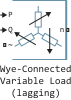
Three-phase variable load connected according to the Star scheme.
blockType: AcausalElectricPowerSystems.Passive.RLC_Assemblies.WyeConnectedVariableLoadLagging
|
Path in the library: |
Description
Block Wye-Connected Variable Load (Lagging) simulates an alternating active-inductive three-phase load connected according to the Star scheme. Each phase of the load contains a resistor and the inductor . The unit calculates the resistance and inductance required to select the active and reactive powers set by the values at the inputs P and Q at rated voltage and rated frequency. Thus, the unit can represent an active-inductive load.
To ensure that the resistance and inductance are always greater than zero, specify the minimum active and reactive power that the load consumes. These values must be greater than zero.
The equations
The series resistance and inductance of each phase are determined as follows:
where
-
— sequential resistance of each phase;
-
— sequential inductance of each phase;
-
— RMS rated line voltage;
-
— rated AC electrical frequency;
-
— required three-phase real power;
-
— required three-phase reactive power.
The inductance is defined as the ratio of the magnetic flux to steady current:
therefore, the dependence of current on voltage for an inductor has the form:
Variables
Use the parameter group Initial Targets to set the priority and initial target values for the block parameter variables before modeling. For more information, see Configuring physical blocks using target values.
Ports
Parameters
Main
#
Rated voltage —
Rated line voltage
V | uV | mV | kV | MV
Details
The RMS value of the nominal line voltage for the resistance equation.
| Units |
|
| Default value |
|
| Program usage name |
|
| Evaluatable |
Yes |
#
Rated electrical frequency —
Rated electrical frequency
Hz | kHz | MHz | GHz
Details
The nominal or nominal frequency of the AC network to which the transformer is connected. The value must be greater than 0.
| Units |
|
| Default value |
|
| Program usage name |
|
| Evaluatable |
Yes |
#
Minimum real power —
minimum active power
W | uW | mW | kW | MW | GW | V*A | HP_DIN
Details
The minimum active power that a three-phase load dissipates when the rated voltage is applied. The value must be greater than 0.
| Units |
|
| Default value |
|
| Program usage name |
|
| Evaluatable |
Yes |
#
Minimum reactive power —
minimum reactive power
W | uW | mW | kW | MW | GW | V*A | HP_DIN
Details
The minimum reactive power consumed by a three-phase load when the rated voltage is applied. The value must be greater than 0.
| Units |
|
| Default value |
|
| Program usage name |
|
| Evaluatable |
Yes |
Parasitics
#
Parasitic parallel conductance —
parasitic parallel conduction
S | nS | uS | mS | 1/Ohm
Details
It represents small parasitic effects. The parameter value corresponds to the parallel conduction value added to all instances of inductors in the load.
| Units |
|
| Default value |
|
| Program usage name |
|
| Evaluatable |
Yes |