dct
Discrete cosine transform.
| Library |
|
Arguments
Input arguments
# x — input array
+
vector | the matrix | An N-dimensional array
Details
An input array specified as a vector, matrix, or multidimensional array with real or complex values.
| Data types |
|
| Support for complex numbers |
Yes |
# n is the length of the conversion
+
a positive integer scalar
Details
The length of the transformation, specified as a positive integer scalar.
| Data types |
|
Output arguments
# y is a discrete cosine transform
+
vector | the matrix | An N-dimensional array
Details
A discrete cosine transform returned as a real or complex vector, matrix, or multidimensional array.
Examples
Energy stored in PREP coefficients
Details
Let’s determine how many DCT coefficients represent 99% of the energy in the sequence.
import EngeeDSP.Functions: dct, norm

x = (1:100) .+ 50 .* cos.((1:100) .* 2π / 40) .^ 3
X = dct(x)
XX = sort(abs.(X), rev = true)
ind = sortperm(abs.(X), rev = true)

i = 1
while (norm(X[ind[1:i]]) / norm(X))^2 < 0.99
   global i += 1
end
needed = i
Let’s restore the signal and compare it with the original one.
import EngeeDSP.Functions: idct

X[ind[needed+1:end]] .= 0
xx = idct(X)

plot(1:100, x, label = "Original", legend = :bottomright)
plot!(1:100, xx, label = "Reconstructed, N = $needed")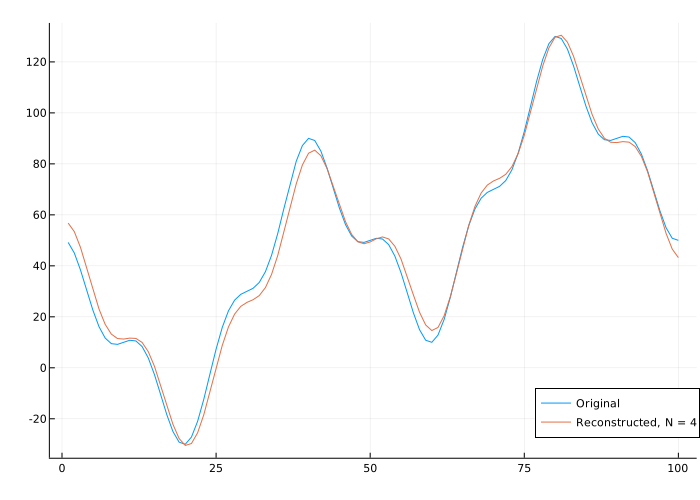
Additional Info
Discrete cosine transform
Details
The discrete cosine transform (DCT) is closely related to the discrete Fourier transform. Often, the sequence can be very accurately reconstructed using only a few PREP coefficients. This property is useful for applications that require data processing.
PREP has four standard options. Only the DKP-2 type is implemented for this function. For the signal lengths and the Kronecker symbol transformations are defined as follows:
-
PREP-1:
-
PREP-2:
-
PREP-3:
-
PREP-4:
The rows are indexed from and instead of the usual ones and since the Engee vectors vary from before , not from before .
All PREP variants are unitar (or, equivalently, _orthogonal): to find their inverse values, swap them and in every definition. DKP-1 and DKP-4 are the opposite of each other. DKP-2 and DKP-3 are the opposite of each other.
Literature
-
Jain, A. K. Fundamentals of Digital Image Processing. Englewood Cliffs, NJ: Prentice-Hall, 1989.
-
Oppenheim, Alan V., Ronald W. Schafer, and John R. Buck. Discrete-Time Signal Processing. 2nd Ed. Upper Saddle River, NJ: Prentice Hall, 1999.
-
Pennebaker, W. B., and J. L. Mitchell. JPEG Still Image Data Compression Standard. New York: Van Nostrand Reinhold, 1993.