stft
The windowed Fourier transform.
| Library |
|
Syntax
Function call
-
s = stft(x)— returns the The windowed Fourier transform (OPF) of the input signalx.
-
s = stft(___,Name,Value)— sets additional parameters using name-value arguments. The values of such arguments include the window and the length of the FFT. These arguments can be added to any of the previous input syntaxes.
-
stft(___)— without output arguments, plots the square of the OPF amplitude in decibels in the current graph window.
Arguments
Input arguments
# x — input signal
+
vector | the matrix
Details
An input signal specified as a vector or matrix.
If it is required that x and s had the same length, value (length(x)-noverlap)/(length(window)-noverlap) it must be an integer. Use the argument Window to set the length window and the argument OverlapLength to ask noverlap.
|
-
If the input data contains multiple channels, specify
xas a matrix, where each column corresponds to a channel.
Each signal channel x It must have a length greater than or equal to the length of the window.
| Data types |
|
| Support for complex numbers |
Yes |
#
fs —
sampling
rate
2π (by default) | positive scalar
Details
The sampling rate, set as a positive scalar.
| Data types |
|
Name-value input arguments
Specify optional argument pairs as Name,Value, where Name — the name of the argument, and Value — the appropriate value. Name-value arguments should be placed after other arguments, but the order of the pairs does not matter.
Use commas to separate the name and value, and Name put it in quotation marks.
# Window — spectral window
+
hann(128,"periodic") (by default) | vector
Details
The spectral window defined as a vector. If the argument is Window not specified or set as empty, the function uses a Hanna window of length 128. Length of the argument Window must be greater than or equal to 2.
For a list of available windows, see Windows - window functions.
| Data types |
|
# OverlapLength — the number of overlapping samples
+
75% of the window length (by default) | a non-negative integer
Details
The number of overlapping samples, set as a positive integer less than the length of the argument Window. If the argument is OverlapLength omitted or empty, the function uses the largest integer smaller than 75% of the window length, which is 96 There are no default counts for the Hanna window.
| Data types |
|
# FFTLength — number of DFT points
+
128 (by default) | a positive integer
Details
The number of DFT points, set as a positive integer. The value must be greater than or equal to the window length. If the length of the input signal is less than the length of the DFT, the data is padded with zeros.
| Data types |
|
# FrequencyRange — frequency range of OPF
+
"centered" (by default) | "twosided" | "onesided"
Details
The frequency range of the OPF, set as "centered", "twosided" or "onesided".
-
"centered"— calculate the two-way centered OPF. If the value of the argument isFFTLengtheven, thenscalculated in the interval rad/countdown. If the value of the argument isFFTLengthIf it’s an odd number, thenscalculated in the interval rad/countdown. If time information is specified, then the intervals are cycles per unit of time and cycles per unit of time, respectively, where — effective sampling rate. -
"twosided"— calculate the two-way OPF in the interval rad/countdown. If time information is specified, the interval is cycles per unit of time. -
"onesided"— calculate the one-way OPF. If the value of the argument isFFTLengtheven, thenscalculated in the interval rad/countdown. If the value of the argument isFFTLengthIf it’s an odd number, thenscalculated in the interval rad/countdown. If time information is specified, the intervals are cycles per unit of time and cycles per unit of time, respectively, where — effective sampling rate. This option is valid only for real signals.
If this argument is set to "onesided", function stft outputs values in the positive Nyquist band and does not save the total power.
|
| Data types |
|
# OutputTimeDimension — time measurement of the output
+
"acrosscolumns" (by default) | "downrows"
Details
The time dimension of the output, set as "acrosscolumns" or "downrows". Set the value "downrows" if it is required that the time dimension s It was displayed in rows, and the frequency value was displayed in columns. Set the value "acrosscolumns" if it is required that the time dimension s It was displayed in columns, and the frequency value was displayed in rows. This input argument is ignored if the function is called without output arguments.
# out — type of output data
+
:data (by default) | :plot
Details
Type of output data:
-
:data— the function returns data; -
:plot— the function returns a graph.
Output arguments
#
s —
windowed Fourier
transform
the matrix | three-dimensional array
Details
A windowed Fourier transform returned as a matrix or three-dimensional array. Time increases by columns s, and the frequency is in rows. The third dimension, if present, corresponds to the input channels.
-
If the signal is
xhas time counts, thenshas columns where , — length of the argumentWindow, — length of the argumentOverlapLength, and the symbols denote the function of rounding down to the nearest integer ( ). -
Number of rows in
sis equal to the value specified in the argumentFFTLength.
| Data types |
|
# f — frequencies
+
vector
Details
The frequencies at which the OPF is calculated, returned as a vector.
| Data types |
|
#
t —
time
points
vector
Details
The time points returned as a vector. Argument t contains time values corresponding to the centers of the data segments used to calculate estimates of the windowed power spectrum.
| Data types |
|
Examples
The windowed Fourier transform of a quadratic chirp
Details
Generate a quadratic chirp signal with a sampling frequency 1 kHz duration 2 c. The instantaneous frequency is 100 Hz at and 200 Hz at with.
import EngeeDSP.Functions: chirp

ts = 0:1/1e3:2

f0 = 100
f1 = 200

x = chirp(ts, f0, 1, f1, "quadratic", 0, "concave");
Calculate and display the windowed Fourier transform of a quadratic chirp signal with a duration of 1 ms.
import EngeeDSP.Functions: hamming, stft

fs = 1e3
win = hamming(100, "periodic")

stft(x, fs, "Window", win, "OverlapLength", 98, "FFTLength", 128, out=:plot)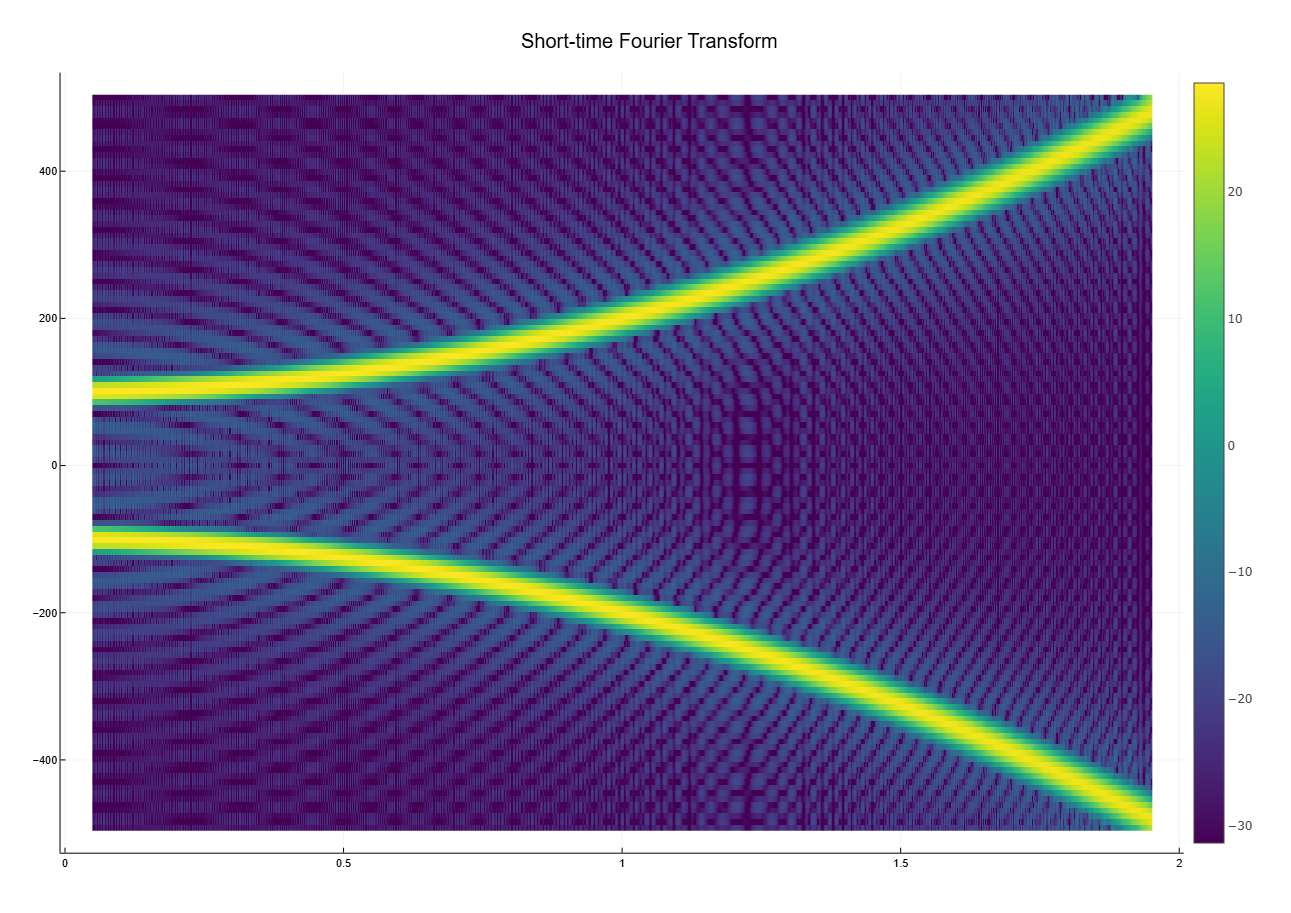
Additional Info
The windowed Fourier transform
Details
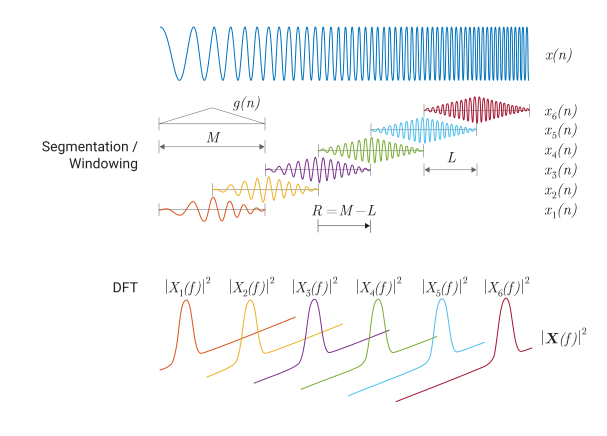
The windowed Fourier transform (OPF) is used to analyze the change in the frequency spectrum of a non-stationary signal over time. The square of the amplitude of the OPF is called the representation of the signal spectrogram in the time-frequency domain.
The OPF of the signal is calculated by moving the _ window of the analysis_ length based on the signal and the calculation of the discrete Fourier transform (DFT) of each segment of the window data. The window shifts according to the original signal with an interval of counts, which is equivalent to counts of overlap between adjacent segments. Most window functions taper towards the edges to avoid the Gibbs effect. The DFT of each window segment is added to a complex matrix containing the amplitude and phase for each time point and frequency. The OPF matrix has
columns where — signal length , and the symbols denote the function . The number of rows in the matrix is , i.e., the number of DFT points, for centered and two-sided transformations, and an odd number close to , for one-way transformations of real signals.
In the OPF matrix -th column
contains a DFT of window data centered relative to time :
Literature
-
Mitra, Sanjit K. Digital Signal Processing: A Computer-Based Approach. 2nd Ed. New York: McGraw-Hill, 2001.
-
Sharpe, Bruce. Invertibility of Overlap-Add Processing. https://gauss256.github.io/blog/cola.html, accessed July 2019.
-
Smith, Julius Orion. Spectral Audio Signal Processing. https://ccrma.stanford.edu/~jos/sasp/, online book, 2011 edition, accessed Nov 2018.