Cycloidal Drive
A high-gear speed reducer based on the motion of a cycloidal disc.
blockType: Engee1DMechanical.Transmission.CycloidalDrive
|
Path in the library: |

Description
Block Cycloidal Drive It is a compact speed reduction mechanism with a high gear ratio, which contains four key components:
-
cycloidal disk;
-
eccentric cam;
-
ring gear housing;
-
videos.
The eccentric coming out of the drive shaft is located inside the cycloidal disk. This disc engages with the ring gear housing. The rollers coming from the driven shaft enter the corresponding holes on the cycloidal disk.
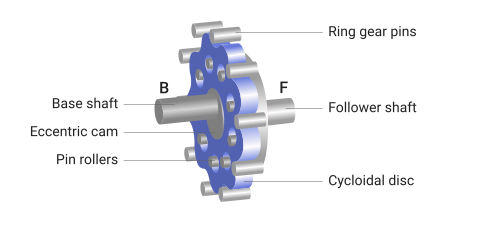
During normal operation, the drive shaft drives the eccentric cam. The cam rotates inside the cycloidal disk, causing it to rotate eccentrically around an offset axis. When moving, the cycloidal disc engages with the inner teeth of the ring gear housing. The internal gearing changes the direction of the rotation speed.
The rollers passing through the holes of the cycloidal disc transmit the rotational motion to the driven shaft. This shaft rotates against the drive shaft at a very low speed. The high gear ratio is due to the almost identical number of teeth of the cycloidal disc and the ring gear. The unit calculates the effective gear ratio as
where
-
— gear ratio;
-
— the number of teeth on the ring gear;
-
— the number of teeth on the cycloidal disc.
The gear ratio limits the angular velocities of the drive and driven shafts in accordance with the expression
where
-
— angular velocity of the driven shaft;
-
— angular velocity of the drive shaft.
The gear ratio also limits the torques acting on the drive and driven shafts, according to the expression
where
-
— torque on the drive shaft;
-
— torque on the driven shaft;
-
— loss of torque due to friction. For more information, see the article Modeling of mechanical gears with losses.
The picture shows a cycloidal drive from the front and from the side. The kinematics of the drive system leads to a change in the angular velocities of the drive and driven shafts, so that both shafts rotate in opposite directions.
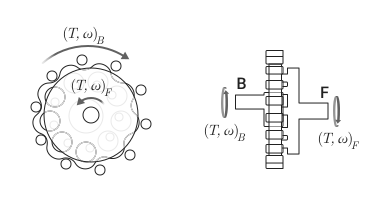
The cycloidal drive can operate in reverse mode, that is, with power transfer from the driven shaft to the drive shaft. In reverse mode, the efficiency of torque transmission is usually negligible. The efficiency can be adjusted by changing the parameter value. Efficiency from follower shaft to base shaft.
Ring gear rotation
When the checkbox is selected Ring gear rotation The unit uses the R port, which allows you to simulate the rotational motion of the ring gear. The block implements this movement as
where — the torque on the ring gear.
The friction model
You can set for Friction model:
-
meaning
No meshing losses - Suitable for HIL simulationwhich ignores losses for optimal performance of your real-time simulation; -
meaning
Constant efficiency, which allows you to set the efficiency of the component, which remains constant throughout the simulation; -
meaning
Temperature-dependent efficiency, which simulates the temperature-dependent efficiency of a component by creating an interpolation table based on a vector Temperature and a given vector of the component’s efficiency. This option also opens a non-directional H port. The H port receives the heat flow into the unit, which is converted to the unit temperature according to the parameter value. Thermal mass.
Ports
Conserving
#
F
—
driven shaft
rotational mechanics
Details
A non-directional port connected to the driven shaft.
| Program usage name |
|
#
H
—
heat flow
warm
Details
A non-directional port connected to the heat flow.
The thermal port allows you to simulate the heat flow between the unit and the connected network.
Dependencies
To use this port, set the parameter Friction model meaning Temperature-dependent efficiency.
| Program usage name |
|
#
R
—
ring gear
rotational mechanics
Details
A non-directional port connected to an annular gear.
Dependencies
To use this port, check the box Ring gear rotation.
| Program usage name |
|
#
B
—
drive shaft
rotational mechanics
Details
A non-directional port connected to the drive shaft.
| Program usage name |
|
Parameters
Meshing Losses
#
Power threshold —
minimum power threshold value
W | uW | mW | kW | MW | GW | V*A | HP_DIN
Details
The absolute power value of the cycloidal disk, when exceeded, the full efficiency value is applied. If the value is lower than the specified value, the efficiency value is smoothed out.
-
If for the parameter Friction model the value is set
Constant efficiencyThe block uses a hyperbolic tangent function to smooth the efficiency to unity, so that the EFFICIENCY loss at rest is zero. -
If for the parameter Friction model the value is set
Temperature-dependent efficiencyThe block uses a hyperbolic tangent function to smooth efficiency in the range from zero at rest to the values provided by the interpolation tables of efficiency versus temperature at power thresholds.
The power threshold must be lower than the expected power transmitted during the simulation. Higher values may cause the block to underestimate the loss of efficiency. However, very low values can increase computational costs.
Dependencies
To use this parameter, set for the parameter Friction model meaning Constant efficiency or Temperature-dependent efficiency.
| Units |
|
| Default value |
|
| Program usage name |
|
| Evaluatable |
Yes |
# Efficiency from follower shaft to base shaft — Efficiency of torque transmission from the driven shaft to the drive shaft
Details
The efficiency of torque transmission when the driven shaft drives the drive shaft, that is, in reverse mode. The efficiency values should be in the range (0, 1]. Higher efficiency values correspond to a greater transmission of torque between the drive and driven shafts. Values close to zero are typical.
If for the parameter Friction model the value is set Constant efficiency, then specify the value Efficiency from follower shaft to base shaft in the form of a scalar.
If for the parameter Friction model the value is set Temperature-dependent efficiency, then specify the value Efficiency from follower shaft to base shaft in the form of a vector. The values of the vector are the efficiency at the corresponding temperature values in the parameter Temperature. Both vectors must be the same size.
Dependencies
To use this parameter, set for the parameter Friction model meaning Constant efficiency or Temperature-dependent efficiency.
| Default value |
|
| Program usage names |
|
| Evaluatable |
Yes |
# Efficiency from base shaft to follower shaft — Efficiency of torque transmission from drive shaft to slave
Details
The efficiency of torque transmission when the drive shaft drives the driven shaft. The efficiency values should be in the range (0, 1]. Higher efficiency values correspond to a greater transmission of torque between the drive and driven shafts. Values close to zero are typical.
If for the parameter Friction model the value is set Constant efficiency, then specify the value Efficiency from base shaft to follower shaft in the form of a scalar.
If for the parameter Friction model the value is set Temperature-dependent efficiency, then specify the value Efficiency from base shaft to follower shaft in the form of a vector. The values of the vector are the efficiency at the corresponding temperature values in the parameter Temperature. Both vectors must be the same size.
Dependencies
To use this parameter, set for the parameter Friction model meaning Constant efficiency or Temperature-dependent efficiency.
| Default value |
|
| Program usage names |
|
| Evaluatable |
Yes |
#
Friction model —
the friction model
No meshing losses - Suitable for HIL simulation | Constant efficiency | Temperature-dependent efficiency
Details
The model of friction losses during engagement:
-
No meshing losses - Suitable for HIL simulation— gearing losses are not taken into account. -
Constant efficiency— the efficiency is set, which remains constant throughout the simulation. -
Temperature-dependent efficiency— The efficiency of torque transmission depends on the values on the H port.
| Values |
|
| Default value |
|
| Program usage name |
|
| Evaluatable |
No |
#
Temperature —
vector of temperature values
K | degC | degF | degR | deltaK | deltadegC | deltadegF | deltadegR
Details
The vector of temperature values used to construct an interpolation table of the dependence of the efficiency of torque transmission on temperature. The elements of the vector should increase monotonously. The number of elements in the vector must match the number of elements in the vectors specified for the parameters. Efficiency from base shaft to follower shaft and Efficiency from follower shaft to base shaft.
Dependencies
To use this parameter, set for the parameter Friction model meaning Temperature-dependent efficiency.
| Units |
|
| Default value |
|
| Program usage name |
|
| Evaluatable |
Yes |
Main
# Number of teeth on ring gear — number of teeth of the ring gear
Details
The total number of teeth or tines protruding inside the ring gear housing. The value of this parameter must be greater than the value of the parameter Number of teeth on cycloid disc. The ratio of the number of gear teeth determines the relative angular velocities of the drive and driven shafts.
| Default value |
|
| Program usage name |
|
| Evaluatable |
Yes |
# Number of teeth on cycloid disc — number of teeth of the cycloidal disc
Details
The total number of teeth protruding beyond the perimeter of the cycloidal disc. The value of this parameter must be less than the value of the parameter Number of teeth on ring gear. The ratio of the number of gear teeth determines the relative angular velocities of the drive and driven shafts.
| Default value |
|
| Program usage name |
|
| Evaluatable |
Yes |
# Ring gear rotation — an option for simulating the movement of an annular gear
Details
An option to account for the rotation of the ring gear. Select this option to use the R port.
| Default value |
|
| Program usage name |
|
| Evaluatable |
No |
Thermal Port
#
Thermal mass —
heat capacity
J/K | kJ/K
Details
The thermal energy required to change the temperature of a component by one degree. The higher the heat capacity, the more resistant the component is to temperature changes.
Dependencies
To use this parameter, set for the parameter Friction model meaning Temperature-dependent efficiency.
| Units |
|
| Default value |
|
| Program usage name |
|
| Evaluatable |
Yes |