Harmonic Drive
A high-gear speed reducer based on the elastic deformation of a flexible wheel.
blockType: Engee1DMechanical.Transmission.Gears.HarmonicDrive
|
Path in the library: |

Description
Block Harmonic Drive It is a compact speed reduction mechanism with a high gear ratio, consisting of three key components:
-
the wave generator;
-
flexible wheel;
-
the hard wheel.
The wave reducer has no backlash and has a high speed reduction ratio. This is advantageous for systems that require precise gear positioning. The drive shaft rotates the wave generator, which has an elliptical shape with bearings around the entire circumference. The bearings allow the wave generator to rotate inside the elliptical flexible wheel. The movement of the wave generator causes the tops of the flexible wheel to move. The deformation of the ellipse causes the teeth of the flexible wheel to slowly rise over the teeth of the rigid wheel. A rigid wheel has more teeth than a flexible one to provide this kind of movement. The flexible wheel transmits the torque to the output shaft by rotating inside the rigid wheel.
Engagement occurs simultaneously at both vertices of the flexible wheel. This design doubles the number of teeth in the engagement, thereby increasing the torque of the drive system.
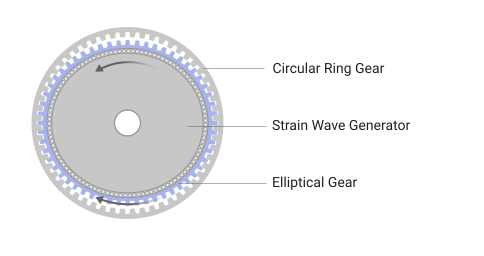
The internal engagement between the two wheels causes the axis of the flexible wheel to rotate against the elliptical deformation wave generator.
Due to the almost identical numbers of wheel teeth, a high gear ratio is achieved. The effective gear ratio of the reduction is
where
-
— gear ratio;
-
— the number of teeth of the hard wheel;
-
— the number of teeth of the flexible wheel.
Block Simple Gear it is the basis for this block.
Rotation of the hard wheel
You can account for the rotation of the hard wheel by checking the box Ring gear rotation. In this case, port C opens, which allows you to control the rotation of the hard wheel using a mechanical rotation input signal.
| Parameter Ring gear rotation defines a method for parameterizing engagement losses. |
If the check box is Ring gear rotation removed, the block calculates the efficiency using the block implementation Simple Gear. In this case, the engagement losses are parameterized in the same way as for the block Simple Gear. However, when the checkbox is checked Ring gear rotation The block calculates the efficiency by implementing the block Planetary Gear. In this case, the engagement losses are parameterized in the same way as for the block Planetary Gear.
Ports
Conserving
#
F
—
driven shaft
rotational mechanics
Details
A non-directional port connected to a driven shaft and a flexible wheel.
If the check box is selected Ring gear rotation, then this port corresponds to the R port for the block Planetary Gear, that is, the ring gear.
| Program usage name |
|
#
H
—
heat flow
warm
Details
A non-directional port connected to the heat flow.
Dependencies
To use this port, set the parameter Friction model meaning Temperature-dependent efficiency or Temperature and load-dependent efficiency.
| Program usage name |
|
#
With
—
the hard wheel
rotational mechanics
Details
A non-directional port connected to a rigid wheel.
This port corresponds to the C port for the block Planetary Gear that is, the driver of the planetary transmission.
Dependencies
To use this port, check the box Ring gear rotation.
| Program usage name |
|
#
B
—
drive shaft
rotational mechanics
Details
A non-directional port connected to the drive shaft and the wave generator.
If the check box is selected Ring gear rotation, then this port corresponds to the S port for the block Planetary Gear that is, the solar gear.
| Program usage name |
|
Parameters
Meshing Losses
#
Sun-carrier and planet-carrier power thresholds —
minimum threshold power values for sun-driven and satellite-driven gears
W | uW | mW | kW | MW | GW | V*A | HP_DIN
Details
A vector of power thresholds, over which the maximum efficiency value is applied. Enter the threshold values in the order wave generator-rigid wheel, flexible wheel-rigid wheel. At values below those indicated, the efficiency is smoothed using a hyperbolic tangent function.
If for the parameter Friction model the value is set Constant efficiency, then the unit reduces losses to zero when no power is transmitted. If for the parameter Friction model the value is set Temperature-dependent efficiency, then the block smooths the efficiency values between zero at rest and the values indicated in the interpolation tables of efficiency values depending on temperature.
Dependencies
To use this option, check the box Ring gear rotation and set for the parameter Friction model meaning Constant efficiency or Temperature-dependent efficiency.
| Units |
|
| Default value |
|
| Program usage name |
|
| Evaluatable |
Yes |
# Efficiency — Torque transmission efficiency
Details
Torque transmission efficiency ( ) between the drive and driven shafts. The efficiency value is inversely proportional to the power loss in the engagement.
If for the parameter Friction model the value is set Constant efficiency, then specify the value Efficiency in the form of a scalar.
If for the parameter Friction model the value is set Temperature-dependent efficiency, then specify the value Efficiency in the form of a vector. The values of the vector are the efficiency at the corresponding temperature values in the parameter Temperature. Both vectors must be the same size.
Dependencies
To use this option, uncheck the box. Ring gear rotation and set for the parameter Friction model meaning Constant efficiency or Temperature-dependent efficiency.
| Default value |
|
| Program usage names |
|
| Evaluatable |
Yes |
#
Nominal output torque —
the torque at which efficiency is normalized
N*m | uN*m | mN*m | kN*m | MN*m | GN*m | kgf*m | lbf*in | lbf*ft
Details
The torque on the driven shaft, at which the efficiency is normalized depending on the load.
Dependencies
To use this option, uncheck the box. Ring gear rotation and set for the parameter Friction model meaning Load-dependent efficiency.
| Units |
|
| Default value |
|
| Program usage name |
|
| Evaluatable |
Yes |
#
Load at elliptical gear —
vector of loads on a flexible wheel for tabular parameterization of efficiency
N*m | uN*m | mN*m | kN*m | MN*m | GN*m | kgf*m | lbf*in | lbf*ft
Details
Vector of loads on a flexible wheel used to construct a two-dimensional interpolation table of efficiency values depending on temperature and load. The elements of the vector should increase monotonously. The number of elements in the vector must match the number of elements in one column of the efficiency matrix. Efficiency matrix.
Dependencies
To use this option, uncheck the box. Ring gear rotation and set for the parameter Friction model meaning Temperature and load-dependent efficiency.
| Units |
|
| Default value |
|
| Program usage name |
|
| Evaluatable |
Yes |
#
Friction model —
the friction model, if the movement of a rigid wheel is not simulated
No meshing losses - Suitable for HIL simulation | Constant efficiency | Load-dependent efficiency | Temperature-dependent efficiency | Temperature and load-dependent efficiency
Details
The model of friction losses during engagement:
-
No meshing losses - Suitable for HIL simulation— gearing losses are not taken into account. -
Constant efficiency— the efficiency is set, which remains constant throughout the simulation. -
Load-dependent efficiency— reduction of torque transmission by using variable efficiency. The efficiency is in the range of and it depends on the load. -
Temperature-dependent efficiency— The efficiency of torque transmission depends on the values on the H port. The efficiency is in the range of and it does not depend on the load. -
Temperature and load-dependent efficiency— reducing the transmission of torque by the amount of efficiency, depending on temperature and load. The efficiency is in the range of and it varies depending on the load.
Dependencies
To use this option, uncheck the box. Ring gear rotation.
| Values |
|
| Default value |
|
| Program usage name |
|
| Evaluatable |
No |
# Efficiency at nominal output torque — Torque transmission efficiency
Details
Torque transmission efficiency at the rated torque on the driven shaft. High efficiency values correspond to a greater transmission of torque between the drive and driven shafts.
Dependencies
To use this option, uncheck the box. Ring gear rotation and set for the parameter Friction model meaning Load-dependent efficiency.
| Default value |
|
| Program usage name |
|
| Evaluatable |
Yes |
# Efficiency matrix — matrix of efficiency values for tabular parameterization
Details
A matrix of component efficiency values used to construct a two-dimensional interpolation table of efficiency values depending on temperature and load.
Each element represents the efficiency at the corresponding temperature value in the parameter Temperature and with the corresponding load value in the parameter Load at elliptical gear.
The number of rows must be equal to the number of elements in the parameter vector. Temperature. The number of columns must be equal to the number of elements in the parameter vector. Load at elliptical gear.
Dependencies
To use this option, uncheck the box. Ring gear rotation and set for the parameter Friction model meaning Temperature and load-dependent efficiency.
| Default value |
|
| Program usage name |
|
| Evaluatable |
Yes |
#
Follower power threshold —
minimum threshold power value
W | uW | mW | kW | MW | GW | V*A | HP_DIN
Details
The absolute value of the power of the driven shaft, when exceeded, the maximum efficiency values are applied. The hyperbolic tangent function smooths the efficiency from zero at rest to the maximum efficiency at a power threshold.
The power threshold must be lower than the expected power transmitted during the simulation. Higher values may cause the block to underestimate losses. Very low values increase the computational cost of modeling.
Dependencies
To use this option, uncheck the box. Ring gear rotation and set for the parameter Friction model meaning Constant efficiency.
| Units |
|
| Default value |
|
| Program usage name |
|
| Evaluatable |
Yes |
# Ring-planet efficiency — vector of efficiency values of torque transmission from the annular to the planetary gear
Details
The vector of the ratio of output and input power, describing the transmitted power from a flexible wheel to a rigid wheel. The block uses these values to build an interpolation table of efficiency values depending on temperature.
Each element is an efficiency value at the corresponding temperature value in the parameter Temperature. The length of the vector must be equal to the length of the parameter vector. Temperature. Each element of the vector must be in the range (0, 1].
Dependencies
To use this option, check the box Ring gear rotation and set for the parameter Friction model meaning Temperature-dependent efficiency.
| Default value |
|
| Program usage name |
|
| Evaluatable |
Yes |
#
Input shaft torque at no load —
idle torque
N*m | uN*m | mN*m | kN*m | MN*m | GN*m | kgf*m | lbf*in | lbf*ft
Details
The torque acting on the drive shaft in idle mode, i.e. when the transmission of torque to the driven shaft is zero. At non-zero values, the input power in idle mode is completely dissipated due to gearing losses.
Dependencies
To use this option, uncheck the box. Ring gear rotation and set for the parameter Friction model meaning Load-dependent efficiency.
| Units |
|
| Default value |
|
| Program usage name |
|
| Evaluatable |
Yes |
#
Friction model —
the friction model, if the motion of a rigid wheel is modeled
No meshing losses - Suitable for HIL simulation | Constant efficiency | Temperature-dependent efficiency
Details
The model of friction losses during engagement:
-
No meshing losses - Suitable for HIL simulation— gear engagement is considered ideal. -
Constant efficiency— the transmission of torque between pairs of gears is reduced by a constant amount of efficiency , such that . -
Temperature-dependent efficiency— the transmission of torque between pairs of gears is determined by an interpolation table of efficiency values depending on temperature.
Dependencies
To use this option, check the box Ring gear rotation.
| Values |
|
| Default value |
|
| Program usage name |
|
| Evaluatable |
No |
#
Follower angular velocity threshold —
the angular velocity of the driven shaft at which the maximum efficiency value is applied
rad/s | deg/s | rad/min | deg/min | rpm | rps
Details
The absolute value of the angular velocity of the driven shaft , at which the maximum value of the torque transmission efficiency is achieved. At values below the specified value, the hyperbolic tangent function smooths the efficiency to unity, reducing losses to zero at rest.
Dependencies
To use this option, uncheck the box. Ring gear rotation and set for the parameter Friction model meaning Load-dependent efficiency.
| Units |
|
| Default value |
|
| Program usage name |
|
| Evaluatable |
Yes |
# Sun-planet and ring-planet ordinary efficiencies — vector efficiency of torque transmission
Details
The vector of efficiency of torque transmission, where the first element is the engagement between the wave generator and the flexible wheel, and the second element is the engagement between the flexible wheel and the rigid wheel.
Dependencies
To use this option, check the box Ring gear rotation and set for the parameter Friction model meaning Constant efficiency.
| Default value |
|
| Program usage name |
|
| Evaluatable |
Yes |
#
Temperature —
vector of temperature values
K | degC | degF | degR | deltaK | deltadegC | deltadegF | deltadegR
Details
A vector of temperature values used to construct an interpolation table of efficiency values depending on temperature. The elements of the vector should increase monotonously.
Dependencies
To use this parameter, set for the parameter Friction model meaning Temperature-dependent efficiency or Temperature and load-dependent efficiency.
| Units |
|
| Default value |
|
| Program usage name |
|
| Evaluatable |
Yes |
# Sun-planet efficiency — vector of the efficiency values of the transmission of torque from the solar to the planetary gear
Details
The vector of the ratio of output and input power, describing the transmitted power from the wave generator to the flexible wheel. The block uses these values to build an interpolation table of efficiency values depending on temperature.
Each element is an efficiency value at the corresponding temperature value in the parameter Temperature. The length of the vector must be equal to the length of the parameter vector. Temperature. Each element of the vector must be in the range (0, 1].
Dependencies
To use this option, check the box Ring gear rotation and Friction model meaning Temperature-dependent efficiency.
| Default value |
|
| Program usage name |
|
| Evaluatable |
Yes |
Thermal port
#
Initial temperature —
Initial temperature
K | degC | degF | degR | deltaK | deltadegC | deltadegF | deltadegR
Details
The temperature of the component at the beginning of the simulation. The initial temperature sets the efficiency of the component in accordance with the specified efficiency vector, affecting the initial engagement or friction losses.
Dependencies
To use this parameter, set for the parameter Friction model meaning Temperature-dependent efficiency or Temperature and load-dependent efficiency.
| Units |
|
| Default value |
|
| Program usage name |
|
| Evaluatable |
Yes |
#
Thermal mass —
heat capacity
J/K | kJ/K
Details
The thermal energy required to change the temperature of a component by one degree. The higher the heat capacity, the more resistant the component is to temperature changes.
Dependencies
To use this parameter, set for the parameter Friction model meaning Temperature-dependent efficiency or Temperature and load-dependent efficiency.
| Units |
|
| Default value |
|
| Program usage name |
|
| Evaluatable |
Yes |
Inertia
# Inertia — inertia activation option
Details
An option that allows you to take into account the inertia caused by the rotation of the hard wheel during modeling.
Dependencies
To use this option, check the box Ring gear rotation.
| Default value |
|
| Program usage name |
|
| Evaluatable |
No |
#
Planet gear inertia —
inertia caused by the movement of a rigid wheel
kg*m^2 | g*m^2 | kg*cm^2 | g*cm^2 | lbm*in^2 | lbm*ft^2 | slug*in^2 | slug*ft^2
Details
The value of inertia caused by the movement of a rigid wheel.
Dependencies
To use this option, check the box Ring gear rotation and Inertia.
| Units |
|
| Default value |
|
| Program usage name |
|
| Evaluatable |
Yes |
Main
# Number of teeth on elliptical gear — the number of teeth of a flexible wheel
Details
The total number of teeth protruding beyond the perimeter of the flexible wheel. The value of this parameter should be slightly less than the number of teeth on the hard wheel. The default value is usually two teeth difference. The ratio of the number of teeth determines the relative angular velocities of the drive and driven shafts.
| Default value |
|
| Program usage name |
|
| Evaluatable |
Yes |
# Ring gear rotation — an option for simulating the movement of a hard wheel
Details
An option for simulating the rotation of a hard wheel. Select this option to open the R port.
| Default value |
|
| Program usage name |
|
| Evaluatable |
No |
# Number of teeth on circular gear — number of teeth of the hard wheel
Details
The total number of teeth protruding inwards from the perimeter of the hard wheel. The value of this parameter should be slightly more than the number of teeth on the flexible wheel. By default, a difference of two teeth is used. The ratio of the number of teeth determines the relative angular velocities of the drive and driven shafts.
| Default value |
|
| Program usage name |
|
| Evaluatable |
Yes |
Viscous Losses
#
Viscous friction coefficients at base (B) and follower (F) —
coefficients of viscous friction between shafts
N*m*s/rad | mN*m*s/rad | kN*m*s/rad | kgf*m*s/rad | lbf*ft*s/rad
Details
A two-element vector of values of viscous friction coefficients for the movement of the drive and driven shafts, respectively. To ignore viscous losses, use the default value.
| Units |
|
| Default value |
|
| Program usage name |
|
| Evaluatable |
Yes |