IMT Mixer (CE)
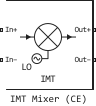
Mixer model with the usage of intermodulation table (IMT).
blockType: SubSystem
|
Path in the library: |
Description
Block IMT Mixer (CE) It is used to perform the frequency conversion defined in the intermodulation table (see [1], [2]) for a single-tone carrier signal mixed with a reference oscillator (LO) signal. The block takes into account nonlinear amplification , as well as parasitic components. For a single-tone carrier signal , nonlinearly modulated by a reference oscillator signal with a frequency of intermodulation components at the output of the mixer occur at frequencies:
Where
-
— the carrier frequency of the input radio frequency (RF) signal;
-
— frequency of the reference generator;
-
and — non - negative integers (from
0up to the order of nonlinearity);
The main harmonics can be considered . All other combinations and they are parasitic intermodulation components.
Ports
Conserving
#
In+
—
RF input signal
electricity
Details
A positive electrical port connected to the RF input signal.
| Program usage name |
|
#
In-
—
RF input signal
electricity
Details
A negative electrical port connected to the RF input signal.
| Program usage name |
|
#
Out+
—
The output signal
electricity
Details
A positive electrical port connected to the output signal.
| Program usage name |
|
#
Out-
—
The output signal
electricity
Details
The negative electrical port connected to the output signal.
| Program usage name |
|
Parameters
Main
Main
# Carrier frequency, Hz — carrier frequency
Details
The carrier frequency in Hz, set as a scalar. When multiple carriers are present at the input connection, the carrier frequency set in this parameter is selected as the RF input signal. The distance between adjacent carriers must be greater than .
| Default value |
|
| Program usage name |
|
| Tunable |
No |
| Evaluatable |
Yes |
# Local oscillator frequency, Hz — frequency of the reference oscillator
Details
The frequency of the reference oscillator in Hz, set as a scalar.
| Default value |
|
| Program usage name |
|
| Tunable |
No |
| Evaluatable |
Yes |
# Reference input power, dBm — reference input power
Details
The reference input power in dBm, set as a scalar. The expression for the normalized input signal at a given reference input power has the form:
where — parameter value Reference input power, dBm.
The intermodulation tables assume that the levels of parasitic components are measured for reference input and output power. For example, if you increase the input power by 10 dB, then the parasitic components caused by second-order nonlinearity will increase by 20 dB, and the parasitic components caused by third—order nonlinearity are 30 dB and so on.
| Default value |
|
| Program usage name |
|
| Tunable |
No |
| Evaluatable |
Yes |
# Nominal output power, dBm — rated power of the reference generator
Details
Rated output power in dBm, set as a scalar. The expression for the normalized output signal at a given reference input power has the form:
where — parameter value Nominal output power, dBm.
| Default value |
|
| Program usage name |
|
| Tunable |
No |
| Evaluatable |
Yes |
# Input impedance, Ohm — mixer input resistance
Details
The input resistance of the mixer in ohms, set as a real scalar.
For input and output resistances not equal 50 Ohms, the IMT data is normalized to 50 Om.
|
| Default value |
|
| Program usage name |
|
| Tunable |
No |
| Evaluatable |
Yes |
# Output impedance, Ohm — mixer output resistance
Details
The output resistance of the mixer in ohms, set as a real scalar.
For input and output resistances not equal 50 Ohms, the IMT data is normalized to 50 Om.
|
| Default value |
|
| Program usage name |
|
| Tunable |
No |
| Evaluatable |
Yes |
IMT
IMT
# IM Table — inharmonic spectral components
Details
Inharmonic spectral components of IMT, defined as a square matrix.
| Default value |
|
| Program usage name |
|
| Tunable |
No |
| Evaluatable |
Yes |
Literature
-
Faria, Daniel. Lawrence Dunleavy, and Terje Svensen. The Use of Intermodulation Tables for Mixer Simulations. Microwave Journal, April 2002. https://www.microwavejournal.com/articles/3430-the-use-of-intermodulation-tables-for-mixer-simulations
-
RF Mixing / Multiplication: Frequency Mixers. Electronic Notes. https://www.electronics-notes.com/articles/radio/rf-mixer/rf-mixing-basics.php