Sun-Planet Worm Gear
A planetary gear train consisting of a carrier, a worm gear and a solar gear, with an adjustable gear ratio, type of worm thread and friction losses.
blockType: Engee1DMechanical.Transmission.Gears.Planetary.Auxiliary.SunPlanetWorm
|
Path in the library: |
Description
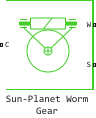
Block Sun-Planet Worm Gear It is a planetary gear with two degrees of freedom, consisting of a carrier, solar and planetary gears. By type, the solar and planetary gears are crossed oblique cylindrical gears arranged in the form of a worm gear, in which the planetary gear is a worm. Such gears are used in the Torsen® T-1 differential. When transmitting power, the solar gear can rotate independently of the worm (planetary) gear, the carrier, or both of them.
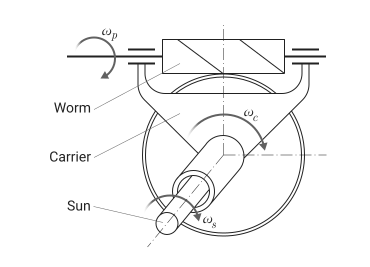
A fixed gear ratio is set in the block parameters, which is defined as the ratio of the angular velocity of the worm and the angular velocity of the solar gear. The direction of rotation is also set according to the type of worm thread: left or right. The rotation of the right worm in the positive direction causes the sun gear to rotate in the positive direction. The positive directions of rotation of the sun gear and the driver coincide.
The thermal model
You can simulate the effects of heat flow and temperature changes by turning on an additional heat port. To use the thermal port, set the parameter Friction model meaning Temperature-dependent efficiency.
The equations
The following variables are used in the equations:
-
— the gear ratio, which determines the ratio of the angular velocity of the worm to the angular velocity of the solar gear: the ratio is positive for the right worm and negative for the left;
-
— angular velocity of the solar gear;
-
— angular velocity of the worm gear;
-
— angular velocity of the driver;
-
— angular velocity of the solar gear relative to the driver;
-
— normal pressure angle;
-
— thread lifting angle;
-
— the thread stroke of the worm;
-
— the average diameter of the worm thread;
-
— torque on the solar shaft;
-
— torque on the planetary shaft;
-
— torque on the bearing shaft;
-
— torque due to friction in the engagement: losses depend on the efficiency of the device and the direction of the power flow. To avoid sudden changes in the moment of friction when , the friction torque is introduced using a hyperbolic function;
-
— the instantaneous value of the friction moment used to simulate friction losses;
-
— the moment of friction in steady state;
-
— losses during transmission of torque;
-
— coefficient of friction;
-
— EFFICIENCY of torque transmission from worm to gear;
-
— The efficiency of the transmission of torque from the gear to the worm;
-
— power threshold value;
-
— coefficient of viscous friction between the solar gear and the driver;
-
— coefficient of viscous friction between the worm and the driver.
_ Limits for ideal gear transmission and gear ratio_
Block Sun-Planet Worm Gear imposes one kinematic constraint on three connected axes:
The transmission has two independent degrees of freedom. The transmission pair has the following symbol .
The transmission of torque is carried out as follows:
Ideally, when there is no loss of torque, .
not ideal transfer
In an imperfect case . For more information, see the article Modeling of mechanical gears with losses.
In an imperfect transmission, the angular velocity and geometric constraints remain unchanged, but the transmitted torque and power are reduced by:
-
Coulomb friction when the worm engages with the solar gear, which is characterized by the coefficient of friction or constant efficiencies ;
-
viscous friction of the coupling of drive shafts with bearings, which is characterized by viscous friction coefficients and .
Since the transmission uses a worm gear, the efficiencies for forward and reverse power transmission are different. The table shows the efficiency values for all power transmission combinations.
Drive shaft |
Driven Shaft |
||
Planetary Gear |
Solar Gear |
Driver |
|
Planetary gear |
N/A |
|
|
Solar gear |
|
N/A |
No losses |
Driver |
|
No losses |
N/A |
geometric surface contact friction
If for the parameter Friction model set the value Constant efficiency, and for Friction parameterization set the value Friction coefficient and geometrical parameters, then the model takes into account the geometric friction at the contact of the surfaces. In this case and defined by:
-
the geometry of the worm gear thread, determined by the lifting angle and the normal pressure angle ;
-
coefficient of surface contact friction .
constant EFFICIENCY
If for the parameter Friction model set the value Constant efficiency, and for Friction parameterization set the value Efficiencies, or for Friction model set the value Temperature-dependent efficiency, then the model considers efficiency as a constant value. In this case, you specify and regardless of the geometric features.
_ Self-locking and negative efficiency_
You can enable self-locking by setting the efficiency to negative. Power cannot be transferred from the solar gear to the worm or from the driver to the worm unless torque is applied to the worm to unlock the gear train. In this case, the absolute efficiency value determines the gear ratio at which the decoupling occurs. The smaller the lifting angle of the thread, the lower the efficiency of the reverse stroke.
CPE of engagement
Gearing efficiency The distance between the worm gear and the planetary gear is maximum only if the transmitted power exceeds the threshold value.
If the power is less than the threshold value, the actual efficiency is automatically adjusted to unity at zero speed.
Viscous friction force_
The viscous friction coefficients of the worm-carrier and solar gear-carrier bearings determine the viscous friction torque generated in the transmission gear due to the lubricated imperfect gear thread. For more information, see Imperfect transmission.
Simulation in a hardware loop
For optimal performance of your real-time simulation, set the parameter Friction model meaning No meshing losses - Suitable for HIL simulation.
Assumptions and limitations
-
The inertia of the gear gears is negligible.
-
Gears are treated as solids.
-
Coulomb friction slows down the simulation. For more information, see here.
Ports
Conserving
#
W
—
worm gear
rotational mechanics
Details
A non-directional port connected to a worm gear.
| Program usage name |
|
#
C
—
The planetary transmission driver
rotational mechanics
Details
A non-directional port connected to the planetary transmission carrier.
| Program usage name |
|
#
S
—
The solar gear
rotational mechanics
Details
A non-directional port connected to the solar gear.
| Program usage name |
|
#
H
—
heat flow
warm
Details
A non-directional port connected to the heat flow.
The heat flow affects the transmission efficiency by changing the temperature of the gears.
Dependencies
To use this port, set the parameter Friction model meaning Temperature-dependent efficiency.
| Program usage name |
|
Parameters
Meshing Losses
# Worm-gear efficiency — EFFICIENCY of torque transmission from worm gear to solar gear
Details
Relationship output power to input, describing the flow of power from a worm gear to a solar one.
If for the parameter Friction model the value is set Constant efficiency, then specify the value Worm-gear efficiency in the form of a scalar.
If for the parameter Friction model the value is set Temperature-dependent efficiency then specify the value Worm-gear efficiency in the form of a vector. The values of the vector are the efficiency at the corresponding temperature values in the parameter Temperature. Both vectors must be the same size. Each element of the vector Worm-gear efficiency must be in the range of (0, 1].
Dependencies
To use this parameter, set for the parameter Friction model meaning Constant efficiency or Temperature-dependent efficiency.
| Default value |
|
| Program usage names |
|
| Evaluatable |
Yes |
#
Power threshold —
minimum power threshold value
W | uW | mW | kW | MW | GW | V*A | HP_DIN
Details
Power threshold value , when exceeded, the value of the total torque transmission efficiency is applied. If the value is lower than the specified value, the efficiency value is smoothed using the hyperbolic tangent function.
-
If for the parameter Friction model the value is set
Constant efficiencyThe unit reduces losses to zero when no power is transmitted. -
If for the parameter Friction model the value is set
Temperature-dependent efficiencyThe unit smooths the efficiency in the range from zero at rest to the values provided by the interpolation tables for matching temperature and efficiency at power thresholds.
Dependencies
To use this parameter, set for the parameter Friction model meaning Constant efficiency or Temperature-dependent efficiency.
| Units |
|
| Default value |
|
| Program usage name |
|
| Evaluatable |
Yes |
# Gear-worm efficiency — The efficiency of torque transmission from the solar gear to the worm gear
Details
Relationship output power to input, describing the power flow from the solar gear to the worm gear.
If for the parameter Friction model the value is set Constant efficiency, then specify the value Gear-worm efficiency in the form of a scalar.
If for the parameter Friction model the value is set Temperature-dependent efficiency, then specify the value Gear-worm efficiency in the form of a vector. The values of the vector are the efficiency at the corresponding temperature values in the parameter Temperature. Both vectors must be the same size. Each element of the vector Gear-worm efficiency must be in the range of (0, 1].
Dependencies
To use this parameter, set for the parameter Friction model meaning Constant efficiency or Temperature-dependent efficiency.
| Default value |
|
| Program usage names |
|
| Evaluatable |
Yes |
#
Friction parameterization —
the friction parameterization method
Friction coefficient and geometrical parameters | Efficiencies
Details
A method for determining the friction between gears:
-
Friction coefficient and geometrical parameters— friction is determined by the contact friction between the surfaces; -
Efficiencies— friction is determined by constant efficiency .
Dependencies
To use this parameter, set for the parameter Friction model meaning Constant efficiency.
| Values |
|
| Default value |
|
| Program usage name |
|
| Evaluatable |
No |
#
Normal pressure angle —
normal pressure angle
rad | deg | rev | mrad | arcsec | arcmin | gon
Details
Pressure angle on the thread in the normal plane. The value must be in the range (0°, 90°).
Dependencies
To use this parameter, set for the parameter Friction model meaning Constant efficiency, and for the parameter Friction parameterization meaning Friction coefficient and geometrical parameters.
| Units |
|
| Default value |
|
| Program usage name |
|
| Evaluatable |
Yes |
# Friction coefficient — coefficient of friction of the thread
Details
The dimensionless coefficient of normal friction in the thread. The value must be greater than zero.
Dependencies
To use this parameter, set for the parameter Friction model meaning Constant efficiency, and for the parameter Friction parameterization meaning Friction coefficient and geometrical parameters.
| Default value |
|
| Program usage name |
|
| Evaluatable |
Yes |
#
Friction model —
the friction model
No meshing losses - Suitable for HIL simulation | Constant efficiency | Temperature-dependent efficiency
Details
The friction model:
-
No meshing losses - Suitable for HIL simulation— gear engagement is considered ideal. -
Constant efficiency— the transmission of torque between pairs of gears is reduced by a constant amount of efficiency , such that . -
Temperature-dependent efficiency— the transmission of torque between pairs of gears is determined according to the interpolation table of the dependence of efficiency on temperature.
| Values |
|
| Default value |
|
| Program usage name |
|
| Evaluatable |
No |
#
Lead angle —
thread lifting angle
rad | deg | rev | mrad | arcsec | arcmin | gon
Details
Thread lifting angle , where — the thread stroke of the worm, and — the average diameter of the worm thread. This value must be greater than zero.
Dependencies
To use this parameter, set for the parameter Friction model meaning Constant efficiency, and for the parameter Friction parameterization meaning Friction coefficient and geometrical parameters.
| Units |
|
| Default value |
|
| Program usage name |
|
| Evaluatable |
Yes |
#
Temperature —
vector of temperature values
K | degC | degF | degR | deltaK | deltadegC | deltadegF | deltadegR
Details
A vector of temperature values used to construct an interpolation table of temperature and torque transmission efficiency. The elements of the vector should increase monotonously.
Dependencies
To use this parameter, set for the parameter Friction model meaning Temperature-dependent efficiency.
| Units |
|
| Default value |
|
| Program usage name |
|
| Evaluatable |
Yes |
Main
# Gear ratio — Gear ratio
Details
Relationship the angular velocity of the worm gear is relative to the angular velocity of the solar gear. The value must be strictly positive.
| Default value |
|
| Program usage name |
|
| Evaluatable |
Yes |
#
Worm thread type —
direction of thread rotation
Right-hand | Left-hand
Details
The direction of the worm’s positive rotation. If you choose Left-hand then the positive rotation of the worm leads to a negative rotation of the gear.
| Values |
|
| Default value |
|
| Program usage name |
|
| Evaluatable |
No |
Thermal port
#
Thermal mass —
heat capacity
J/K | kJ/K
Details
The thermal energy required to change the temperature of a component by one degree. The higher the heat capacity, the more resistant the component is to temperature changes.
Dependencies
To use this parameter, set for the parameter Friction model meaning Temperature-dependent efficiency.
| Units |
|
| Default value |
|
| Program usage name |
|
| Evaluatable |
Yes |
Viscous Losses
#
Worm-carrier and sun-carrier viscous friction coefficients —
coefficients of viscous friction between gears
N*m*s/rad | mN*m*s/rad | kN*m*s/rad | kgf*m*s/rad | lbf*ft*s/rad
Details
Two-element vector of viscous friction coefficients , where
-
— coefficient of viscous friction between the solar gear and the driver;
-
— coefficient of viscous friction between the worm and the driver.
| Units |
|
| Default value |
|
| Program usage name |
|
| Evaluatable |
Yes |