Transmission
Abstract transmission for modeling the drive mechanism at the system level.
blockType: Engee1DMechanical.Transmission.Abstract
|
Path in the library: |
Description
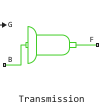
Block Transmission It represents an abstract transmission for models of drive mechanisms at the system level. The block takes the gear ratio as a scalar signal to port G, where 0 indicates neutral, −1 — reverse gear, and the parameter values Forward gear ratios they represent forward gears. The length of this vector corresponds to the number of forward gears. The block rounds the input values to integers. The transmission is non-sequential, which allows you to switch between any two gear ratios without stopping at intermediate values. In order for the unit to work as a sequential transmission, each gear ratio must be set in sequence.
Block Transmission It is a combination of two blocks. The block uses a sub-component version of the block Variable Ratio Transmission to simulate the dynamics of transmission gear ratios and the block Logic-Controlled Clutch for modeling abstract coupling dynamics.
Ports
Conserving
#
F
—
driven shaft
rotational mechanics
Details
A non-directional port connected to the driven shaft.
| Program usage name |
|
#
H
—
heat flow
heat
Details
A non-directional port connected to the heat flow.
Dependencies
To use this port, check the box Thermal port.
| Program usage name |
|
#
B
—
drive shaft
rotational mechanics
Details
A non-directional port connected to the drive shaft.
| Program usage name |
|
Input
#
G
—
transmission selection
scalar
Details
The input signal associated with the transmission selection. The input signal, where 0 denotes neutral, −1 — reverse gear, and parameter values Forward gear ratios they represent forward gears. The block limits the signal from −1 up to the value of the vector length Forward gear ratios.
| Data types |
|
| Complex numbers support |
I don’t |
Parameters
Thermal Port
#
Initial temperature —
temperature at the beginning of the simulation
K | degC | degF | degR | deltaK | deltadegC | deltadegF | deltadegR
Details
The temperature of the component at the beginning of the simulation of heat flow and temperature changes.
Dependencies
To use this option, check the box Thermal port.
| Units |
|
| Default value |
|
| Program usage name |
|
| Evaluatable |
Yes |
# Thermal port — activating the thermal port
Details
The ability to activate the thermal port H and its associated parameters.
| Default value |
|
| Program usage name |
|
| Evaluatable |
No |
#
Thermal mass —
heat capacity
J/K | kJ/K
Details
The thermal energy required to change the temperature of a component by one degree. The higher the heat capacity, the more resistant the component is to temperature changes.
Dependencies
To use this option, check the box Thermal port.
| Units |
|
| Default value |
|
| Program usage name |
|
| Evaluatable |
Yes |
Clutch
#
Initial state —
the state of coupling at the beginning of the simulation
Unlocked | Locked
Details
The ability to start the simulation with the clutch unlocked or locked.
| Values |
|
| Default value |
|
| Program usage name |
|
| Evaluatable |
No |
#
Shift model —
the ability to turn on the end switching time
Instantaneous | Finite shift time
Details
An option that allows you to choose between instant gearshift and switching the unit to the neutral position in a finite amount of time.
| Values |
|
| Default value |
|
| Program usage name |
|
| Evaluatable |
No |
#
Shift time —
the time spent in the neutral position between gears
s | ns | us | ms | min | hr | d
Details
The time it takes to complete the gear shift. During this time, the transmission remains in the neutral position.
Dependencies
To use this parameter, set for the parameter Shift model meaning Finite shift time.
| Units |
|
| Default value |
|
| Program usage name |
|
| Evaluatable |
Yes |
#
Clutch velocity tolerance —
minimum angular velocity of coupling
rad/s | deg/s | rad/min | deg/min | rpm | rps
Details
Minimum angular velocity of the clutch.
| Units |
|
| Default value |
|
| Program usage name |
|
| Evaluatable |
Yes |
#
Kinetic friction torque —
threshold value of the kinetic friction moment
N*m | uN*m | mN*m | kN*m | MN*m | GN*m | kgf*m | lbf*in | lbf*ft
Details
The minimum threshold torque required to maintain relative motion between the clutch discs.
| Units |
|
| Default value |
|
| Program usage name |
|
| Evaluatable |
Yes |
#
Static friction torque —
threshold value of the moment of static friction
N*m | uN*m | mN*m | kN*m | MN*m | GN*m | kgf*m | lbf*in | lbf*ft
Details
The minimum amount of torque required for the relative movement between the clutch discs.
| Units |
|
| Default value |
|
| Program usage name |
|
| Evaluatable |
Yes |
Gears
#
Follower power threshold —
minimum threshold power value
W | uW | mW | kW | MW | GW | V*A | HP_DIN
Details
The absolute value of the power of the driven shaft, when exceeded, the maximum efficiency values are applied.
Dependencies
To use this parameter, set for the parameter Friction model meaning Constant efficiency or Gear-dependent efficiencies.
| Units |
|
| Default value |
|
| Program usage name |
|
| Evaluatable |
Yes |
#
Stiffness at base (B) —
drive shaft stiffness coefficient
N*m/rad | mN*m/rad | kN*m/rad | kgf*m/rad | lbf*ft/rad | N*m/deg | mN*m/deg | kN*m/deg | kgf*m/deg | lbf*ft/deg | W*s/rad | HP_DIN/rpm | HP_DIN*s/rad
Details
The value is the inverse of the angular compliance of the transmission, measured for the drive shaft.
| Units |
|
| Default value |
|
| Program usage name |
|
| Evaluatable |
Yes |
# Forward gear ratios — gear ratios of the front gears
Details
An ordered vector of transmission gear ratios. The block uses the position of each element in the vector to assign this element to a given input signal. An arbitrary number of gear ratios can be parameterized.
| Default value |
|
| Program usage name |
|
| Evaluatable |
Yes |
#
Damping at base (B) —
damping coefficient of the drive shaft
N*m*s/rad | mN*m*s/rad | kN*m*s/rad | kgf*m*s/rad | lbf*ft*s/rad
Details
The inverse of the angular damping of the transmission measured for the drive shaft.
| Units |
|
| Default value |
|
| Program usage name |
|
| Evaluatable |
Yes |
# Efficiency vector — efficiency values depending on the gear ratio
Details
A vector of efficiency values depending on the gear ratio, where each element corresponds to the gear ratio in the parameter Forward gear ratios.
Dependencies
To use this parameter, set for the parameter Friction model meaning Gear-dependent efficiencies.
| Default value |
|
| Program usage name |
|
| Evaluatable |
Yes |
# Reverse efficiency — reverse gear efficiency value
Details
The efficiency that the unit provides when the reverse gear is switched on.
| Default value |
|
| Program usage name |
|
| Evaluatable |
Yes |
#
Viscous friction coefficients at base (B) and follower (F) —
coefficients of viscous friction between shafts
N*m*s/rad | mN*m*s/rad | kN*m*s/rad | kgf*m*s/rad | lbf*ft*s/rad
Details
A two-element vector of values of viscous friction coefficients for the movement of the drive and driven shafts, respectively.
| Units |
|
| Default value |
|
| Program usage name |
|
| Evaluatable |
Yes |
#
Initial input torque at base (B) —
initial torque on the drive shaft
N*m | uN*m | mN*m | kN*m | MN*m | GN*m | kgf*m | lbf*in | lbf*ft
Details
The torque applied to the drive shaft at the beginning of the simulation.
| Units |
|
| Default value |
|
| Program usage name |
|
| Evaluatable |
Yes |
#
Friction model —
the friction model
No losses - Suitable for HIL simulation | Constant efficiency | Gear-dependent efficiencies
Details
The model of friction losses during engagement:
-
No losses - Suitable for HIL simulation— gearing losses are not taken into account. -
Constant efficiency— the parameter value is set Efficiency which remains constant throughout the simulation. In accordance with it, the block reduces the transmission of torque between all pairs of gears. -
Gear-dependent efficiencies— determination of the transmission of torque between pairs of gears using the parameter value Efficiency vector.
| Values |
|
| Default value |
|
| Program usage name |
|
| Evaluatable |
No |
# Efficiency — Transmission EFFICIENCY
Details
The transmission efficiency that the unit provides for all gear ratios.
Dependencies
To use this parameter, set for the parameter Friction model meaning Constant efficiency.
| Default value |
|
| Program usage name |
|
| Evaluatable |
Yes |
# Reverse gear ratio — reverse gear ratio
Details
The gear ratio of the rear transmission.
Dependencies
To use this parameter, set for the parameter Friction model meaning Gear-dependent efficiencies.
| Default value |
|
| Program usage name |
|
| Evaluatable |
Yes |