Development of a simulation model of the ventilation and recirculation system of a passenger aircraft
In the process of designing aircraft life support systems, the assessment of the distribution of impurities and humidity in the passenger cabin plays a key role. This work is devoted to the creation of a simulation model of a ventilation and air recirculation system, focused on analyzing the dynamics of the accumulation of co₂ and water vapor. The model reproduces the geometric and flow characteristics of a Superjet 100 aircraft cabin at a fixed temperature field of 23°C.
Model structure and parameters
The geometric part of the model represents the interior as a sequential connection of eighteen volumes (Constant Volume Chamber) by each with a cross-section between the rows .
The inlet tank simulates the air already prepared for the cabin, therefore it has a relative humidity of 30%, an initial mass fraction of Co₂ equal to 0.0004 and a temperature of 23 °C.
The sources of impurities in each chamber simulate the vital activity of a number of four passengers: the mass fraction of Co₂ is 0.0004 rel. units, the intensity of moisture release is 0.04 g/s. Fresh air is supplied by a 0.3 kg/s pump, the exhaust pump has the same flow rate. The recirculation circuit (30%) is implemented by a 0.09 kg/s pump with flow return to the inlet.
The thermal model is simplified — the air temperature in each row of seats (in each control volume) is considered stable at 23°C.
engee.open( "$(@__DIR__)/" * "cabin_air_recirculation_model.engee");
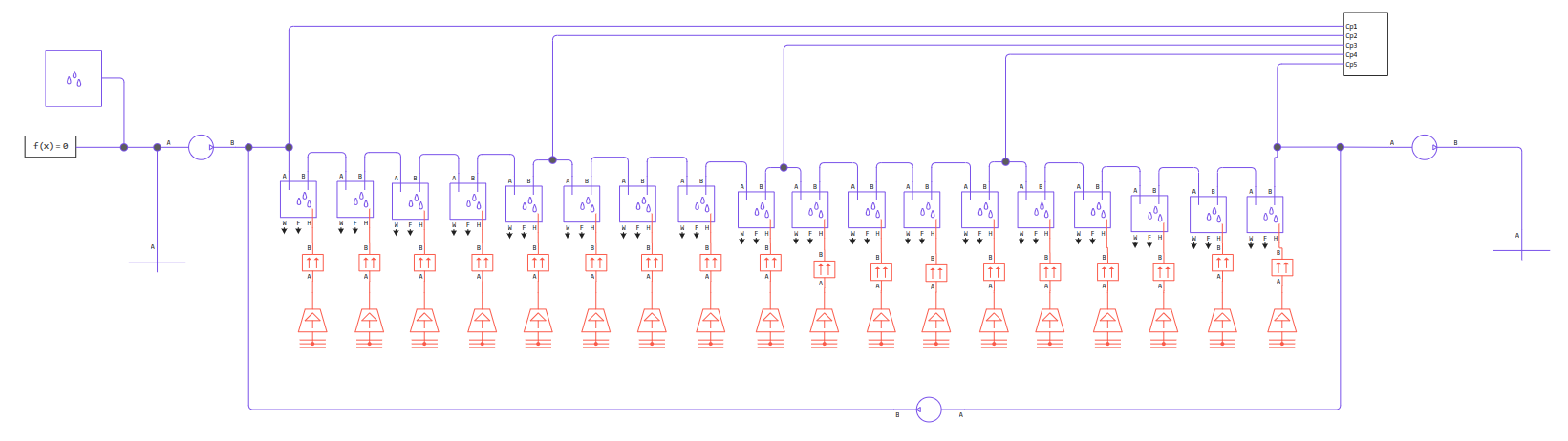
Damping convection units with very high thermal conductivity have been added after the temperature sources.
In addition, all pumps have disabled isentropic operation accounting models so that they do not calculate air heating during pumping.
Simulation results
We will get data on the model execution:
data = engee.run( "cabin_air_recirculation_model" );
And let's build graphs:
co2_content = collect(data["Impurities"]);
humidity = collect(data["Humidity"]);

plot(
    plot( co2_content.time, reduce(hcat, co2_content.value)', title="Content of CO₂",
    label=["Row 1" "Row 6" "Row 10" "Row 14" "Row 18"], lw=3, xlabel="Time, from", ylabel="Mass fraction of CO2"),
    plot( humidity.time, reduce(hcat, humidity.value)', title="Humidity in the cabin", label=false, lw=3,
    xlabel="Time, from", ylabel="Relative humidity"),
    guidefont=font(8)
)
Simulation over an interval of 10,000 seconds (approximately 2.8 hours) showed that the co₂ concentration reached steady state after 2000 s.
The mass fraction of Co₂ before the first row stabilized at 0.00076 (0.76 g/kg), after the eighteenth row — 0.0015 (1.5 g/kg), which corresponds to a volume concentration of 0.1% and is within the limits of sanitary standards.
The relative humidity in the system reached 30% in the first row and 27% in the last, which confirms the adequacy of the selected moisture release rates.
Conclusion
The created simulation model of the ventilation and recirculation system makes it possible to predict the gas composition in the passenger compartment with an accuracy acceptable for engineering tasks. The interest of the development lies in the possibility of exploring various scenarios (changes in the number of passengers, the proportion of recirculation, the parameters of the air conditioning system) without the cost of field experiments. The proposed formula provides a conservative estimate of the expected concentrations and can be used for preliminary design of gas composition systems.