Voltage Transformer (Three-Phase)
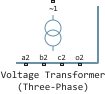
Three-phase voltage transformer (TN).
blockType: AcausalElectricPowerSystems.Passive.Transformers.ThreePhaseVoltage
|
Path in the library: |
Description
Block Voltage Transformer (Three-Phase) It is a multi-winding transformer that can be modeled as a three-phase voltage transformer with various levels of nonlinearity.
Parameter Group Initial Conditions It is used to set the initial current or flow for each of the inductors. Note that these values are not used if in the solver configuration Solver Configuration the flag is selected Start simulation from steady state.
Parameter Group Parasitic it represents small parasitic effects. Small parallel conductivities may be required to model some circuit topologies.
For more information about the equations and modes implemented in the block, see Nonlinear Transformer.
Ports
Conserving
#
~1
—
three-phase port
electricity
Details
A three-phase electrical port corresponding to the first winding of the transformer.
| Program usage name |
|
#
a2
—
terminal of the second winding of phase a
electricity
Details
The electrical port corresponding to the terminal of the second winding of phase a.
Dependencies
To use this port, set the parameter Winding 2 connection meaning Wye with zero port.
| Program usage name |
|
#
b2
—
terminal of the second winding of phase b
electricity
Details
The electrical port corresponding to the terminal of the second winding of phase b.
Dependencies
To use this port, set the parameter Winding 2 connection meaning Wye with zero port.
| Program usage name |
|
#
c2
—
terminal of the second phase winding c
electricity
Details
The electrical port corresponding to the terminal of the second winding of phase c.
Dependencies
To use this port, set the parameter Winding 2 connection meaning Wye with zero port.
| Program usage name |
|
#
o2
—
neutral port of the second winding
electricity
Details
The neutral port of the second winding.
Dependencies
To use this port, set the parameter Winding 2 connection meaning Wye with zero port.
| Program usage name |
|
#
a2+
—
the positive terminal of the second winding of phase a
electricity
Details
The electrical port corresponding to the positive terminal of the second winding of phase a.
Dependencies
To use this port, set the parameter Winding 2 connection meaning Expanded port.
| Program usage name |
|
#
a2–
—
negative terminal of the second winding of phase a
electricity
Details
The electrical port corresponding to the negative terminal of the second winding of phase a.
Dependencies
To use this port, set the parameter Winding 2 connection meaning Expanded port.
| Program usage name |
|
#
b2+
—
the positive terminal of the second winding of phase b
electricity
Details
The electrical port corresponding to the positive terminal of the second winding of phase b.
Dependencies
To use this port, set the parameter Winding 2 connection meaning Expanded port.
| Program usage name |
|
#
b2–
—
the negative terminal of the second winding of phase b
electricity
Details
The electrical port corresponding to the negative terminal of the second winding of phase b.
Dependencies
To use this port, set the parameter Winding 2 connection meaning Expanded port.
| Program usage name |
|
#
c2+
—
positive terminal of the second phase winding c
electricity
Details
The electrical port corresponding to the positive terminal of the second winding of phase c.
Dependencies
To use this port, set the parameter Winding 2 connection meaning Expanded port.
| Program usage name |
|
#
c2–
—
negative terminal of the second phase winding c
electricity
Details
The electrical port corresponding to the negative terminal of the second winding of phase c.
Dependencies
To use this port, set the parameter Winding 2 connection meaning Expanded port.
| Program usage name |
|
#
H2
—
output of H(H) the open triangle of the second winding
electricity
Details
Output of H(H) the open triangle of the second winding
Dependencies
To use this port, set the parameter Winding 2 connection meaning Broken delta.
| Program usage name |
|
#
K2
—
output of K(K) the open triangle of the second winding
electricity
Details
Output of K(K) the open triangle of the second winding.
Dependencies
To use this port, set the parameter Winding 2 connection meaning Broken delta.
| Program usage name |
|
#
F2
—
output F(F) of the open triangle of the second winding
electricity
Details
Output F(F) of the open triangle of the second winding
Dependencies
To use this port, set the parameter Winding 2 connection meaning Broken delta.
| Program usage name |
|
#
U2
—
output of U(I) the open triangle of the second winding
electricity
Details
Output of U(I) the open triangle of the second winding
Dependencies
To use this port, set the parameter Winding 2 connection meaning Broken delta.
| Program usage name |
|
#
n1
—
neutral port of the first winding
electricity
Details
The neutral port of the first winding.
Dependencies
To use this port, set the parameter Winding 1 connection meaning Wye with neutral port.
| Program usage name |
|
#
a3+
—
the positive terminal of the third winding of phase a
electricity
Details
The electrical port corresponding to the positive terminal of the third winding of phase a.
Dependencies
To use this port, set the parameter Number of windings meaning Three, and for the parameter Winding 3 connection meaning Expanded port.
| Program usage name |
|
#
a3–
—
the negative terminal of the third winding of phase a
electricity
Details
The electrical port corresponding to the negative terminal of the third winding of phase a.
Dependencies
To use this port, set the parameter Number of windings meaning Three, and for the parameter Winding 3 connection meaning Expanded port.
| Program usage name |
|
#
b3+
—
the positive terminal of the third winding of phase b
electricity
Details
The electrical port corresponding to the positive terminal of the third winding of phase b.
Dependencies
To use this port, set the parameter Number of windings meaning Three, and for the parameter Winding 3 connection meaning Expanded port.
| Program usage name |
|
#
b3–
—
the negative terminal of the third winding of phase b
electricity
Details
The electrical port corresponding to the negative terminal of the third winding of phase b.
Dependencies
To use this port, set the parameter Number of windings meaning Three, and for the parameter Winding 3 connection meaning Expanded port.
| Program usage name |
|
#
c3+
—
the positive terminal of the third winding of phase c
electricity
Details
The electrical port corresponding to the positive terminal of the third winding of phase c.
Dependencies
To use this port, set the parameter Number of windings meaning Three, and for the parameter Winding 3 connection meaning Expanded port.
| Program usage name |
|
#
c3–
—
the negative terminal of the third winding of the c phase
electricity
Details
The electrical port corresponding to the negative terminal of the third winding of phase c.
Dependencies
To use this port, set the parameter Number of windings meaning Three, and for the parameter Winding 3 connection meaning Expanded port.
| Program usage name |
|
#
a3
—
terminal of the third winding of phase a
electricity
Details
The electrical port corresponding to the terminal of the third winding of phase a.
Dependencies
To use this port, set the parameter Number of windings meaning Three, and for the parameter Winding 3 connection meaning Wye with zero port.
| Program usage name |
|
#
b3
—
terminal of the third winding of phase b
electricity
Details
The electrical port corresponding to the terminal of the third winding of phase b.
Dependencies
To use this port, set the parameter Number of windings meaning Three, and for the parameter Winding 3 connection meaning Wye with zero port.
| Program usage name |
|
#
c3
—
terminal of the third winding of phase c
electricity
Details
The electrical port corresponding to the terminal of the third winding of phase c.
Dependencies
To use this port, set the parameter Number of windings meaning Three, and for the parameter Winding 3 connection meaning Wye with zero port.
| Program usage name |
|
#
o3
—
neutral port of the third winding
electricity
Details
The neutral port of the third winding.
Dependencies
To use this port, set the parameter Number of windings meaning Three, and for the parameter Winding 3 connection meaning Wye with zero port.
| Program usage name |
|
#
H3
—
output of H(H) the open triangle of the third winding
electricity
Details
Output of H(H) the open triangle of the third winding.
Dependencies
To use this port, set the parameter Number of windings meaning Three, and for the parameter Winding 3 connection meaning Broken delta.
| Program usage name |
|
#
K3
—
output of K(K) the open triangle of the third winding
electricity
Details
Output of K(K) the open triangle of the third winding.
Dependencies
To use this port, set the parameter Number of windings meaning Three, and for the parameter Winding 3 connection meaning Broken delta.
| Program usage name |
|
#
F3
—
output F(F) of the open triangle of the third winding
electricity
Details
Pin F(F) of the open triangle of the third winding.
Dependencies
To use this port, set the parameter Number of windings meaning Three, and for the parameter Winding 3 connection meaning Broken delta.
| Program usage name |
|
#
U3
—
output of U(I) the open triangle of the third winding
electricity
Details
Output of U(I) the open triangle of the third winding.
Dependencies
To use this port, set the parameter Number of windings meaning Three, and for the parameter Winding 3 connection meaning Broken delta.
| Program usage name |
|
Parameters
Main
#
Number of windings —
switching between a two-winding and a three-winding transformer
Two | Three
Details
Switching between a two-winding and a three-winding transformer.
| Values |
|
| Default value |
|
| Program usage name |
|
| Evaluatable |
No |
#
Turns ratio parameterization by —
the option of setting the transformation coefficient TN
Number of turns
Details
Choose one of the following methods for setting the TN transformation coefficient:
-
Number of turns— through the number of turns.
| Values |
|
| Default value |
|
| Program usage name |
|
| Evaluatable |
No |
#
Winding 1 connection —
connection diagram of the first windings
Wye with floating neutral | Wye with neutral port | Wye with grounded neutral
Details
Choose the connection scheme of the first windings:
-
Wye with floating neutral; -
Wye with neutral port; -
Wye with grounded neutral.
| Values |
|
| Default value |
|
| Program usage name |
|
| Evaluatable |
No |
# First winding number of turns — number of turns of the first winding
Details
The number of turns of the wire of the first transformer winding.
Dependencies
To use this parameter, set for the parameter Turns ratio parameterization by meaning Number of turns.
| Default value |
|
| Program usage name |
|
| Evaluatable |
Yes |
#
Winding 2 connection —
connection diagram of the second winding
Expanded port | Wye with zero port | Broken delta
Details
Select the connection scheme of the second winding:
-
Expanded port; -
Wye with zero port; -
Broken delta.
| Values |
|
| Default value |
|
| Program usage name |
|
| Evaluatable |
No |
# Second winding number of turns — number of turns of the second winding
Details
The number of turns of the wire of the second transformer winding.
Dependencies
To use this parameter, set for the parameter Turns ratio parameterization by meaning Number of turns.
| Default value |
|
| Program usage name |
|
| Evaluatable |
Yes |
#
Winding 3 connection —
connection diagram of the third winding
Expanded port | Wye with zero port | Broken delta
Details
Select the connection scheme of the third winding:
-
Expanded port; -
Wye with zero port; -
Broken delta.
| Values |
|
| Default value |
|
| Program usage name |
|
| Evaluatable |
No |
# Third winding number of turns — number of turns of the third winding
Details
The number of turns of the wire of the third transformer winding.
Dependencies
To use this parameter, set for the parameter Turns ratio parameterization by meaning Number of turns.
| Default value |
|
| Program usage name |
|
| Evaluatable |
Yes |
#
Winding parameterized by —
type of windings scattering representation
Combined primary and secondary values | Separate primary and secondary values
Details
The method of scattering in the winding. Set as:
-
Combined primary and secondary values— use concentrated resistance and inductance values representing the combined leakage in the primary and secondary windings.; -
Separate primary and secondary values— Use separate resistances and inductors to represent leaks in the primary and secondary windings.
Dependencies
To use this parameter, set for the parameter Number of windings meaning Two.
| Values |
|
| Default value |
|
| Program usage name |
|
| Evaluatable |
No |
#
Combined winding resistance —
total active resistance of the windings
Ohm | mOhm | kOhm | MOhm | GOhm
Details
The concentrated equivalent active resistance is Req, which represents the combined power losses of the first and second windings.
Dependencies
To use this parameter, set for the parameter Winding parameterized by meaning Combined primary and secondary values.
| Units |
|
| Default value |
|
| Program usage name |
|
| Evaluatable |
Yes |
#
Combined leakage inductance —
cumulative scattering inductance
H | nH | uH | mH
Details
The concentrated equivalent inductance is Leq, which represents the combined magnetic flux losses of the first and second windings.
Dependencies
To use this parameter, set for the parameter Winding parameterized by meaning Combined primary and secondary values.
| Units |
|
| Default value |
|
| Program usage name |
|
| Evaluatable |
Yes |
#
First winding resistance —
active resistance of the first winding
Ohm | mOhm | kOhm | MOhm | GOhm
Details
The active resistance is R1, which represents the power loss of the first winding.
Dependencies
To use this parameter, set for the parameter Winding parameterized by meaning Separate primary and secondary values or set for the parameter Number of windings meaning Three.
| Units |
|
| Default value |
|
| Program usage name |
|
| Evaluatable |
Yes |
#
First leakage inductance —
scattering inductance of the first winding
H | nH | uH | mH
Details
The inductance is L1, which represents the magnetic flux loss of the first winding.
Dependencies
To use this parameter, set for the parameter Winding parameterized by meaning Separate primary and secondary values or set for the parameter Number of windings meaning Three.
| Units |
|
| Default value |
|
| Program usage name |
|
| Evaluatable |
Yes |
#
Second winding resistance —
active resistance of the second winding
Ohm | mOhm | kOhm | MOhm | GOhm
Details
The active resistance is R2, which represents the power loss of the second winding.
Dependencies
To use this parameter, set for the parameter Winding parameterized by meaning Separate primary and secondary values or set for the parameter Number of windings meaning Three.
| Units |
|
| Default value |
|
| Program usage name |
|
| Evaluatable |
Yes |
#
Second leakage inductance —
scattering inductance of the second winding
H | nH | uH | mH
Details
The inductance is L2, which represents the magnetic flux loss of the second winding.
Dependencies
To use this parameter, set for the parameter Winding parameterized by meaning Separate primary and secondary values or set for the parameter Number of windings meaning Three.
| Units |
|
| Default value |
|
| Program usage name |
|
| Evaluatable |
Yes |
#
Third winding resistance —
active resistance of the third winding
Ohm | mOhm | kOhm | MOhm | GOhm
Details
The active resistance is R3, which represents the power loss of the third winding.
Dependencies
To use this parameter, set for the parameter Number of windings meaning Three.
| Units |
|
| Default value |
|
| Program usage name |
|
| Evaluatable |
Yes |
#
Third leakage inductance —
scattering inductance of the third winding
H | nH | uH | mH
Details
The inductance is L3, which represents the magnetic flux loss of the third winding.
Dependencies
To use this parameter, set for the parameter Number of windings meaning Three.
| Units |
|
| Default value |
|
| Program usage name |
|
| Evaluatable |
Yes |
Magnetization
#
Magnetization resistance —
active magnetization resistance
Ohm | mOhm | kOhm | MOhm | GOhm
Details
The active resistance is Rm, representing the magnetic losses in the transformer core.
| Units |
|
| Default value |
|
| Program usage name |
|
| Evaluatable |
Yes |
#
Magnetization inductance parameterized by —
parameterization of the block
Single inductance (linear) | Single saturation point | Magnetic flux versus current characteristic | Magnetic flux density versus magnetic field strength characteristic | Magnetic flux density versus magnetic field strength characteristic with hysteresis | Voltage versus current characteristic
Details
The block parameterization method. Set as:
-
Single inductance (linear)— the values of the number of turns, unsaturated and saturated inductors, saturation magnetic flux and parasitic parallel conductivity are indicated. This option is used by default. -
Single saturation point— the values of the number of turns, unsaturated inductance and parasitic parallel conductivity are indicated. -
Magnetic flux versus current characteristic— in addition to the number of turns and the value of the parasitic parallel conductivity, the current vector and the magnetic flux vector are indicated to fill in the table of the dependence of the magnetic flux on the current. -
Magnetic flux density versus magnetic field strength characteristic— in addition to the number of turns and the value of parasitic parallel conductivity, the values of the effective length and cross-sectional area of the core, as well as the vector of magnetic field strength and the vector of magnetic induction are indicated to fill in the table of dependence of magnetic induction on magnetic field strength. -
Magnetic flux density versus magnetic field strength characteristic with hysteresis— in addition to the number of turns, the effective length and the cross-sectional area of the core, the values of the initial derivative of the anhysteresis curve B-H, magnetic induction and field strength at a certain point of the curve B-H are indicated, as well as the coefficient of reversible magnetization, the coefficient of volumetric coupling and the coefficient of inter-domain coupling to determine magnetic induction depending on the current value and history changes in magnetic field strength. -
Voltage versus current characteristic— setting saturation via the volt-ampere characteristic (VAC).
| Values |
|
| Default value |
|
| Program usage name |
|
| Evaluatable |
No |
#
Magnetic field strength vector, H —
vector of magnetic field strength values
A/m
Details
The values of the magnetic field strength used to fill in the table of the dependence of magnetic induction on the magnetic field strength.
Dependencies
To use this parameter, set for the parameter Magnetization inductance parameterized by meaning Magnetic flux versus current characteristic.
| Units |
|
| Default value |
|
| Program usage name |
|
| Evaluatable |
Yes |
#
Magnetic flux density vector, B —
vector of magnetic induction values
T | nT | uT | mT | G
Details
The values of magnetic induction used to fill in the table of dependence of magnetic induction on the strength of the magnetic field.
Dependencies
To use this parameter, set for the parameter Magnetization inductance parameterized by meaning Magnetic flux versus current characteristic.
| Units |
|
| Default value |
|
| Program usage name |
|
| Evaluatable |
Yes |
#
Effective length —
effective core length
m | um | mm | cm | km | in | ft | yd | mi | nmi
Details
The effective length of the core, i.e. the average length of the magnetic flux path.
Dependencies
To use this parameter, set for the parameter Magnetization inductance parameterized by meaning Magnetic flux density versus magnetic field strength characteristic or Magnetic flux density versus magnetic field strength characteristic with hysteresis.
| Units |
|
| Default value |
|
| Program usage name |
|
| Evaluatable |
Yes |
#
Effective cross-sectional area —
effective cross-sectional area
m^2 | um^2 | mm^2 | cm^2 | km^2 | in^2 | ft^2 | yd^2 | mi^2 | ha | ac
Details
The effective cross-sectional area of the core, i.e. the average area of the magnetic flux path.
Dependencies
To use this parameter, set for the parameter Magnetization inductance parameterized by meaning Magnetic flux density versus magnetic field strength characteristic or Magnetic flux density versus magnetic field strength characteristic with hysteresis.
| Units |
|
| Default value |
|
| Program usage name |
|
| Evaluatable |
Yes |
#
Unsaturated inductance —
unsaturated inductance
H | nH | uH | mH
Details
The value of the inductance used when the transformer is operating in the linear domain.
Dependencies
To use this parameter, set for the parameter Magnetization inductance parameterized by meaning Single inductance (linear) or Single saturation point.
| Units |
|
| Default value |
|
| Program usage name |
|
| Evaluatable |
Yes |
#
Saturated inductance —
saturated inductance
H | nH | uH | mH
Details
The value of the inductance used when the transformer is operating in the saturation zone.
Dependencies
To use this parameter, set for the parameter Magnetization inductance parameterized by meaning Single saturation point.
| Units |
|
| Default value |
|
| Program usage name |
|
| Evaluatable |
Yes |
#
Current vector, i —
vector of current values
A | pA | nA | uA | mA | kA | MA
Details
The current values used to fill in the table of magnetic flux versus current.
Dependencies
To use this parameter, set for the parameter Magnetization inductance parameterized by meaning Magnetic flux versus current characteristic.
| Units |
|
| Default value |
|
| Program usage name |
|
| Evaluatable |
Yes |
#
Magnetic flux vector, Φ —
vector of magnetic flux values
Wb | mN*m/A | N*m/A | kN*m/A | kgf*m/A
Details
The values of the magnetic flux used to fill in the table of the dependence of the magnetic flux on the current.
Dependencies
To use this parameter, set for the parameter Magnetization inductance parameterized by meaning Magnetic flux versus current characteristic.
| Units |
|
| Default value |
|
| Program usage name |
|
| Evaluatable |
Yes |
#
Current vector for V-I option, (secondary side - RMS) —
the vector of effective values of the VAC current
A | pA | nA | uA | mA | kA | MA
Details
The vector of the effective values of the VAC current.
Dependencies
To use this parameter, set for the parameter Magnetization inductance parameterized by meaning Voltage versus current characteristic.
| Units |
|
| Default value |
|
| Program usage name |
|
| Evaluatable |
Yes |
#
Voltage vector for V-I option, (secondary side - RMS) —
the vector of effective voltage values of the VAC
V | uV | mV | kV | MV
Details
The vector of the effective voltage values of the VAC.
Dependencies
To use this parameter, set for the parameter Magnetization inductance parameterized by meaning Voltage versus current characteristic.
| Units |
|
| Default value |
|
| Program usage name |
|
| Evaluatable |
Yes |
#
System frequency —
network frequency
Hz | kHz | MHz | GHz
Details
Network frequency.
Dependencies
To use this parameter, set for the parameter Magnetization inductance parameterized by meaning Voltage versus current characteristic.
| Units |
|
| Default value |
|
| Program usage name |
|
| Evaluatable |
Yes |
#
Saturation magnetic flux —
saturated magnetic flux
Wb | mN*m/A | N*m/A | kN*m/A | kgf*m/A
Details
The value of the magnetic flux at which the transformer is saturated.
Dependencies
To use this parameter, set for the parameter Magnetization inductance parameterized by meaning Single saturation point.
| Units |
|
| Default value |
|
| Program usage name |
|
| Evaluatable |
Yes |
#
Anhysteretic B-H gradient when H is zero —
derivative of the anhysteresis curve B-H near zero field strength
H/m | mH/m | nH/m | uH/m | H/km | mH/km | T*m/A
Details
The derivative of the anhysteretic (without hysteresis) B-H curve is near zero field strength. It is set as the average value of the derivative of the positive and negative hysteresis curves.
Dependencies
To use this parameter, set for the parameter Magnetization inductance parameterized by meaning Magnetic flux density versus magnetic field strength characteristic with hysteresis.
| Units |
|
| Default value |
|
| Program usage name |
|
| Evaluatable |
Yes |
#
Flux density point on anhysteretic B-H curve —
the value of magnetic induction at a point on the anhysteresis curve B-H
T | nT | uT | mT | G
Details
Specify the value of the magnetic induction at a point on the anhysteresis curve. The most accurate option is to select a point at high field strength, when the positive and negative hysteresis curves coincide.
Dependencies
To use this parameter, set for the parameter Magnetization inductance parameterized by meaning Magnetic flux density versus magnetic field strength characteristic with hysteresis.
| Units |
|
| Default value |
|
| Program usage name |
|
| Evaluatable |
Yes |
#
Corresponding field strength —
appropriate field strength
A/m
Details
The corresponding field strength for the point specified by the parameter Flux density point on anhysteretic B-H curve.
Dependencies
To use this parameter, set for the parameter Magnetization inductance parameterized by meaning Magnetic flux density versus magnetic field strength characteristic with hysteresis.
| Units |
|
| Default value |
|
| Program usage name |
|
| Evaluatable |
Yes |
# Coefficient for reversible magnetization, c — coefficient of reversible magnetization
Details
The proportion of magnetization that is reversible. The value must be greater than zero and less than one.
Dependencies
To use this parameter, set for the parameter Magnetization inductance parameterized by meaning Magnetic flux density versus magnetic field strength characteristic with hysteresis.
| Default value |
|
| Program usage name |
|
| Evaluatable |
Yes |
#
Bulk coupling coefficient, K —
volumetric coupling coefficient
A/m
Details
A parameter of the Giles—Atherton model, which primarily determines the magnitude of the field strength at which the B-H curve intersects the line of zero magnetic induction.
Dependencies
To use this parameter, set for the parameter Magnetization inductance parameterized by meaning Magnetic flux density versus magnetic field strength characteristic with hysteresis.
| Units |
|
| Default value |
|
| Program usage name |
|
| Evaluatable |
Yes |
# Inter-domain coupling factor, α — the coefficient of inter-domain communication
Details
The Giles—Atherton parameter, which primarily affects the intersection points of the B-H curves with the zero field strength line. Typical values range from 1e−4 before 1e−3.
Dependencies
To use this parameter, set for the parameter Magnetization inductance parameterized by meaning Magnetic flux density versus magnetic field strength characteristic with hysteresis.
| Default value |
|
| Program usage name |
|
| Evaluatable |
Yes |
#
Interpolation option —
the interpolation option
Linear | Smooth
Details
The option to interpolate the search table. Set as:
-
Linear— Choose this option to get the best performance.; -
Smooth— select this option to obtain a continuous curve with continuous first-order derivatives.
| Values |
|
| Default value |
|
| Program usage name |
|
| Evaluatable |
No |
Initial Conditions
#
Combined leakage current —
the initial current of the cumulative scattering inductance
A | pA | nA | uA | mA | kA | MA
Details
The initial value of the cumulative scattering inductance current.
Dependencies
To use this parameter, set for the parameter Winding parameterized by meaning Combined primary and secondary values.
| Units |
|
| Default value |
|
| Program usage name |
|
| Evaluatable |
Yes |
#
First leakage inductance current —
the initial current of the scattering inductance of the first winding
A | pA | nA | uA | mA | kA | MA
Details
The initial value of the scattering inductance current of the first transformer winding.
Dependencies
To use this parameter, set for the parameter Winding parameterized by meaning Separate primary and secondary values or set for the parameter Number of windings meaning Three.
| Units |
|
| Default value |
|
| Program usage name |
|
| Evaluatable |
Yes |
#
Second leakage inductance current —
the initial current of the scattering inductance of the second winding
A | pA | nA | uA | mA | kA | MA
Details
The initial value of the scattering inductance current of the second transformer winding.
Dependencies
To use this parameter, set for the parameter Winding parameterized by meaning Separate primary and secondary values or set for the parameter Number of windings meaning Three.
| Units |
|
| Default value |
|
| Program usage name |
|
| Evaluatable |
Yes |
#
Third leakage inductance current —
the initial current of the scattering inductance of the third winding
A | pA | nA | uA | mA | kA | MA
Details
The initial value of the scattering inductance current of the third transformer winding.
Dependencies
To use this parameter, set for the parameter Number of windings meaning Three.
| Units |
|
| Default value |
|
| Program usage name |
|
| Evaluatable |
Yes |
#
Specify magnetization inductance state by —
the option to set the initial state
Current | Magnetic flux
Details
The option to set the initial state. Set as:
-
Current— setting the initial state of the transformer based on the initial current through the transformer. This option is used by default.; -
Magnetic flux— setting the initial state of the transformer by magnetic flux.
Dependencies
To use this parameter, set for the parameter Magnetization inductance parameterized by meaning Magnetic flux density versus magnetic field strength characteristic with hysteresis.
| Values |
|
| Default value |
|
| Program usage name |
|
| Evaluatable |
No |
#
Magnetization inductance current —
initial magnetization inductance current
A | pA | nA | uA | mA | kA | MA
Details
The initial value of the current used to calculate the value of the magnetic flux at time zero. This is the current passing through the magnetization inductance of the transformer. The total magnetization current consists of the current passing through the active magnetization resistance and the current passing through the magnetization inductance.
Dependencies
To use this parameter, set for the parameter Specify magnetization inductance state by meaning Current.
| Units |
|
| Default value |
|
| Program usage name |
|
| Evaluatable |
Yes |
#
Magnetization inductance magnetic flux —
the initial magnetic flux of the magnetization inductance
Wb | mN*m/A | N*m/A | kN*m/A | kgf*m/A
Details
The value of the magnetic flux at time zero.
Dependencies
To use this parameter, set for the parameter Specify magnetization inductance state by meaning Magnetic flux.
| Units |
|
| Default value |
|
| Program usage name |
|
| Evaluatable |
Yes |
#
Magnetization inductance magnetic flux density —
initial magnetic induction of the magnetization inductance
T | nT | uT | mT | G
Details
The value of magnetic induction at time zero.
Dependencies
To use this parameter, set for the parameter Magnetization inductance parameterized by meaning Magnetic flux density versus magnetic field strength characteristic with hysteresis.
| Units |
|
| Default value |
|
| Program usage name |
|
| Evaluatable |
Yes |
#
Magnetization inductance field strength —
initial field strength of the magnetization inductance
A/m
Details
The value of the magnetic field strength at time zero.
Dependencies
To use this parameter, set for the parameter Magnetization inductance parameterized by meaning Magnetic flux density versus magnetic field strength characteristic with hysteresis.
| Units |
|
| Default value |
|
| Program usage name |
|
| Evaluatable |
Yes |
Parasitic
#
Combined leakage inductance parasitic parallel conductance —
parasitic parallel conductivity of the total scattering inductance
S | nS | uS | mS | 1/Ohm
Details
This parameter is used to represent small spurious effects in parallel with the cumulative scattering inductance. A small amount of parallel conduction may be required to simulate some circuit topologies.
Dependencies
To use this parameter, set for the parameter Winding parameterized by meaning Combined primary and secondary values.
| Units |
|
| Default value |
|
| Program usage name |
|
| Evaluatable |
Yes |
#
First leakage inductance parasitic parallel conductance —
parasitic parallel conduction of the scattering inductance of the first winding
S | nS | uS | mS | 1/Ohm
Details
This parameter is used to represent small spurious effects parallel to the scattering inductance on the first winding. A small amount of parallel conduction may be required to simulate some circuit topologies.
Dependencies
To use this parameter, set for the parameter Winding parameterized by meaning Separate primary and secondary values or set for the parameter Number of windings meaning Three.
| Units |
|
| Default value |
|
| Program usage name |
|
| Evaluatable |
Yes |
#
Second leakage inductance parasitic parallel conductance —
parasitic parallel conduction of the scattering inductance of the second winding
S | nS | uS | mS | 1/Ohm
Details
This parameter is used to represent small spurious effects in parallel with the scattering inductance on the second winding. A small amount of parallel conduction may be required to simulate some circuit topologies.
Dependencies
To use this parameter, set for the parameter Winding parameterized by meaning Separate primary and secondary values or set for the parameter Number of windings meaning Three.
| Units |
|
| Default value |
|
| Program usage name |
|
| Evaluatable |
Yes |
#
Third leakage inductance parasitic parallel conductance —
parasitic parallel conduction of the scattering inductance of the third winding
S | nS | uS | mS | 1/Ohm
Details
This parameter is used to represent small spurious effects in parallel with the scattering inductance on the third winding.
Dependencies
To use this parameter, set for the parameter Number of windings meaning Three.
| Units |
|
| Default value |
|
| Program usage name |
|
| Evaluatable |
Yes |