zp2ctf
Converting filter parameters with zeros, poles, and gain into a cascade form of a transfer function.
| Library |
|
Syntax
Function call
-
B,A = zp2ctf(z,p)— calculates the Cascading transfer functions of the second-order (Cascaded Transfer Functions, CTF) filter, described by its zeroszand the polesp.
-
B,A = zp2ctf(___,Name,Value)— sets additional parameters using arguments like «name-value».
-
___,gS = zp2ctf(___)— also returns the total gain of the system.
Arguments
Input arguments
# z,p — zeros and poles of the system
+
vectors
Details
The zeros and poles of the filter, set as vectors.
Vectors z and p They contain zeros and poles of the transfer function accordingly.
| Data types |
|
| Support for complex numbers |
Yes |
Input arguments «name-value»
Specify optional argument pairs as Name,Value, where Name — the name of the argument, and Value — the appropriate value. Type arguments «name-value» they should be placed after the other arguments, but the order of the pairs does not matter.
Use commas to separate the name and value, and Name put it in quotation marks.
# SectionOrder — the order of sections of transfer functions
+
2 (by default) | 4
Details
The order of the transfer function sections, given as 2 or 4. Depending on the value specified for the argument SectionOrder, function zp2ctf returns either a cascade transfer function of the second order, or a cascade transfer function of the fourth order.
| Data types |
|
# Direction — the order of the transfer function sections
+
"up" (default) | "down"
Details
The order of the sections of the transfer function, given as "up" or "down". Function zp2ctf sorts the rows of the matrix A depending on the distance between the poles and the origin.
Function zp2ctf sorts the rows of the matrix B so that the zeros in each section are paired with the nearest poles corresponding to the rows of the matrix. A.
| Data types |
|
# Scale — gain scaling
+
"none" (default) | "inf" | "l2"
Details
Gain scaling, set as "none", "inf" or "l2". Function zp2ctf scales the gain and numerator coefficients of all sections using the function filternorm depending on the value specified for the parameter Scale:
-
"none"— without scaling; -
"inf"— infinite rate scaling; -
"l2"— scaling according to the L2 norm.
|
| Data types |
|
Output arguments
# B,A are the coefficients of the cascade transfer function
+
the L × 3 matrix (by default) | the L × 5 matrix
Details
The coefficients of the cascade transfer function returned as matrices of size on or on , where — the number of sections. The number of columns depends on the value specified for the argument SectionOrder.
In matrices B and A The coefficients of the numerator and denominator of the cascade transfer function are listed, respectively. For more information, see Representation of digital filters in CTF format.
# gS is the total gain of the system
+
scalar
Details
The total gain of the system, returned as a real scalar.
-
If specified, you need to return
gS, functionzp2ctfnormalizes the coefficients of the numerator relative to the system gainkand returns the total gain of the system asgS. -
If not specified, what needs to be returned
gS, functionzp2ctfdistributes the system gain evenlykfor all sections of the system using the functionscaleFilterSections.
Additional Info
Cascading transfer functions
Details
Splitting a digital IIR filter into cascaded sections increases its numerical stability and reduces its susceptibility to coefficient quantization errors. Cascade form of the transfer function expressed in terms of transfer functions , has the form
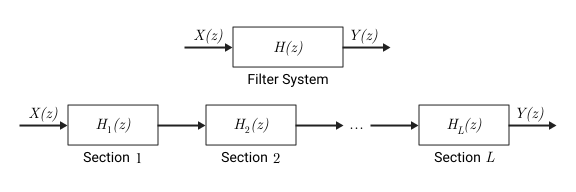
Representation of digital filters in CTF format
Details
Specify the arguments B and A to get the filter coefficients. You can also specify gS to get the overall gain of the filter. By specifying these output arguments, you can design digital filters in CTF format for signal analysis, visualization, and filtering.
coeffects of the filter
If you specify the representation of the numerator and denominator coefficients in CTF format, -lowercase matrices and they are returned as
thus, the total transfer function of the filter is
where — the order of the filter numerator, and — the order of the denominator.
|
The following functions can be used to visualize and analyze filters in CTF format:
|
coeffects and amplification
You can specify that you want to return the coefficients and the total gain of the system using a triplet of output arguments. B,A,gS. In this case, the coefficients of the numerator are normalized, returning the matrices of the filter coefficients and the gain factor in the form
so the transfer function has the form
This transfer function is equivalent to the function defined in section Filter coefficients, where and by and .
Algorithms
Function zp2ctf calculates the coefficients of the numerator and denominator of the cascade sections of the transfer function based on zeros, poles, and the filter gain. For the filter -th order exists possible combinations [1]. Variable — the nearest integer greater than or equal to or for sections of the second or fourth order, respectively.
Set up the sorting criteria for combining zeros and poles into pairs in cascading sections by setting a value for the argument Direction to start with the poles and zeros closest to the origin -planes ("up"), or those closest to the unit circle ("down"). Scale the gain by cascade sections using the argument Scale. Adjust the order of cascading sections by setting for the argument SectionOrder meaning 2 or 4 to create cascading sections of the second or fourth order, respectively.
Output arguments B and A they contain the coefficients of the cascade transfer function of the second or fourth order of the filter, distributed according to lines.
-
Each line of arguments
BandAcontains a list of coefficients in each section.-
The function returns the first column of the matrix
Aan equal1, therefore,A(1) = 1WhenAIt is a string vector. -
If you specify the need to return
gSfunctionzp2ctfnormalizes the coefficients of the numerator so that the first column of the matrixBwas equal to1, and returns the total gain of the system asgS. Thus,B(1) = 1WhenBIt is a string vector. -
If you do not specify
gSas an output argument, the functionzp2ctffirst, normalizes the coefficients of the numerator so that the first column of the matrixBwas equal to1, and then evenly multiplies the normalized coefficients of the numerator bysgn(gS)*gS^(1/L), so the first column of the matrix isBwill be equal tosgn(gS)*gS^(1/L). Thus,B(1) = gSWhenBIt is a string vector.
-
-
When specifying second-order sections or ignoring the argument
SectionOrder, functionzp2ctfreturns matricesBandAsize on where the last two columns correspond to the members and for each cascade section of the filter. -
When specifying fourth-order sections, the function
zp2ctfreturns matricesBandAsize on where the last two columns correspond to the members and for each cascade section of the filter.