txlineDelayLossy
Creates a lossy and delayed transmission line.
| Library |
|
Description
Use the function txlineDelayLossy to create a lossy and delayed transmission line. Also the object txlineDelayLossy It can be used to simulate a lossy and delayed transmission line in RF systems using an object rfbudget.
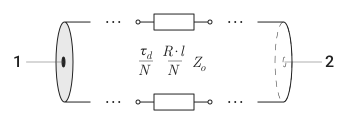
In the picture represents the value of the argument TimeDelay, — the value of the argument Z0, — the value of the argument LineLength, — the value of the argument Resistance, — the number of consecutive segments into which the transmission line is divided, and 1 and 2 are the input and output ports.
Syntax
Function call
-
dlytxline = txlineDelayLossy()— creates a lossy and delayed transmission line object with default properties.
-
dlytxline = txlineDelayLossy(Name=Value)— sets properties specified by one or more arguments of the type «name-value». Unspecified properties retain their default values.
Arguments
Input arguments «name-value»
Specify optional argument pairs as Name=Value, where Name — the name of the argument, and Value — the appropriate value. You can specify multiple pairs «name-value».
Example: dlytxline = txlineDelayLossy(Z0 = 75) creates a lossy and delayed transmission line with impedance 75 Om.
# Z0 — characteristic impedance
+
50.0 (by default) | scalar
Details
Characteristic impedance lossy and delayed transmission lines, set as a positive scalar in ohms.
| Типы данных |
|
# TimeDelay — time delay in the transmission line
+
4.7e−9 (by default) | scalar
Details
Time delay in a lossy and delayed transmission line, set as a positive scalar in seconds.
| Типы данных |
|
# Resistance — linear resistance
+
0.3 (by default) | scalar
Details
Running resistance lossy and delayed transmission lines, set as a positive scalar in ohms/m.
| Типы данных |
|
# lineLength — the physical length of the transmission line
+
0.01 (by default) | scalar
Details
Physical length lossy and delayed transmission lines, defined as a positive scalar in meters.
| Типы данных |
|
# Name — name of the lossy and delayed transmission line
+
"DelayLossy" (by default) | line
Details
The name of the lossy and delayed transmission line, set as a string.
| Типы данных |
|
# Terminals — Lossy and delayed transmission line terminals
+
("p1+", "p2+", "p1−", "p2−") (by default) | tuple of strings
Details
Lossy and delayed transmission line terminals, specified as a tuple of strings from 4 elements.
| This argument is read-only. |
# NumPorts — number of input and output ports
+
2 (default) | scalar
Details
The number of input and output ports, set as a positive scalar.
| This argument is read-only. |
| Типы данных |
|
Output arguments
# dlytxline — transmission line object
+
object
Details
A lossy and delayed transmission line object containing the following properties:
-
Z0— characteristic impedance; -
TimeDelay— time delay; -
Resistance— running resistance; -
LineLength— length of the transmission line; -
Name— the name of the object as a string, for example"DelayLossy"; -
Terminals— terminal names in the form of a tuple of strings; -
NumPorts— number of ports; -
Parent— the parent schema that the chain object belongs to; -
ParentNodes— nodes of the parent schema in the form of a vector of integers, displayed only after adding the child schema to the parent schema; -
ParentPath— the full path to the parent schema as a string, displayed only after adding the child schema to the parent schema.; -
Ports— port names as a tuple of strings:("p1", "p2").
Examples
Creating a lossy and delayed transmission line
Details
We will design a coaxial cable with a length of 500 mm as a lossy and delayed transmission line whose characteristic impedance is 48 Om.
using EngeeRF

dlytxline = txlineDelayLossy(Z0 = 48, LineLength = 500e-3)

println("Z0: ", dlytxline.Z0,
        "\nTimeDelay: ", dlytxline.TimeDelay,
        "\nResistance: ", dlytxline.Resistance,
        "\nLineLength: ", dlytxline.LineLength,
        "\nName: ", dlytxline.Name,
        "\nTerminals: ", dlytxline.Terminals,
        "\nNumPorts: ", dlytxline.NumPorts)
Z0: 48.0
TimeDelay: 4.7e-9
Resistance: 0.3
LineLength: 0.5
Name: DelayLossy
Terminals: ("p1+", "p2+", "p1-", "p2-")
NumPorts: 2Algorithms
The lossy and delayed transmission line object calculates the S-parameters for the specified frequencies. This calculation is based on line length, resistance, and time delay. The S-parameters are calculated using these formulas:
where , here — attenuation coefficient, — the wave number.
Attenuation coefficient associated with losses the ratio
where — length of the transmission line, — continuous resistance. The wave number due to a time delay how
where — the frequency range specified in the input argument of the S-parameter function.