txlineMicrostrip
Creates a microstrip transmission line.
| Library |
|
Description
Use the function txlineMicrostrip to create a standard, embedded, inverted, or suspended microstrip transmission line.
The following figure shows the cross sections of the four types of microstrip transmission line. Its physical characteristics include the width of the conductor , the thickness of the conductor , the thickness of the dielectric , relative permittivity and the height of the conductor above the grounding plane .
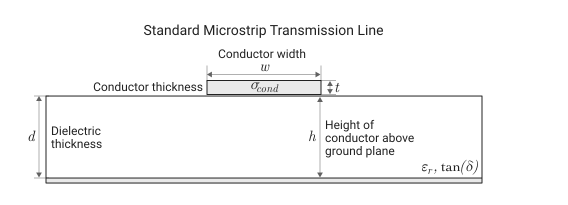
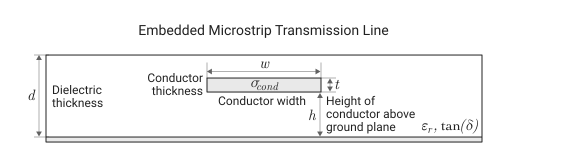
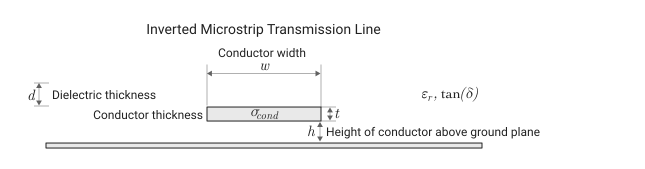
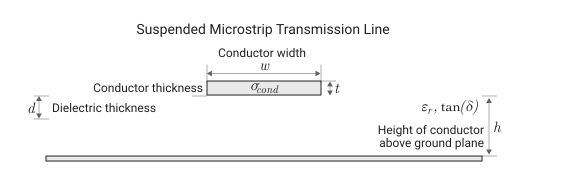
The figure also shows — the value of the argument SigmaCond and — the value of the argument LossTangent.
Syntax
Function call
-
txline = txlineMicrostrip()— creates a standard microstrip transmission line object with default properties.
-
txline = txlineMicrostrip(Name=Value)— sets properties specified by one or more arguments of the type «name-value». Unspecified properties retain their default values.
Arguments
Input arguments «name-value»
Specify optional argument pairs as Name=Value, where Name — the name of the argument, and Value — the appropriate value.
Example: txline = txlineMicrostrip(Width = 0.0046) creates a standard microstrip transmission line with a width of 0.0046 M. You can specify several pairs «name-value».
# Type — type of microstrip transmission line
+
"Standard" (by default) | "Embedded" | "Inverted" | "Suspended"
Details
The type of microstrip transmission line specified by one of the following values:
-
"Standard"— standard microstrip transmission line; -
"Embedded"— built-in microstrip transmission line; -
"Inverted"— inverted microstrip transmission line; -
"Suspended"— suspended microstrip transmission line.
| Типы данных |
|
# lineLength — the physical length of the transmission line
+
0.01 (by default) | scalar
Details
The physical length of the microstrip transmission line, specified as a positive scalar in meters.
| Типы данных |
|
# Width — the physical width of the transmission line
+
0.0006 (by default) | scalar
Details
The physical width of the microstrip transmission line, set as a positive scalar in meters.
| Типы данных |
|
# totalHeight — full height
+
0.000635 (by default) | scalar
Details
The total height, set as a positive scalar in meters.
| Типы данных |
|
# DielectricThickness is the dielectric thickness of the microstrip transmission line
+
0.000635 (by default) | scalar
Details
The dielectric thickness of an inverted, embedded, or suspended microstrip transmission line, specified as a positive scalar in meters. The default dielectric thickness values for embedded, inverted, and suspended microstrip transmission lines are shown in the table, where — thickness of the dielectric, — the width of the conductor.
| Type of microstrip transmission line | The value of the argument DielectricThickness by default |
Expected values |
|---|---|---|
|
|
|
|
|
|
|
|
The default function is txlineMicrostrip sets the dielectric thickness of a standard microstrip transmission line equal to the value of the argument Height.
|
Dependencies
To use this argument, set for the argument Type meaning "Embedded", "Inverted" or "Suspended".
| Типы данных |
|
# Thickness — the physical thickness of the transmission line
+
5.0e−6 (by default) | scalar
Details
The physical thickness of the microstrip transmission line, given as a positive scalar in meters. It is now possible to simulate a microstrip transmission line with a thickness of 0 mm.
| Типы данных |
|
# EpsilonR — relative permittivity
+
9.8 (by default) | scalar
Details
The relative permittivity of a dielectric, given as a positive scalar.
| Типы данных |
|
# LossTangent is the tangent of the dielectric loss angle
+
0.0 (by default) | scalar
Details
The tangent of the dielectric loss angle, given as a non-negative scalar.
| Типы данных |
|
# SigmaCond — linear conductivity
+
Inf (by default) | scalar
Details
Linear conductivity, given as a non-negative scalar in Siemens per meter (Cm/m).
| Типы данных |
|
#
Termination —
closing of the transmission
loop
"NotApplicable" (by default) | "Open" | "Short"
Details
The short circuit of the transmission loop, set by one of the following values: "NotApplicable", "Open", "Short".
# StubMode — loop type
+
"NotAStub" (by default) | "Series" | "Shunt"
Details
The type of loop specified by one of the following values: "NotAStub", "Series", "Shunt".
# Name — name of the transmission line
+
"Microstrip" (by default) | line
Details
The name of the microstrip transmission line, set as a string.
| Типы данных |
|
# Terminals — terminals of the microstrip transmission line
+
("p1+", "p2+", "p1−", "p2−") (by default) | tuple of strings
Details
Terminals of a microstrip transmission line, specified as a tuple of strings from 4 elements.
| This argument is read-only. |
# NumPorts — number of input and output ports
+
2 (by default) | scalar
Details
The number of input and output ports, set as a positive scalar.
| This argument is read-only. |
| Типы данных |
|
Output arguments
# txline — transmission line object
+
object
Details
A microstrip transmission line object containing the following properties:
-
Type— type of transmission line; -
LineLength— length of the transmission line; -
Width— width of the transmission line; -
Height— height of the conductor; -
TotalHeight— full height; -
DielectricThickness— the thickness of the transmission line dielectric; -
Thickness— the thickness of the transmission line; -
EpsilonR— relative dielectric constant; -
LossTangent— tangent of the dielectric loss angle; -
SigmaCond— linear conductivity; -
Termination— shorting of the transmission loop line; -
StubMode— type of train; -
Name— the name of the object as a string, for example"Microstrip"; -
Terminals— terminal names in the form of a tuple of strings; -
NumPorts— number of ports; -
Parent— the parent schema that the chain object belongs to; -
ParentNodes— nodes of the parent schema in the form of an array of integers, displayed only after adding the child schema to the parent schema; -
ParentPath— the full path to the parent schema as a string, displayed only after adding the child schema to the parent schema.; -
Ports— port names as a tuple of strings:("p1", "p2").
Methods
sparameters: Calculation of S-parameters for radio frequency data, networks, circuits and related objects
groupdelay:: Calculation of the group delay of S-parameters, RF filter or circuit object
noisefigure: Calculation of the noise coefficient of transmission lines, serial and parallel RLC circuits
circuit:: Creating an electrical circuit diagram object
clone:: Creating a copy of an existing schema element or schema object
Examples
S-parameters and group delay of the microstrip transmission line
Details
Let’s create a microstrip transmission line with the following properties:
-
Width:
0.08mm; -
Line length:
12.2777mm; -
Thickness:
10e−6m; -
Relative permittivity:
3.9; -
Linear conductivity:
5.88e7Cm/m.
using EngeeRF

microstriptxline = txlineMicrostrip(LineLength = 12.2777e-3,
                                    Width = 0.08e-3, Thickness = 10e-6,
                                    EpsilonR = 3.9, SigmaCond = 5.88e7)
Calculate the S-parameters of the transmission line at the frequency 10 GHz.
sparam = sparameters(microstriptxline, 10e9, 50)

println("Impedance: ", sparam.Impedance,
        "\nNumPorts: ", sparam.NumPorts,
        "\nFrequencies: ", sparam.Frequencies,
        "\nParameters: ", sparam.Parameters)
Impedance: 50
NumPorts: 2
Frequencies: [1.0e10]
Parameters: ComplexF64[0.6948678545439806 + 0.24909256643028208im -0.22768417547072084 + 0.6233009650582779im; -0.22768417547072078 + 0.6233009650582778im 0.6948678545439806 + 0.2490925664302822im;;;]Calculate the group delay of the transmission line at the frequency 10 GHz.
freqs = [10e9, 10e9 + 1e3]
gd = groupdelay(microstriptxline, freqs)
2-element Vector{Float64}:
4.9333968511297063e-11
4.9333968511297063e-11S-parameters of the suspended microstrip line
Details
Let’s create a microstrip transmission line with a copper conductor and a Teflon substrate.
using EngeeRF

tx = txlineMicrostrip(Type = "Suspended", LineLength = 0.04705,
                      Width = 3.5e-3, Height = 1.6e-3,
                      DielectricThickness = 0.8e-3, Thickness = 3.556e-5,
                      EpsilonR = 2.1, LossTangent = 0.2e-3, SigmaCond = 596e5)
Let’s calculate and plot the S-parameters with the reference impedance 50 Om.
freq = (1:40) * 100e6
Srf = sparameters(tx, freq, 50)

rfplot(Srf)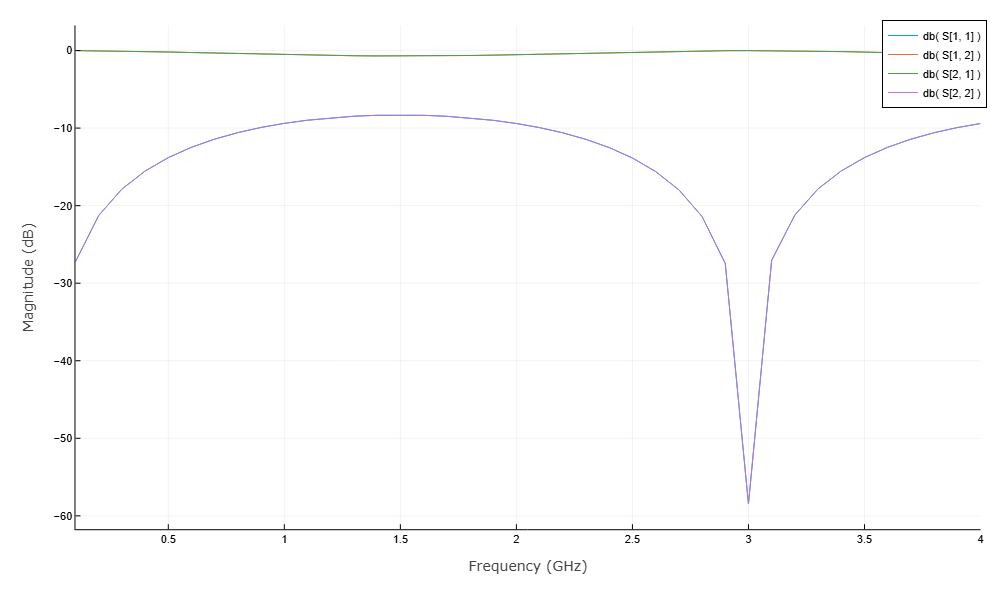
Algorithms
If for an argument StubMode the value is set "Shunt", then the two-port network consists of a loopback transmission line that can be closed or opened, as shown in the following figure.
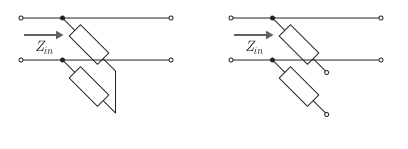
Here — input impedance of the parallel circuit. The ABCD parameters for the parallel loop are calculated as follows:
If for an argument StubMode the value is set "Series", then the two-port network is a serial transmission line that can be closed or opened, as shown in the following figure.
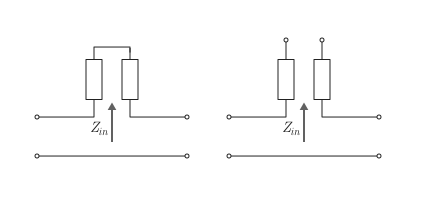
Here — input impedance of the serial circuit. The ABCD parameters for the serial loop are calculated as follows: