Average-Value Rectifier (Three-Phase)
An average converter of three-phase AC voltage to DC voltage with a fixed power loss.
blockType: AcausalElectricPowerSystems.Converters.ThreePhaseAverageValueRectifier
|
Path in the library: |
Description
Block Average-Value Rectifier (Three-Phase) simulates an average full-period six-pulse rectifier. It converts the instantaneous three-phase AC voltage to DC voltage, and the DC power consumption to the three-phase AC power consumption. The corresponding AC power consumption is equal to the sum of the fixed power loss and the DC power consumption.
Block Average-Value Rectifier (Three-Phase) It can only be used as a six-pulse rectifier. Two blocks Average-Value Rectifier (Three-Phase) It cannot be combined to create a twelve-pulse rectifier.
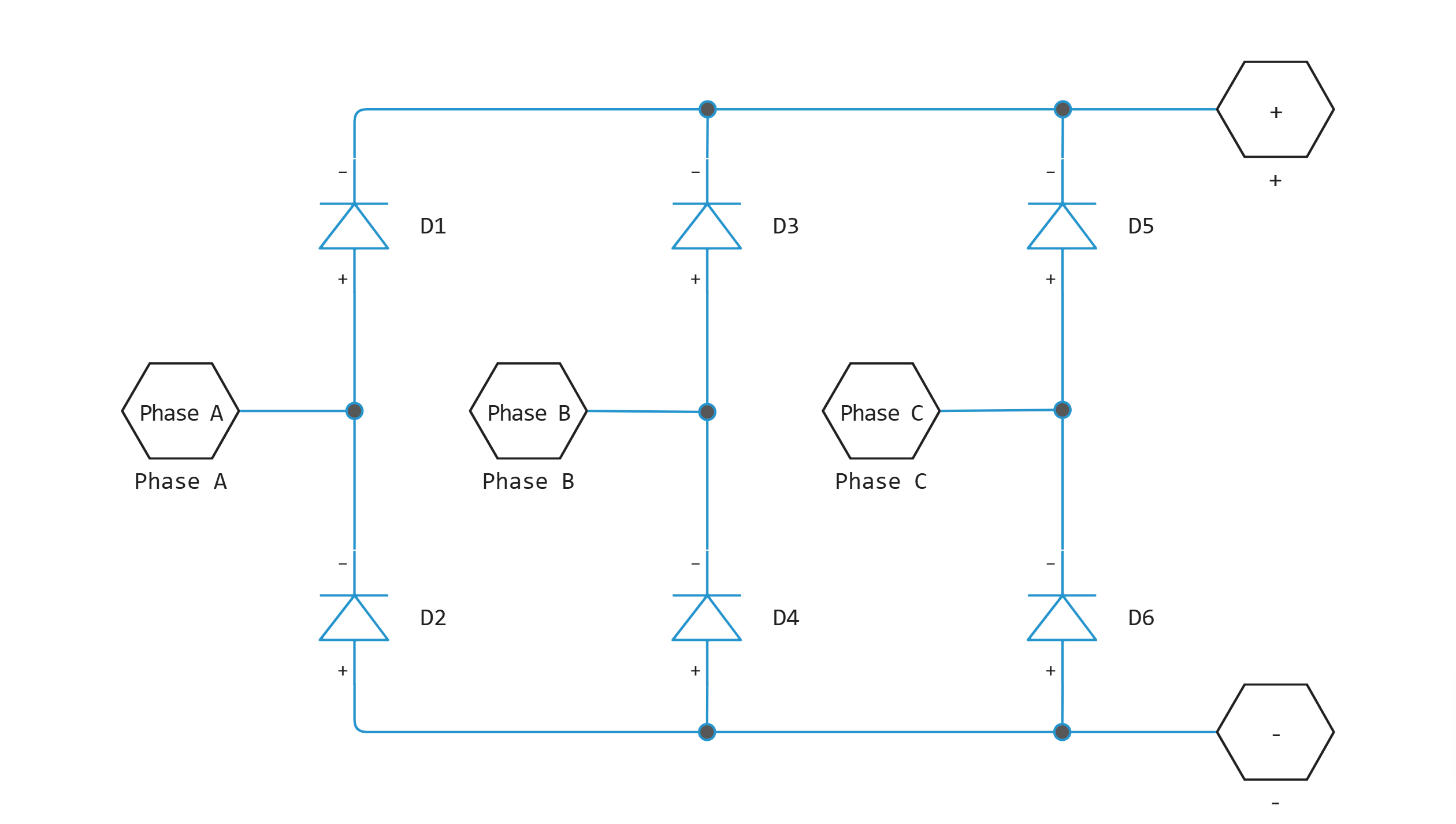
The figure shows an equivalent circuit of a full-period six-pulse rectifier. However, the block Average-Value Rectifier (Three-Phase) it does not produce harmonics, which are usually associated with a detailed representation, because it performs an average power conversion.
Equations defining electrical parameters
The voltages are determined as follows:
where
-
, , — the corresponding phase voltage of alternating current;
-
— DC bias on the AC side; in a balanced AC power supply system without DC bias equally
0In; -
— current AC line voltage;
-
— the voltage difference between the positive and negative terminals of the rectifier;
-
— attitude for a full-period six-pulse rectifier;
-
, — voltage at the positive and negative terminals of the rectifier.
Resistance, power, and currents are determined by the ratios
where
-
— the rated AC voltage specified in the block mask;
-
— the fixed power loss indicated in the block mask;
-
— fixed series resistance of each phase in an equivalent load connected by a star;
-
, — currents flowing through the positive and negative terminals of the rectifier;
-
— output power on the DC side; has a minimum limit
0Tue; -
— the series resistance of each phase in an equivalent load connected by a star;
-
, , — the corresponding alternating currents flowing through the rectifier.
Since the potentials at the output terminals are p and n calculated using the specified expressions, connecting the block Electrical Reference This is unacceptable and leads to a modeling error!
|
Ports
Conserving
#
+
—
positive terminal
electricity
Details
The port connected to the positive terminal.
| Program usage name |
|
#
−
—
negative terminal
electricity
Details
The port connected to the negative terminal.
| Program usage name |
|
#
~
—
three-phase port
electricity
Details
Composite three-phase port.
| Program usage name |
|
Parameters
Main
#
Rated AC voltage —
Rated AC voltage
V | uV | mV | kV | MV
Details
The rated voltage of the AC system.
| Units |
|
| Default value |
|
| Program usage name |
|
| Evaluatable |
Yes |
#
AC frequency —
frequency of alternating current
Variable | Constant
Details
Variable or constant frequency of alternating current:
-
Variable— if the frequency of the alternating current changes; -
Constant— if the AC frequency is constant.
| Values |
|
| Default value |
|
| Program usage name |
|
| Evaluatable |
No |
#
Rated electrical frequency —
rated frequency of electric current
Hz | kHz | MHz | GHz
Details
The rated frequency of the electric current. The value of this parameter should be equal to the nominal frequencies of the electric current of other sinusoidal sources in your model, if any.
Dependencies
To use this parameter, set for the parameter AC frequency meaning Constant.
| Units |
|
| Default value |
|
| Program usage name |
|
| Evaluatable |
Yes |
#
Fixed power loss —
fixed power loss
W | uW | mW | kW | MW | GW | V*A | HP_DIN
Details
The minimum power consumed on the AC side at the rated AC voltage. When the instantaneous AC voltage is equal to the value set for the parameter Rated AC voltage, the AC power consumption is equal to the sum of the value set for the parameter Fixed power loss, and the DC power consumption.
| Units |
|
| Default value |
|
| Program usage name |
|
| Evaluatable |
Yes |