Three-Level Converter (Three-Phase)
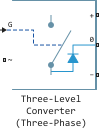
Controlled three-phase three-level converter with neutral point lock.
blockType: AcausalElectricPowerSystems.Converters.ThreePhaseThreeLevel
|
Path in the library: |
Description
Block Three-Level Converter (Three-Phase) It simulates a twelve-pulse three-phase three-level converter with a neutral point lock. This unit is designed to connect a three-phase AC network to a three-level DC network.
Model
The block consists of three bridge arms, each of which consists of four switching devices and corresponding counter-parallel diodes. Possible types of switching devices:
-
GTO— lockable thyristor. For information about the volt-ampere characteristic of the device, see the description of the unit. GTO. -
Ideal Semiconductor Switch— Perfect semiconductor controlled switch. For information about the volt-ampere characteristic of the device, see the description of the unit. Ideal Semiconductor Switch. -
IGBT— a bipolar transistor with an isolated gate. For information about the volt-ampere characteristic of the device, see the description of the unit. IGBT (Ideal, Switching). -
MOSFET— n-channel MOSFET for switching circuits. For information about the volt-ampere characteristic of the device, see the description of the unit. MOSFET (Ideal, Switching). -
Averaged Switch— an average semiconductor switch with an antiparallel diode. The control signal port G takes values in the range[0, 1]. When G is equal to0or1, the averaged switch is fully open or fully closed, respectively. The switch behaves similarly to the block Ideal Semiconductor Switch with an antiparallel diode. When G is in the range of0before1, the averaged switch is partially open. You can average the pulse width modulation (PWM) signal over a specific period. Then you can reduce the sampling of the model and use modulating waveforms instead of PWM signals.
Each component in the three-way circuit represents the same switching device, which is set in the parameter Switching device. The switching devices that can be set are implementations of blocks from the library. Semiconductors & Converters.
The figure shows an equivalent circuit of a block using a block as a switching device. Ideal Semiconductor Switch.

Control the gate ports of the 12 switching devices through the input to the G port of the unit Three-Level Converter (Three-Phase).
-
Multiplex all 12 gate signals into a single vector using the block Twelve-Pulse Gate Multiplexer.
-
Connect the output of the unit Twelve-Pulse Gate Multiplexer to the block Three-Level Converter (Three-Phase) through the G port.
Using the settings Diodes, it is possible to turn on an internal protective diode for each switching device. The built-in diode protects the device by providing a conduction channel for reverse current, a sudden surge of which occurs when the device suddenly turns off the voltage supply to the inductive load.
Set the value for the parameter Integral protection diode depending on the goals.
| Goals | Value for selection | Internal protective diode |
|---|---|---|
Priority of simulation speed |
|
Block Diode |
The priority of modeling accuracy is to accurately indicate the charge dynamics in the reverse mode. |
|
Dynamic block model Diode |
In the parameter group Snubbers You can include a snubber (damper) circuit for each switching device. Snubber circuits contain a resistor and a capacitor connected in series. They protect switching devices from the high voltage that inductive loads create when the device turns off the voltage supply to the load. In addition, snubber circuits prevent excessive current change rates when switching on the switching device.
Piecewise constant approximation in an averaged switch
If set for the parameter Switching device meaning Averaged Switch and use the partitioning solver, block, to create the model. Three-Level Converter (Three-Phase) creates nonlinear splits because the equations of the averaged mode include modes , which are functions of the input signal G. To activate the piecewise constant approximation, set the parameter Integer for piecewise constant approximation of gate input (0 for disabled) a value greater than 0. Then this block will consider the mode as a piecewise constant integer with a fixed range. This transforms previously non-linear partitions into linear, time-varying ones.
An integer value in the range [0, K], where — parameter value Integer for piecewise constant approximation of gate input (0 for disabled), is now associated with each mode of the real value in the range [0, 1]. The block calculates the piecewise constant approximation mode by dividing the initial mode by to normalize it back to the range [0, 1]:
Ports
Conserving
#
+
—
positive terminal
electricity
Details
The port connected to the positive DC terminal.
| Program usage name |
|
#
–
—
negative terminal
electricity
Details
The port connected to the negative DC terminal.
| Program usage name |
|
#
0
—
neutral terminal
electricity
Details
The port connected to the neutral DC terminal.
| Program usage name |
|
#
G
—
shutter
electricity
Details
The input port connected to the gate terminals of switching devices. Connect this port to the unit Twelve-Pulse Gate Multiplexer.
| Program usage name |
|
#
~
—
three-phase port
electricity
Details
Composite three-phase port.
| Program usage name |
|
Parameters
Switching Devices
#
Off-state conductance —
conductivity in the off state
S | nS | uS | mS | 1/Ohm
Details
Conductivity between ports + and − (cathode-anode for GTO, Ideal Semiconductor Switch, the emitter collector for IGBT, or the drain-source for MOSFET) when the device is turned off. The value must be less than , where — parameter value On-state resistance.
Dependencies
To use this parameter, set for the parameter Switching device meaning GTO, Ideal Semiconductor Switch, IGBT or MOSFET.
| Units |
|
| Default value |
|
| Program usage name |
|
| Evaluatable |
Yes |
#
Forward voltage, Vf —
forward voltage
V | uV | mV | kV | MV
Details
Minimum voltage required at the anode-cathode ports (for GTO) or collector-emitter (for IGBT), so that the gradient of the volt-ampere characteristic of the device is equal to , where — parameter value On-state resistance.
Dependencies
To use this parameter, set for the parameter Switching device meaning GTO or IGBT.
| Units |
|
| Default value |
|
| Program usage name |
|
| Evaluatable |
Yes |
#
On-state resistance —
resistance in the switched-on state
Ohm | mOhm | kOhm | MOhm | GOhm
Details
Resistance between ports + and − (cathode-anode for GTO, Ideal Semiconductor Switch and Averaged Switch, or an emitter collector for IGBT) when the device is turned on.
Dependencies
To use this parameter, set for the parameter Switching device meaning GTO, Ideal Semiconductor Switch, IGBT or Averaged Switch.
| Units |
|
| Default value |
|
| Program usage name |
|
| Evaluatable |
Yes |
#
Gate trigger voltage, Vgt —
shutter release voltage
V | uV | mV | kV | MV
Details
The gate-cathode threshold voltage. The device turns on when the gate-cathode voltage exceeds this value.
Dependencies
To use this parameter, set for the parameter Switching device meaning GTO.
| Units |
|
| Default value |
|
| Program usage name |
|
| Evaluatable |
Yes |
# Integer for piecewise constant approximation of gate input (0 for disabled) — piecewise constant approximation
Details
An integer used to perform a piecewise constant approximation of the gate input data.
Dependencies
To use this parameter, set for the parameter Switching device meaning Averaged Switch.
| Default value |
|
| Program usage name |
|
| Evaluatable |
Yes |
#
Switching device —
switching device
GTO | Ideal Semiconductor Switch | IGBT | MOSFET | Averaged Switch
Details
Converter switching device:
-
GTO; -
Ideal Semiconductor Switch; -
IGBT; -
MOSFET; -
Averaged Switch.
Dependencies
Depending on the choice of a specific switching device, several additional parameters will become visible.
| Values |
|
| Default value |
|
| Program usage name |
|
| Evaluatable |
No |
#
Gate turn-off voltage, Vgt_off —
shutter release voltage
V | uV | mV | kV | MV
Details
The gate-cathode threshold voltage. The device turns off when the gate-cathode voltage falls below this value.
Dependencies
To use this parameter, set for the parameter Switching device meaning GTO.
| Units |
|
| Default value |
|
| Program usage name |
|
| Evaluatable |
Yes |
#
Drain-source on resistance, R_DS(on) —
drain-source resistance
Ohm | mOhm | kOhm | MOhm | GOhm
Details
Drain-source resistance when the device is switched on.
Dependencies
To use this parameter, set for the parameter Switching device meaning MOSFET.
| Units |
|
| Default value |
|
| Program usage name |
|
| Evaluatable |
Yes |
#
Threshold voltage, Vth —
Threshold voltage
V | uV | mV | kV | MV
Details
Threshold voltage between ports G (gate) and * (cathode for `{blockLibraryPP_blockTypesPP_AcausalElectricPowerSystemsBB_PP_ConvertersBB_PP_ThreePhaseThreeLevelPP_BasePP_paramsPP_PP_SwitchingSS_DevicesPP_device_typePP_optionsPP_IdealSS_SemiconductorSS_Switch}`, the emitter for `{blockLibraryPP_blockTypesPP_AcausalElectricPowerSystemsBB_PP_ConvertersBB_PP_ThreePhaseThreeLevelPP_BasePP_paramsPP_PP_SwitchingSS_DevicesPP_device_typePP_optionsPP_IGBT}`, or the source for `{blockLibraryPP_blockTypesPP_AcausalElectricPowerSystemsBB_PP_ConvertersBB_PP_ThreePhaseThreeLevelPP_BasePP_paramsPP_PP_SwitchingSS_DevicesPP_device_typePP_optionsPP_MOSFET}`). The device turns on when the voltage between the ports of the *G* and * block exceeds this value.
Dependencies
To use this parameter, set for the parameter Switching device meaning Ideal Semiconductor Switch, IGBT or MOSFET.
| Units |
|
| Default value |
|
| Program usage name |
|
| Evaluatable |
Yes |
#
Holding current —
holding current
A | pA | nA | uA | mA | kA | MA
Details
The current threshold value. The device remains switched on when the current exceeds this value, even if the gate-cathode voltage drops below the gate release voltage.
Dependencies
To use this parameter, set for the parameter Switching device meaning GTO.
| Units |
|
| Default value |
|
| Program usage name |
|
| Evaluatable |
Yes |
Diodes
# Reverse recovery time stretch factor — the stretching coefficient of the reverse recovery time
Details
The value used by the block to calculate the parameter Reverse recovery time, trr. This value should be higher. 1. Specifying the stretching coefficient is an easier way to parameterize the reverse recovery time than specifying the reverse recovery charge. The higher the value of the stretching coefficient, the longer it takes for the reverse recovery current to dissipate.
Dependencies
To use this parameter, set for the parameter Integral protection diode meaning Diode with charge dynamics, and for the parameter Reverse recovery time parameterization meaning Specify stretch factor.
| Default value |
|
| Program usage name |
|
| Evaluatable |
Yes |
#
Peak reverse current, iRM —
peak reverse current
A | pA | nA | uA | mA | kA | MA
Details
The peak return current measured by the external test circuit. This value must be less than zero. The default value is -235 A.
Dependencies
To use this parameter, set for the parameter Integral protection diode meaning Diode with charge dynamics.
| Units |
|
| Default value |
|
| Program usage name |
|
| Evaluatable |
Yes |
#
Integral protection diode —
internal protective diode
Diode with no dynamics | Diode with charge dynamics
Details
An internal protective diode for each switching device.
If it is necessary to turn on the internal protective diode, then there are two possible options:
-
Diode with no dynamics; -
Diode with charge dynamics.
If for the parameter Switching device the value is set Averaged Switch in the settings Switching Devices, then this parameter is not displayed and the value Diode with no dynamics it is selected automatically.
|
| Values |
|
| Default value |
|
| Program usage name |
|
| Evaluatable |
No |
#
Rate of change of current when measuring iRM —
the rate of change of current during iRM measurement
A/s | A/us
Details
The rate of change of the current when measuring the peak reverse current. This value must be less than zero.
Dependencies
To use this parameter, set for the parameter Integral protection diode meaning Diode with charge dynamics.
| Units |
|
| Default value |
|
| Program usage name |
|
| Evaluatable |
Yes |
#
Reverse recovery time, trr —
reverse recovery time
s | ns | us | ms | min | hr | d
Details
The interval between the moment when the current initially drops to zero (when the diode turns off) and the moment when the current drops to a value less than 10% of the peak return current. Parameter Value Reverse recovery time, trr there must be more than the parameter value. Peak reverse current, iRM, divided by the parameter value Rate of change of current when measuring iRM.
Dependencies
To use this parameter, set for the parameter Integral protection diode meaning Diode with charge dynamics, and for the parameter Reverse recovery time parameterization meaning Specify reverse recovery time directly.
| Units |
|
| Default value |
|
| Program usage name |
|
| Evaluatable |
Yes |
#
Junction capacitance —
transfer capacity
F | pF | nF | uF | mF
Details
The capacitance of the diode junction.
Dependencies
To use this parameter, set for the parameter Integral protection diode meaning Diode with charge dynamics.
| Units |
|
| Default value |
|
| Program usage name |
|
| Evaluatable |
Yes |
#
Off conductance —
conductivity at shutdown
S | nS | uS | mS | 1/Ohm
Details
The conductivity of the diode is reversed.
| Units |
|
| Default value |
|
| Program usage name |
|
| Evaluatable |
Yes |
#
Initial forward current when measuring iRM —
initial forward current during iRM measurement
A | pA | nA | uA | mA | kA | MA
Details
The initial forward current when measuring the peak reverse current. This value must be greater than zero.
Dependencies
To use this parameter, set for the parameter Integral protection diode meaning Diode with charge dynamics.
| Units |
|
| Default value |
|
| Program usage name |
|
| Evaluatable |
Yes |
#
Reverse recovery time parameterization —
parameterization of the reverse recovery time
Specify stretch factor | Specify reverse recovery time directly | Specify reverse recovery charge
Details
Defines how the reverse recovery time is set in the block. Default value — Specify reverse recovery time directly.
If you select a value Specify stretch factor or Specify reverse recovery charge you specify the value that the block uses to calculate the reverse recovery time.
Dependencies
To use this parameter, set for the parameter Integral protection diode meaning Diode with charge dynamics.
| Values |
|
| Default value |
|
| Program usage name |
|
| Evaluatable |
No |
#
On resistance —
resistance when switching on
Ohm | mOhm | kOhm | MOhm | GOhm
Details
The rate of voltage change depending on the current is higher Forward voltage.
| Units |
|
| Default value |
|
| Program usage name |
|
| Evaluatable |
Yes |
#
Forward voltage —
forward voltage
V | uV | mV | kV | MV
Details
The minimum voltage required at ports + and − so that the gradient of the volt-ampere characteristic of the diode is equal to , where — parameter value On resistance.
| Units |
|
| Default value |
|
| Program usage name |
|
| Evaluatable |
Yes |
#
Reverse recovery charge, Qrr —
reverse recovery charge
C | nC | uC | mC | nA*s | uA*s | mA*s | A*s | mA*hr | A*hr | kA*hr | MA*hr
Details
The value used by the block to calculate the parameter Reverse recovery time, trr. Use this parameter if the reverse recovery charge value is specified in the technical description of your diode device instead of the reverse recovery time value.
The reverse recovery charge is the total charge that continues to dissipate when the diode is turned off. The value should be less than , where
-
— parameter value Peak reverse current, iRM;
-
— parameter value Rate of change of current when measuring iRM.
Dependencies
To use this parameter, set for the parameter Integral protection diode meaning Diode with charge dynamics, and for the parameter Reverse recovery time parameterization meaning Specify reverse recovery charge.
| Units |
|
| Default value |
|
| Program usage name |
|
| Evaluatable |
Yes |
Snubbers
#
Snubber resistance —
damper resistance
Ohm | mOhm | kOhm | MOhm | GOhm
Details
The resistance of the damper.
Dependencies
To use this option, check the box Snubber.
| Units |
|
| Default value |
|
| Program usage name |
|
| Evaluatable |
Yes |
# Snubber — activating the damper
Details
Adding a damper to the switching device.
| Default value |
|
| Program usage name |
|
| Evaluatable |
No |
#
Snubber capacitance —
damper capacity
F | pF | nF | uF | mF
Details
The capacity of the damper.
Dependencies
To use this option, check the box Snubber.
| Units |
|
| Default value |
|
| Program usage name |
|
| Evaluatable |
Yes |