QPSK communication system with adaptive alignment
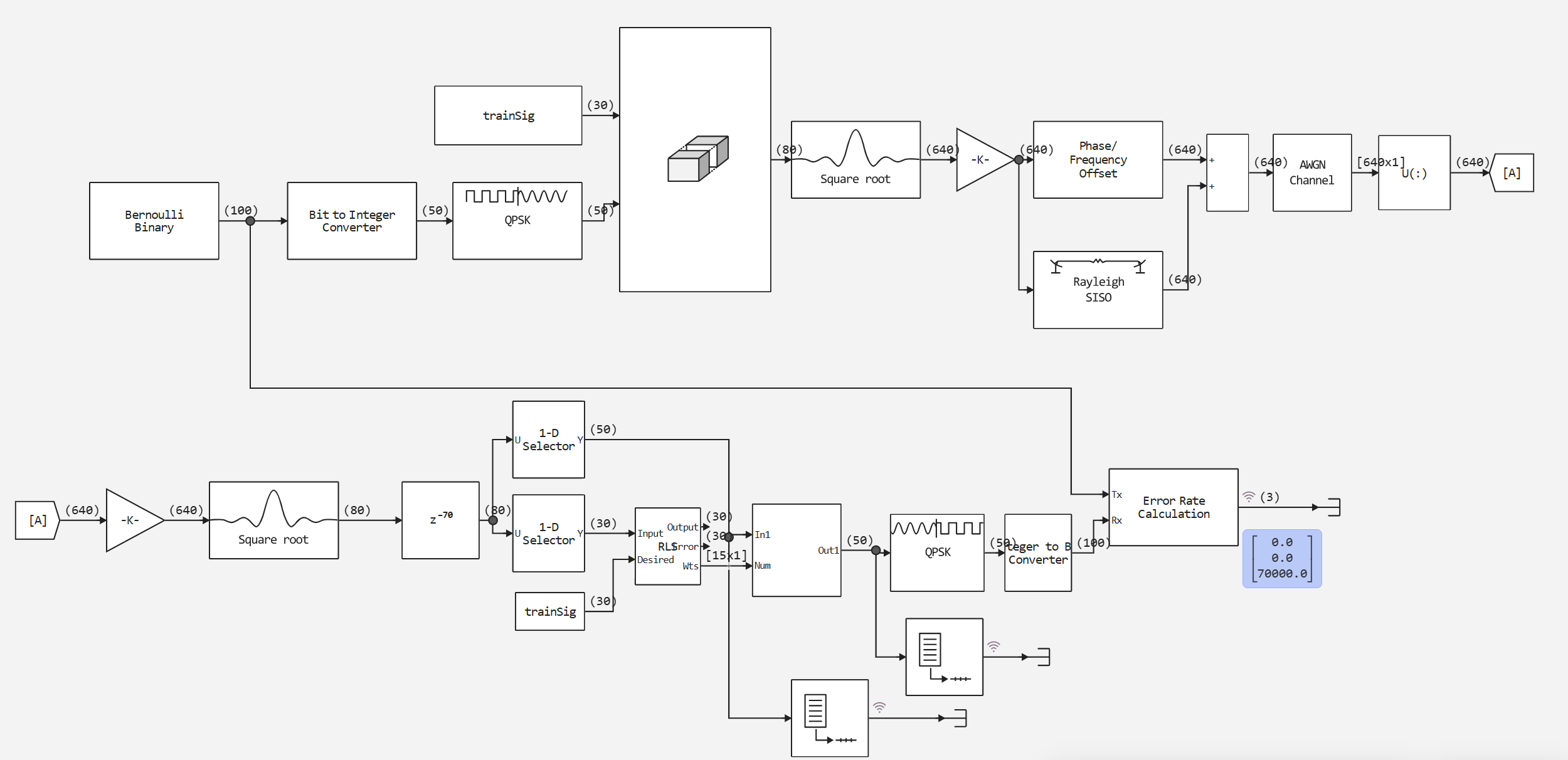
The model presented in this example demonstrates a practical QPSK modulated digital communication system that combats the real problems of wireless channels: frequency offsets, multipath fading, and noise. The main goal is to show the effectiveness of adaptive channel alignment using an RLS filter to compensate for distortion.
Full data transmission path:
- Generation of bits → Modulation → Pulse shaping
- Passing through a realistic communication channel
- Reception → Alignment → Demodulation → Error estimation
Key channel effects:
- Phase and frequency shift (Doppler up to 10 Hz+ fixed 120° shift)
- Multipath propagation (two paths with different delays and attenuations)
- Additive white Gaussian noise (SNR = 30 dB)
Frame structure
- Training sequence (30 characters) — used to "train" the adaptive filter
- Useful data (50 characters) — real information
- This structure simulates practical communication systems (Wi-Fi, LTE), where pilot signals are periodically transmitted.
Two-stage processing
Frame → [Training part] → RLS filter (training) → [Data] → FIR filter (application of scales)
- Training stage: The RLS filter adjusts coefficients based on a known training sequence
- Operation stage: The adjusted weights are used in the FIR filter to align the useful data
What the model demonstrates
-
The viability of QPSK in difficult conditions — even with frequency shifts and fades, the system remains operational
-
Adaptive equalization efficiency — how a properly tuned filter can "clean up" a distorted signal
-
A practical approach to synchronization is to use training sequences instead of ideal assumptions.
-
Compromise between efficiency and overhead — 30 characters of training per 50 characters of data (37.5% overhead)
Application areas
- Educational demonstration of the principles of digital communication
- Testing of alignment and compensation algorithms
- Evaluation of the noise immunity of various modulation schemes
- Prototyping solutions for wireless systems
Now let's move on to initializing and running the model. The code below initializes the parameters of the QPSK communication system with adaptive alignment: sets the transmission rate of 1 Mbit/s, the frame structure (100 bits, including 30 training characters), the parameters of the modulation and shaping filter, adjusts the channel with a frequency offset of up to 10 Hz and double-beam fading, and determines the parameters of the RLS filter (15 weights and a forgetting factor of 0.95) and prepares a training sequence for adjusting the equalizer.
bitRate = 1000000;
numBitsPerFrame = 100;
bitsPerSymbol = 2;
numTrainSyms = 30;
pulseDelay = 8;
oversampleFactor = 8;
rolloffFactor = 0.2;
modOrder = 2^bitsPerSymbol;
numDataSymsPerFrame = numBitsPerFrame / bitsPerSymbol;
numSymsPerFrame = numDataSymsPerFrame + numTrainSyms;

qpskmod = EngeeComms.QPSKBasebandModulator(PhaseOffset = pi/4);
trainSig = qpskmod(rand(0:modOrder-1,numTrainSyms));
maxDoppler = 10;

numEqWeights = 15;
refTap = 8;
lambda = 0.95;
snrdB = 30;


symbolPeriod = bitsPerSymbol/bitRate;
chanSamplePeriod = symbolPeriod/oversampleFactor * 50/80;

pathDelays = [0 chanSamplePeriod];
pathGains = [0 -6];

numDataSymsPerFrame = numBitsPerFrame / bitsPerSymbol;
numSymsPerFrame = numDataSymsPerFrame + numTrainSyms;

initEqWeights = complex(zeros(numEqWeights));
eqDelay = refTap - 1;
trimTrainSig = trainSig[1:end-eqDelay];

println("Speed: $(bitRate/1e6) Mbps, Frame: $(numBitsPerFrame) bits")
println("Structure: $(Int.(numDataSymsPerFrame)) data + $(numTrainSyms) training characters")
println("Channel: Doppler $(maxDoppler) Hz, 2 beams, SNR$(snrdB) dB")
println("Equalizer: RLS filter of $(numEqWeights) samples, λ=$(lambda)")
function run_model( name_model)
    Path = (@__DIR__) * "/" * name_model * ".engee"
    if name_model in [m.name for m in engee.get_all_models()] # Checking the condition for loading a model into the kernel
        model = engee.open( name_model ) # Open the model
        model_output = engee.run( model, verbose=true ); # Launch the model
    else
        model = engee.load( Path, force=true ) # Upload a model
        model_output = engee.run( model, verbose=true ); # Launch the model
        engee.close( name_model, force=true ); # Close the model
    end
    sleep(0.1)
    return model_output
end
run_model("qpsk_freqfade")
WorkspaceArrays.plot_wa(WorkspaceArray{Vector{Float64}}("qpsk_freqfade/Error Rate Calculation.1"))
Output
Analyzing the BER graph, we clearly see that with our channel parameters, the error is zero. The system shows that even relatively simple adaptive filtering methods (RLS+ pilot training) can effectively combat serious distortions in real communication channels, making high-speed data transmission possible in non-ideal conditions. The model illustrates a fundamental principle of digital communications: processing on the receiving side can compensate for many of the problems of the physical channel, turning a "dirty" analog signal into pure digital data.