A multi-stage inventory management model based on the example of optimizing fertilizer production
Introduction
This example shows how to use Engee to create an intelligent production and inventory planning model. It is necessary to make strategic decisions for the whole year ahead.
Let's imagine that we run a factory that produces two types of fertilizers. We have several types of raw materials (ingredients) at our disposal, the price of which varies from month to month according to a well—known schedule (for example, seasonally). At the same time, we know exactly how many tons of each type of fertilizer customers will order each month. The
goal is to maximize profits. To do this, you need to find the perfect balance between:
- Produce exactly as much as you need (or you can sell it profitably);
- Purchase of raw materials in the cheapest months;
- Storing finished products in a warehouse when it is economically feasible.
For such a long-term strategy, you can use financial instruments (for example, futures contracts) to fix commodity prices for the future and protect yourself from risks. Our mathematical model will help you calculate the most profitable plan, taking into account all these factors.
We will connect the necessary libraries.
import Pkg
neededLibs = ["JuMP" ,"GLPK", "NamedArrays", "Measures" ]

for lib in neededLibs
    try
        eval(Meta.parse("using $lib"))
    catch ex
        Pkg.add(lib)
        eval(Meta.parse("using $lib"))
    end
end
Fertilizers and their composition
Granular fertilizers contain three key nutrients: nitrogen, phosphorus and potassium. At the factory, we do not produce them from scratch, but mix ready—made raw materials to obtain commercial brands of fertilizers with the right composition.
We have several "ingredients" - each with its own unique set of nutrients. By combining them in the right proportions, we create a finished product — a balanced fertilizer that our customers need.
Initial data
We will determine the data on the basis of which we will optimize production.:
- the amount of demand for fertilizers;
- list of months in a year;
- Initial stock values;
- percentage of nutrients in each type of fertilizer;
- the size of fertilizer orders;
- prices for fertilizers;
- Storage capacity;
- cost of storage;
- Production capacity;
- cost of raw materials;
- the content of nutrients in the raw materials.
Demand for food = DataFrame(
    Balanced = [750, 800, 900, 850, 700, 700, 700, 600, 600, 550, 550, 550],
    High nitrogen = [300, 310, 600, 400, 350, 300, 200, 200, 200, 200, 200, 200]
)
месяцы = ["January", "February", "March", "April", "May", "June",
          "July", "August", "September", "October", "November", "December"]
initial reserves = DataFrame(
    Balanced = [200, 200],
    High nitrogen = [200, 200]
)
nutritional content in fertilizers = DataFrame(
    Balanced = [10, 10, 10],
    High nitrogen = [20, 10, 10]
)
Food order = DataFrame(
    Balanced = [200, 400, 400, 400, 400, 400, 200, 0, 0, 0, 0, 0],
    High nitrogen = [0, 100, 200, 200, 200, 200, 200, 0, 0, 0, 0, 0]
)
Prices for fertilizers = DataFrame(
    Balanced = [400],
    High nitrogen = [550]
)
Storage capacity = 1000
unit storage cost = 10
production_power = 1200

raw materials cost = DataFrame(
    Monoammonium Phosphate = [350, 360, 350, 350, 320, 320, 320, 320, 320, 310, 310, 340],
    Potassium chloride_cali = [610, 630, 630, 610, 600, 600, 600, 600, 600, 600, 600, 600],
    Ammiachna_seliter = [300, 300, 300, 300, 300, 300, 300, 300, 300, 300, 300, 300],
    Ammonium sulfate_ammonium = [135, 140, 135, 125, 125, 125, 125, 125, 125, 125, 125, 125],
    Triple Superphosphate = [250, 275, 275, 250, 250, 250, 250, 240, 240, 240, 240, 240],
    Sand = [80, 80, 80, 80, 80, 80, 80, 80, 80, 80, 80, 80]
)

feed_containment_in raw materials = DataFrame(
    Monoammonium phosphate = [11, 48, 0],
    Potassium chloride_ = [0, 0, 60],
    Ammoniacal_seliter = [35, 0, 0],
    Ammonium sulfate_ = [21, 0, 0],
    Ternar_superphosphate = [0, 46, 0],
    Sand = [0, 0, 0]
)
types of fertilizers = names(in demand for fertilizers)
вещества = ["Nitrogen", "Phosphorus", "Potassium"]
types of raw materials = names(cost of raw materials)
number of types of fertilizers = length(types of fertilizers)
number of types of raw materials = length(types of raw materials)
quantity of nutrients = length(substances)
number of months = length(months)
monthly demand = copy(demand for fertilizers)
insertcols!(demand in months, 1, :Month => months)
cost of raw materials in months = copy(cost of raw materials)
insertcols!(cost of raw materials in months, 1, :Month => months)
The content of the fertilizers with the names = copy(the content of nutritious fertilizers)
insertcols!(the content of fertilizers with names, 1, :Nutrition_material => substances)
The contents of the raw materials with names = copy(the contents of the nutritious materials)
insertcols!(the content of raw materials with names, 1, :Nutrition_material => substances)
Let's define a function for displaying data in the form of a table.
function вывести_таблицу(df::DataFrame, заголовок::String="")
    if !isempty(header)
        println("\n$header:")
    end
    column name = names(df)
    column width_ = []
    for column in column name_
        width = length(string(column))
        for i in 1:nrow(df)
            value = df[i, column]
            if isa(value, Number)
                string_values = string(round(Int, value))
            else
                string_values = string(value)
            end
            width = max(width, length(string_values))
        end
        push!(column width_, width + 2)
    end
    заголовок_таблицы = ""
    for (i, column) in enumerate(column name_)
        table heading_= rpad(column, column width_[i])
    end
    println(table header)
    разделитель = ""
    for width in column width_
        разделитель *= repeat("-", ширина)
    end
    println(separator)
    for i in 1:nrow(df)
        строка = ""
        for (j, column) in enumerate(column name_)
            value = df[i, column]
            if isa(value, Number)
                string_values = string(round(Int, value))
            else
                string_values = string(value)
            end
            row *= rpad(row_value, column width_[j])
        end
        println(string)
    end
    println()
end
There are two types of fertilizers available:
-
Balanced — the standard composition is 10% nitrogen, 10% phosphorus, 10% potassium.
-
High nitrogen — nitrogen-enhanced version: 20% nitrogen, 10% phosphorus, 10% potassium.
The only difference is the doubled proportion of nitrogen in "High Nitrogen", which makes it more expensive to produce.
println("Nutrient content in fertilizers (in percent):")
view the table(the content of the improvements with the names)
Raw materials and their nutritional composition (in % by weight):
println("The content of nutrients in the raw materials (in percent):")
view the table(the contents of the raw materials with names)
Sand is a neutral filler. There are no nutrients in it. It is used as a "diluent" to accurately maintain the required percentage in the finished mixture when the active ingredients are too concentrated.
Volume of orders and prices for fertilizers
For the entire planning period, we know the exact monthly order volume for each brand of fertilizers.
println("Order volume:")
check the table(demand in months)
Prices are fixed for the whole year. This means that our revenue depends only on the volume of sales, not on time. This stability simplifies planning and allows you to focus on cost optimization.
println("Fertilizer prices:")
view the table(prices for fertilizers)
The cost of raw materials
Raw material prices are a key variable in our model. Unlike stable prices for finished products, the cost of ingredients changes every month (for example, due to seasonality or market conditions).
println("The cost of raw materials:")
view the table(the cost of raw materials in months)
Production and storage
We will display the cost of unit storage, warehouse capacity, and production capacity.
println("Unit storage cost: $unit storage cost")
println("Warehouse capacity: $Warehouse capacity")
println("Production capacity: $production_power")
If we were unable to produce and ship the entire volume of orders in one month, the balance will not be transferred to the next month. This forces the model to always plan production ahead of demand. Thus, the model is looking for a balance: to produce enough to fulfill orders and reach the target balances, but not to produce too much, so as not to incur storage costs.
Setting the task
The model is based on an objective function that needs to be maximized. In our case, it's a profit.
model = Model(GLPK.Optimizer)
Variables
The variables in the task are the volumes of fertilizer mixtures that we produce and sell each month, as well as the raw materials used to make them.
@variable(model, produce[1:number of months, 1:number of types of improvements] >= 0)
@variable(model, sell[1:number of months, 1:number of types of improvements] >= 0)
@variable(model, use[1:number of months, 1:number of types of raw materials, 1:number of types of fertilizers] >= 0)
In addition, we will create a variable representing the amount of inventory at each point in time.
@variable(model, 0 <= stocks[1:number of months, 1:number of types of fertilizers] <= warehouse capacity)
The upper limit for sales is the demand for each time period and each brand of fertilizer.
for i in 1:number of months, b in 1:number of types of fertilizers
    set_upper_bound(sell[i, b], demand for fertilizers[i, b])
end
Expressions
To calculate the objective function using task variables, you need to calculate revenue and costs. Revenue is the sales volume of each type of fertilizer multiplied by its price, summed up over all time periods and all types of fertilizers. Let's define an expression for revenue.
@expression(model, revenue, sum(prices for fertilizers[1, j] * sum(sell[i, j] for i in 1:number of months) for j in 1:the number of types of fertilizers))
Let's define an expression for the cost of raw materials. The cost of raw materials is the cost of each ingredient used at each point in time, summed up over all periods. Since the volume of raw materials used at each moment is divided by the amount used for each fertilizer, the summation is also carried out by types of fertilizers.
@expression(model, raw materials used[i=1:number of months, r=1:number of types of raw materials], sum(use[i, r, b] for b in 1:number of types of fertilizers))
@expression(model, total cost of raw materials, sum(cost of raw materials[i, r] * raw materials used[i, r] for i in 1:number of months for r in 1:number of types of raw materials))
Let's define an expression for storage costs. Storage costs are the cost of maintaining stocks during each time period, summed up by time and types of fertilizers.
@expression(model, total storage cost, unit storage cost * sum(stocks))
Target function
Let's define the objective function.
@objective(model, Max, revenue - general value of raw materials - general value of storage)
Limitations
The model must comply with key production rules.:
- Inventory balance: the balance in the warehouse is the sum of the balance of the previous month and the difference in the quantities of products produced and sold;
- target stocks: by the end of the year, it is necessary to reach the set balance level;
- Limits: Warehouse capacity and factory capacity are limited;
- balance of materials: the amount of finished products is equal to the amount of consumed raw materials;
- Quality: the chemical composition of each batch must strictly comply with the formulation.
All these rules are formalized into mathematical constraints and loaded into the model to find the optimal plan.
@constraint(model, material_balance1[i=2:number of months, b=1:number of types of fertilizers],
    stocks[i, b] == stocks[i-1, b] + produce[i, b] - sell[i, b])
@constraint(model, material_balance2[b=1:number of types of improvements],
    stocks[1, b] == initial stocks[1, b] + produce[1, b] - sell[1, b])
@constraint(model, final stocks[b=1:number of types of fertilizers], stocks[number of months, b] == initial stocks[2, b])
@constraint(model, storage limite_[i=1:number of months], sum(stocks[i, :]) <= storage capacity)
@constraint(model, capacity limite_[i=1:number of months], sum(produce[i, :]) <= production capacity)
@constraint(model, raw materials usage[i=1:number of months, b=1:number of types of fertilizers],
    sum(use[i, r, b] for r in 1:quantity of raw materials) == produce[i, b])
@constraint(model, quality of fertilizers[i=1:number of months, n=1:number of nutrients, b=1:number of types of fertilizers],
    sum(nutritional content in raw materials[n, r] * use[i, r, b] for r in 1:quantity of raw materials) == nutritional content in fertilizers[n, b] * produce[i, b])
Solving and visualizing the results
Let's start solving the optimization problem.
optimize!(model)
Let's display the solution as a table (if the table does not fit in width, zoom out in the browser).
status = termination_status(model);
if status == MOI.OPTIMAL
    profit = round(Int, objective_value(model))
    println("\Optimal solution found")
    println("Profit: $profit")
    value_product = value.(produce)
    value_sell = value.(sell)
    stock_values = value.(stocks)
    produce rounded = round.(Int, values to produce)
    sell_ rounded = round.(Int, sell values)
    stock_ rounded = round.(Int, stock_values)
    production table_ = DataFrame()
    for b in 1:number of types of fertilizers
        таблица_производства[!, Symbol("to produce_" * replace(виды_удобрений[b], " " => "_"))] = производить_округленные[:, b]
    end
    sales table_ = DataFrame()
    for b in 1:number of types of fertilizers
        таблица_продаж[!, Symbol("to sell_" * replace(виды_удобрений[b], " " => "_"))] = продавать_округленные[:, b]
    end
    inventory table_ = DataFrame()
    for b in 1:number of types of fertilizers
        таблица_запасов[!, Symbol("stocks_" * replace(виды_удобрений[b], " " => "_"))] = запасы_округленные[:, b]
    end
    Production plan = hcat(production table, sales table, inventory table)
    production_plan[!, :Month] = months
    production plan = production plan[:, [end, 1:end-1...]]
    println("\Nproduction plan:")
    view the table(production plan)
end
produce balanced = produce rounded[:, 1];
produce high-nitrogen = produce rounded[:, 2];
sell balanced = sell rounded[:, 1];
sell high-nitrogen = sell rounded[:, 2];
stock_balanced = stock_ rounded[:, 1];
high-nitrogen stocks = round stocks[:, 2];
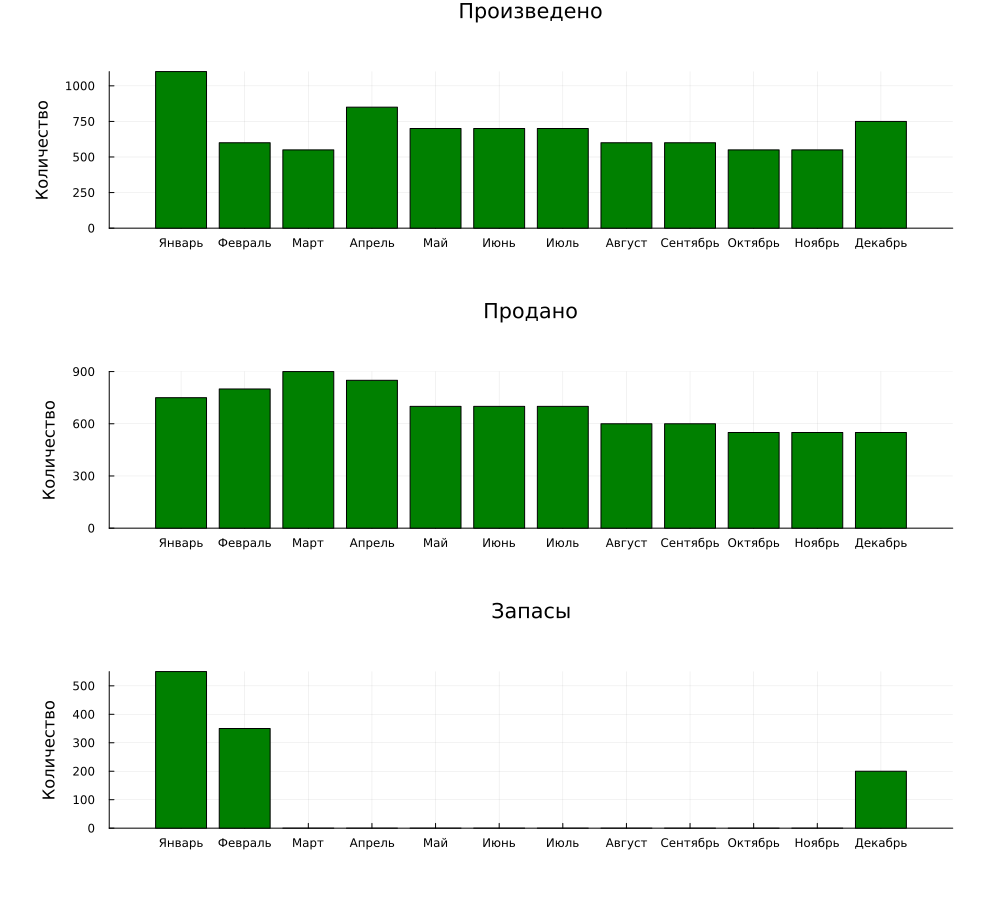
We will display a histogram of optimal production, sales, and inventory of a balanced fertilizer.
p1 = bar(месяцы, производить_сбалансированное, title="Produced by", xlabel="", color=:green, ylabel="Quantity")
p2 = bar(месяцы, продавать_сбалансированное, title="Sold", xlabel="", color=:green, ylabel="Quantity")
p3 = bar(месяцы, запасы_сбалансированное, title="Stocks", color=:green, ylabel="Quantity")
graph1 = plot(p1, p2, p3, layout=(3, 1), size=(1000, 900), margin=10mm, legend=false)
display(graph1)
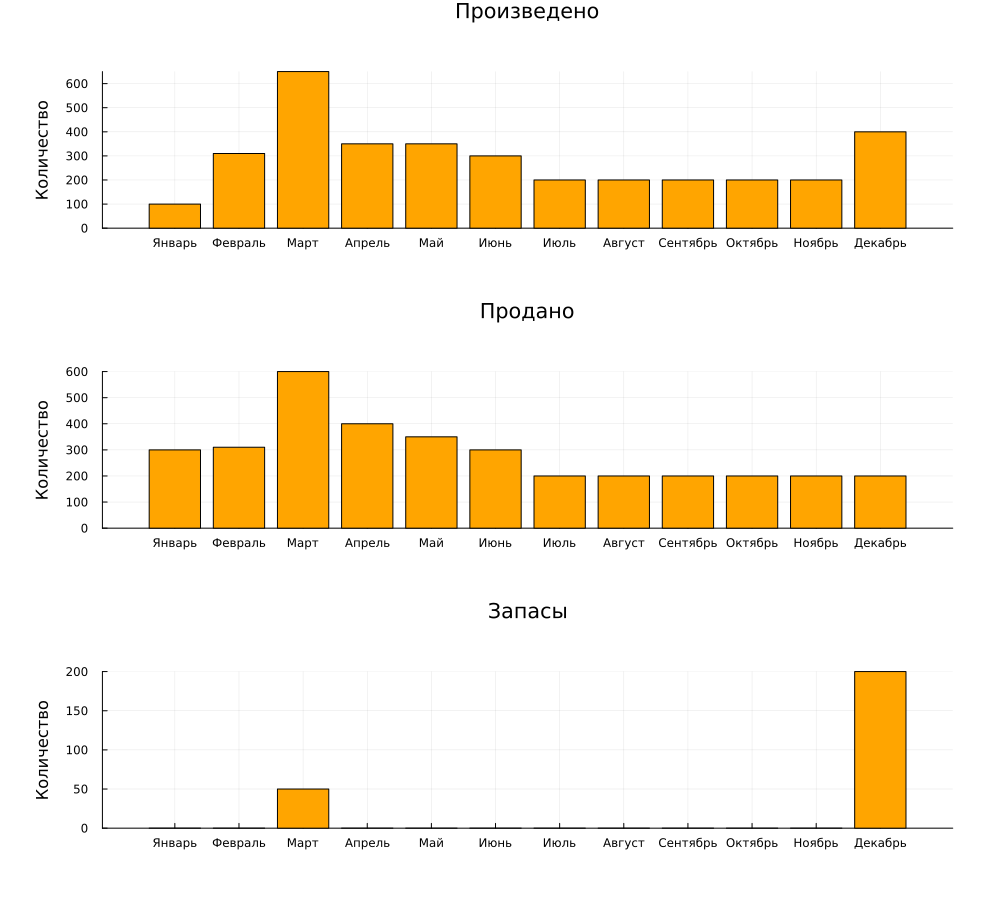
We will display a histogram of optimal production, sales, and inventory of high nitrogen fertilizers.
p1 = bar(месяцы, производить_высокоазотное, title="Produced by", xlabel="", color=:orange, ylabel="Quantity")
p2 = bar(месяцы, продавать_высокоазотное, title="Sold", xlabel="", color=:orange, ylabel="Quantity")
p3 = bar(месяцы, запасы_высокоазотное, title="Stocks", color=:orange, ylabel="Quantity")
graph2 = plot(p1, p2, p3, layout=(3, 1), size=(1000, 900), margin=10mm, legend=false)
display(graph2)
Conclusion
The conducted modeling of a multi-stage production task demonstrates the effectiveness of optimization methods for strategic planning in a dynamic market. The solution provides an accurate and practical plan.
Key findings:
-
Release strategy: The model has identified the priority of producing high-margin products during periods of peak demand, while the base product supports overall capacity utilization. This is directly consistent with the goal of maximizing profits.
-
Dynamic role of reserves: The analysis showed that reserves do not serve as a reserve, but as an active buffer smoothing the imbalance between variable demand and fixed capacities. A strategy of planned accumulation and subsequent reduction of stocks is used to minimize total costs.
-
Impact of constraints: Tight constraints on capacity and target end balances form a specific structure of the plan, causing production spikes to meet the boundary conditions. This confirms the high sensitivity of the system to the control parameters.
Thus, the model adequately formalizes a complex planning task, transforming it into an optimization one. The result is a strategic map that identifies profit growth points and system bottlenecks, which makes this approach a valuable tool for justifying management decisions.