Three-phase asynchronous motor with direct start connected to a hydraulic pump
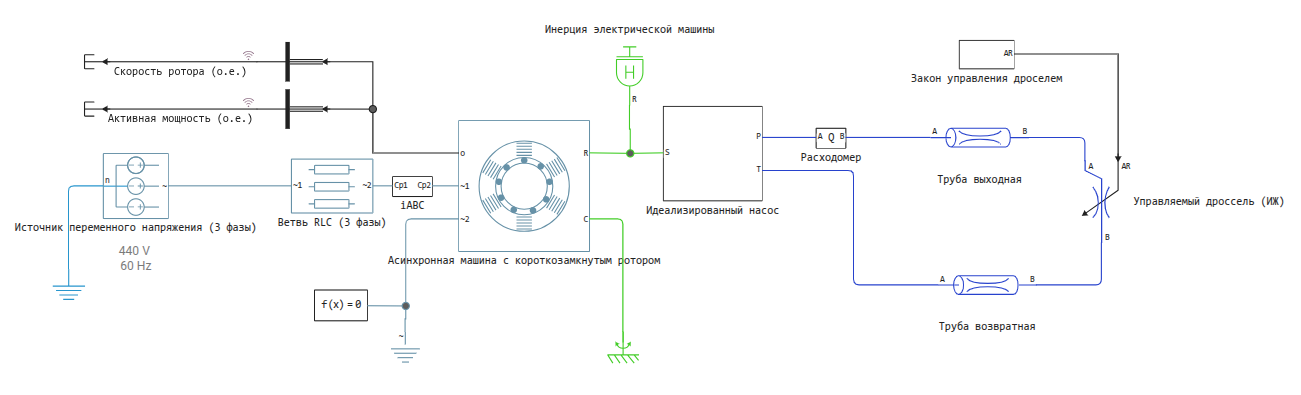
In this example, an asynchronous motor is connected to an idealized pump model.
Let's see how throttling the hydraulic system changes the speed and current consumed by the motor.
Studying the model
Open the model and run it for execution:
cd() # Go to the folder with the example
engee.open( "$(@__DIR__)/" * "induction_motor_online_pump.engee");
data = engee.run("induction_motor_online_pump");
At the initial moment, the engine speed is zero, then it starts, and by 2.5 seconds it reaches the rated speed. At the 9th second, when the valve diameter decreases from 20 to 4 cm, the engine begins to noticeably slip.
p1 = plot( eachcol(collect(data["Diameter of the throttle valve"]))..., title="Throttle opening area (m2)" )
p2 = plot( data["Phase current"].time, reduce(hcat, data["Phase current"].value)', title="Current in the windings (A)" )
p3 = plot( eachcol(collect(data["Active power (OE)"]))... )
     plot!( eachcol(collect(data["Rotor speed (OE)"]))..., title="Active power and speed of the rotor (relative units)" )
p4 = plot( eachcol(collect(data["Q"]))..., title="Flow rate through pipes (m3/s)", xlabel="Time, from" )

plot( p1, p2, p3, p4, layout=(4,1), leg=false, size=(1200,600), titlefont=font(10) )
A sharp decrease in the capacity of the hydraulic system for an asynchronous pump is an emergency mode that leads not to a simple stop, but to an operating mode close to a short circuit, with the risk of rapid thermal destruction of the engine.
Conclusion
This model allows you to study the dynamics of the joint operation of an electric motor and a hydraulic load, assess the system's resistance to changes (for example, to valve blockage), as well as to verify the correct choice of engine and protection settings without risk to real equipment, which reduces development time and increases reliability.