The phenomenon of cavitation in a two-phase liquid
In this project, we will show how blocks of the "Two-phase liquid" (2P) palette can be used to observe the cavitation effect on a model.
Description of the model
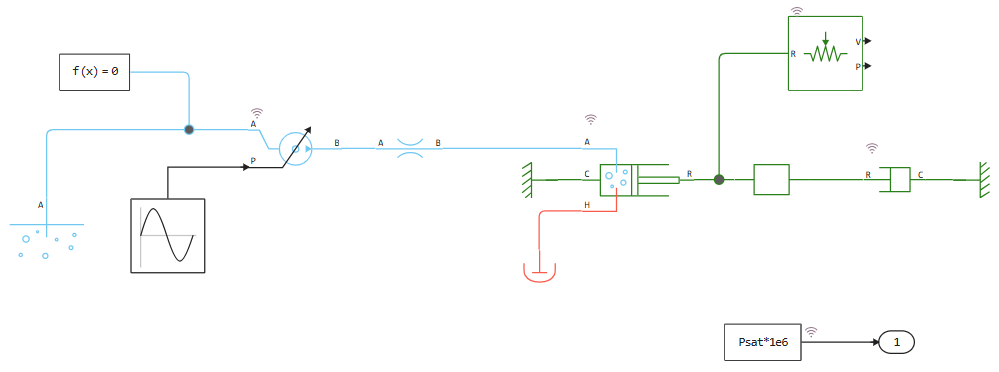
The model is based on a piston driven by a pressure source with a sinusoidal law of change. During the negative part of the pressure source cycle, cavitation begins in the liquid, which consumes some of the energy, which decreases the force generated by the converter. As a result, the movement pattern of the piston rod changes. The rod starts to drift and does not return to its original position.
Calculation results
Let's run the model in program control mode and study the results.
engee.open("cavitation_two_phase_fluid.engee")
data = engee.run();
In addition to the two-phase version (where the working fluid can partially or completely turn into gas), the model also has a path assembled from the elements of the Isothermal Fluid library.
This way we can compare the operation of two hydraulic models on the same graph.:
sl = data["Constant.1"]
# Two-phase liquid
s_2p = data["Controlled Pressure Difference Source (2P).outlet.p"]
d_2p = data["Absolute translational motion sensor.p"]
p_2p = data["Translational Mechanical Converter (2P).p"]
# Isothermal liquid
p_il = data["Converter to translational motion (IL).p"]
s_il = data["Differential pressure source (IP).outlet.p"]
d_il = data["Absolute translational motion sensor-1.p"]

plot(
    plot([p_2p.time p_il.time s_2p.time sl.time], [p_2p.value p_il.value s_2p.value sl.value]./1e6, label = ["2F" "IZH" "Pump output" "Saturation line"], c=[:steelblue1 :blue :orange 2], lw=[4 1 2 2], ls=[:solid :dash :dot :solid], title="Pressure, MPa"),
    plot(d_2p.time, [d_2p.value d_il.value], label=false, title = "Movement of the rod, m", c=[:steelblue1 :blue], lw=[4 1]),
    titlefont=font(10), guidefont=font(8), layout=(2,1)
)
This graph shows the normalized internal energy (unorm) of the volume of liquid in the piston (2F). The graph can determine the phase of the working fluid in the piston.:
-
ordinary liquid when -1 <= unorm < 0;
-
two-phase mixture when 0<= unorm <= 1;
-
superheated steam when 1 <unorm<= 2.
include("plotNormalizedInternalEnergy.jl")
When the liquid is in a two-phase mixture, the unorm value corresponds to the vapor content.
Conclusion
This example clearly demonstrates how cavitation affects the operation of a mechanical transducer, and was created so that we can better understand and predict the behavior of systems with two-phase fluids under variable pressure conditions.