Longitudinal dynamics of the car
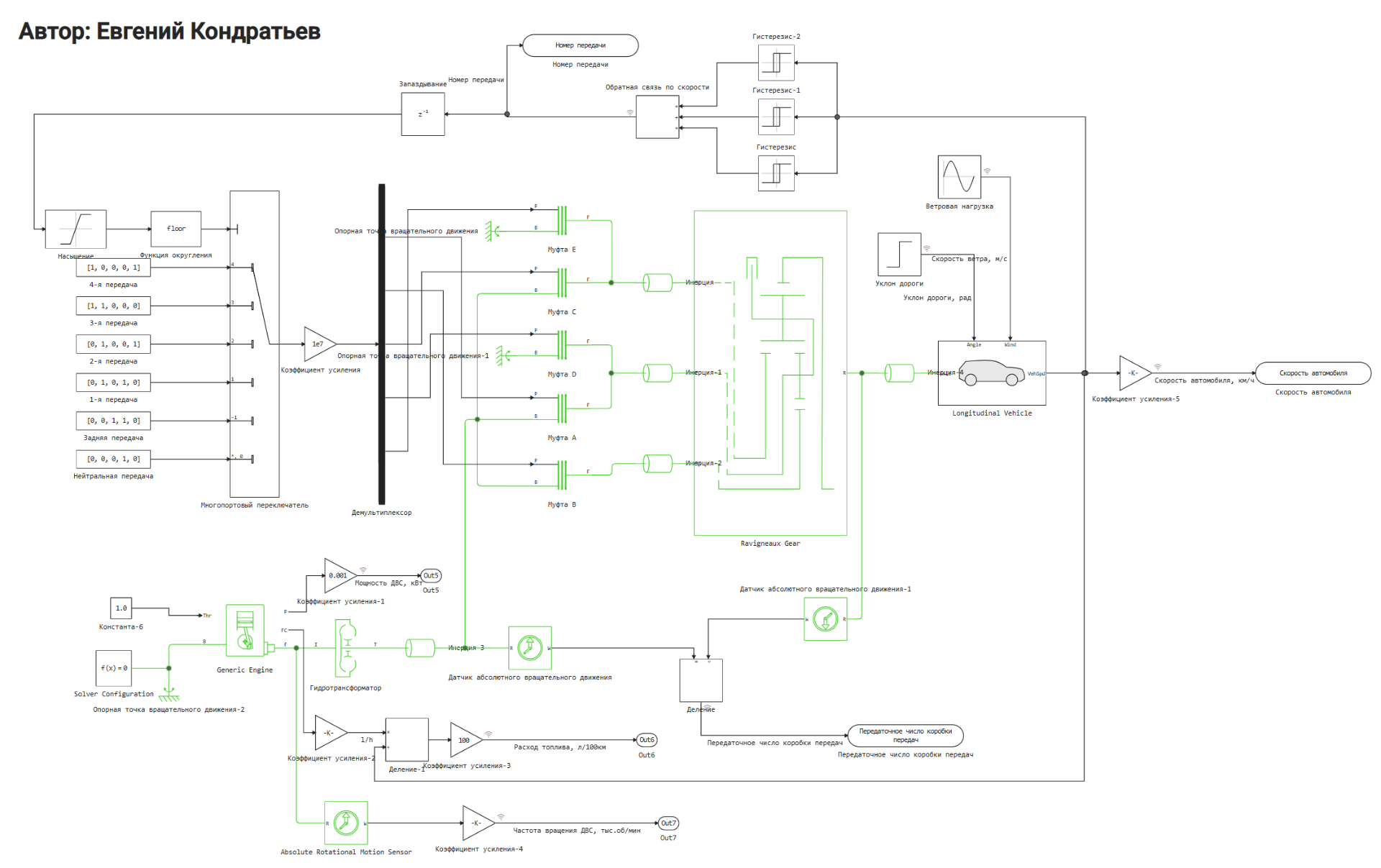
The model allows you to calculate the longitudinal movement of the car: the gasoline engine accelerates the body through a torque converter and an automatic transmission based on the Ravigno planetary scheme, overcoming rolling resistance, aerodynamic drag, road slope and headwind.
Introduction
In the upper part of the circuit there is a Generic Engine with tables of torque, power, speed and specific fuel consumption, set depending on the speed and degree of throttle opening.
Its shaft transmits torque to the wheels via a torque converter (dual-mode, with a capacity factor of 0.83) and a Ravigne planetary gearbox; four sets of satellites and five friction clutches (A-E) form four forward, neutral and reverse gears.
A separate block Longitudinal Vehicle describes the actual vehicle:
- weighing 500 kg,
- with a drag area of 2.3 m2,
- coefficient of resistance 0.31,
- rolling resistance 0.0136 and
- wheel radius 0.3 m,
moreover, the slope of the road (* step pi/4 at the 6th second*) and the wind speed (a sine wave with an amplitude of 50 m/s) are applied to its entrances.
The gearshift logic is implemented by a relay-hysteresis automaton: three relays with thresholds of 6, 20 and 40 m/s, an adder, a one-step delay, saturation with a range from -1 to 4 and rounding form the transmission number, and a multiport switch using this number provides the activation vector for the desired coupling combination.
An engineer needs such a model in order to evaluate acceleration and maximum speed, fuel consumption, switching quality and slope maneuverability before manufacturing the assembly, as well as to develop and test engine and gearbox control algorithms, including in the HIL-stand circuit.
Launching the model
Let's open and run this model:
engee.open("longitudinal_vehicle.engee")
data = engee.run();
include("longitudinal_vehicle_plot.jl")
Conclusion
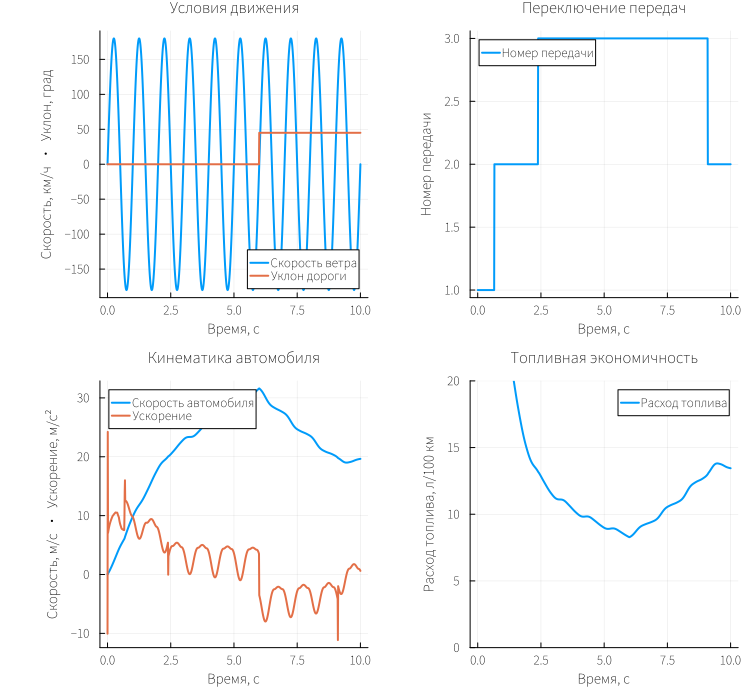
The dynamic characteristics of the longitudinal movement are calculated: the speed of the car and its change during acceleration, the actual number and gear ratio of the gearbox, engine speed and power, as well as fuel consumption in liters/100 km. At the same time, the applied disturbances, road slope and wind speed are displayed on the graphs.
Thanks to the same model, you can:
- calculate the acceleration time from 0-100 km/h, as well as the maximum speed and maximum climb,
- Build fuel efficiency maps and switching quality scales depending on the mode,
- Optimize the shift map and gear ratios,
- evaluate the thermal loads and wear of the couplings,
- simulate acceleration from a standstill and the operation of a torque converter on a slippery surface,
and also use the model as a reference object for setting and checking the engine and gearbox regulators in the HIL-stand circuit.